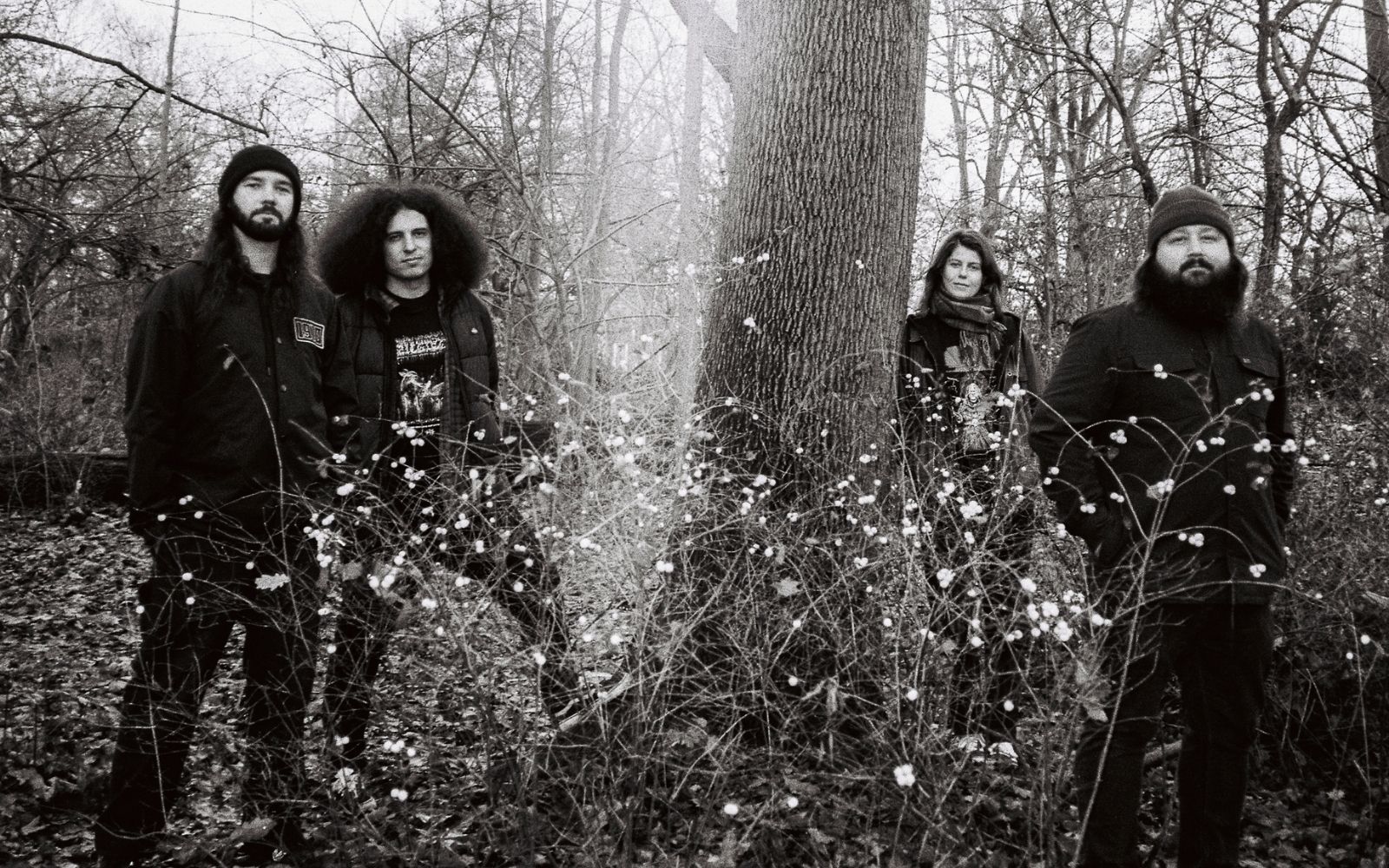
Ahead of their first Australian shows, Slomosa's frontman talks about coining a genre, writing on the road, winning Norway's equivalent of the ARIAs and selling out 25 of 28 dates on their first US headline tour.
Slomosa exist because Bergen’s music scene didn’t have enough riffs. Two friends from a small village outside the city decided to fix that, and nine years later the four-piece have a self-coined genre (tundra rock), a Spellemannprisen win, a sold-out 25-date US headline tour and a festival in Bergen named after them. The first show, they weren’t even sure there’d be a second.
Their second album, Tundra Rock, was recorded live at Bergen Kjøtt – an old meat factory – and mixed by instinct rather than rulebook. It pulled 9/10s from Metal Hammer and Distorted Sound and won Best Rock at Norway’s Spellemannprisen. Ahead of their first Australian tour, we talked with founding member, vocalist and guitarist Benjamin Berdous about the record, mixing philosophy, what it took to capture their live energy on record and why American amps are the secret to the desert rock sound.
How did the band come together, and was there a clear vision for the sound from the start?
Me and founding guitarist Anders grew up in the countryside in a small village playing in bands, but our bands were not very good, and we didn’t really understand the demands of playing live and how tight you have to be. For me, at least, I didn’t feel I was a very good musician. When we moved to Bergen to study, I’d go to gigs and see that there were a lot of musicians my age who I thought were really good. After a while, I think we were a little bit frustrated because the bands we saw in town were very jammy, and there weren’t a lot of riffs. We grew up loving riffs and writing riffs, and started the band as a reaction to the lack of riffs in town.
We had two other members – also two close friends of mine – and we just jammed and enjoyed ourselves for a couple of years. Jamming these songs that eventually became songs on the first album. Then we played our first gig. I don’t think we played that well. Back in the start, I’d always sing off beat, and never took singing that seriously. But it was sold out, and after the gig, the feedback was amazing. People could hear what we were trying to do, and it was the first time we thought, okay, maybe we can play another show. And maybe we could play in our capital, Oslo. We really didn’t expect anything, but it became pretty apparent after a couple of gigs that people were kind of hyping it a little bit. And I think that’s when we realised that, okay, we could maybe be an active band. We could make music, and we should release this. I’d never released any music before in my life – before the first Slomosa record, I’d never even been in the studio. And there are a lot of people who had released a lot of music and were amazing musicians, and they weren’t touring that much. So, you know, you don’t expect anything for yourself. But I was completely wrong.
Catch up on all the latest features and interviews here.
The current four-piece has been together since 2020. How did that stability change things creatively?
Most of the songwriting responsibility went over to me, which was a scary thing in the beginning when Anders and the others left the group. It was Covid times and there wasn’t really that much to leave – they didn’t leave a band that was going somewhere, we were just playing a couple of gigs and were all at university getting degrees with different plans for life.
Suddenly, I found myself missing two members. I asked Tor, the guitarist who I played with as a teenager, and he wanted to be in a band as well. Marie was a musician I admired a lot – she played in Razika, which at one point was one of the biggest bands in Norway. For 15 years, they were an all-girl band and were kind of pioneers in that sense. I knew that they were disbanding, but as I said, Slomosa was nothing then; we hadn’t released music. I called her, and she said she could try. But it was suddenly clear that songwriting was mainly my responsibility. Marie, Tor and Jard are all amazing musicians, and they really raised the level of the band exponentially – they came in with an energy and a passion. I am so grateful and fortunate that they came into the band with the enthusiasm they did. This band means a lot to me, and you don’t expect other people to find the same meaning in it that you do. They made me a much better musician, and it’s an amazing band now.
You and Anders didn’t grow up in Bergen – you moved there to study. How much did coming from outside the city’s music scene shape what Slomosa sounds like?
One of the main factors for Slomosa is that we didn’t grow up in a music scene, just like Gojira growing up in a small village in France. The chances for developing your own sound and doing something different are a lot bigger when you come from outside the music scene, outside the cities. You can be influenced by the collective, living in a city or a big scene. I’m glad I grew up without one. Here in Bergen, I can hear the same sound in a lot of bands, and I don’t want to criticise, but we felt like something was missing – there was an opportunity to bring our sound and our music out and offer something new for the people here.
You coined “tundra rock” to describe your sound, then named the album after it. Did the music grow into the term, or did the term grow into the music?
We started with the music before the name came, but I always wanted to call the music something – another genre – inspired by the Norwegian band Turbonegro, who call their music death punk. I read an autobiography about them, and the bass player coined that term. So I always had that in the back of my mind: if I one day had a band, we’d have to coin a term. Desert rock is, of course, the music we play – very heavily inspired by the Palm Desert scene. And we don’t have deserts, but we do have tundra, which is kind of a lifeless landscape. So naturally, tundra rock.
How much of Tundra Rock was written in the room together versus brought in as demos? Did the process feel different from how you approached the debut?
Yes, there is a difference, because for the debut we weren’t touring or playing gigs, so we had a lot of time to jam and find the sound and the songs. The second album was written whilst we were touring intensively. That was a different experience, and a method I was a little bit stressed about, because I liked the first album a lot and I attribute that to the method we were using – jamming through the songs and feeling them out for a long time. So going into the second album, I was like, ‘how the fuck are we gonna do this?’ I made longer demos at home and had to put together more complete sketches for the songs. When we got together, we had to be more effective.
Producer Eirik had a bigger role on this record – he’s also a live member of the band at festivals in the summer – and his feedback and thoughts about the music help a lot. So yeah, it was a different experience, but I think it went very well. I’m proud of the band that we managed to write another good record whilst being so occupied. Back then, we also had jobs on the side of music, so when we came home from tours, we had to work as well. And then there’s the business side – when you have a band like this, you have to start a company, and there’s a lot of administrative work. When I think back, I’m not sure how we did it, but we did it.
Where did you record Tundra Rock, and how long did it take? Was there a particular approach you wanted to bring to the production?
It was recorded at Bergen Kjøtt – which translates to Bergen Meat – an old meat factory with a lot of studios here in town. Our producer Eirik had his own studio there. We recorded the framework of the songs live in the studio, the drums and bass. Marie is a one-take monster and recorded all the bass while we were playing as a band. We go into the studio later with that framework and start putting guitars and vocals on, then me and Eirik spend a lot of time mixing together.
The mixing is the most important thing, and I think it’s what sets us a little bit apart. A lot of bands and producers think too much about balance – they want it to sound “good”, they have a very theoretical idea of how it has to sound “correct.” But when I think about all the bands I love, like Kyuss and Pixies and Mastodon, they had albums that were mixed in a specific way that maybe wasn’t “correct” – not enough of this frequency or that. Since I haven’t studied production, I don’t carry those unwritten rules. The sound is my passion, and I know how I want it to sound. When we sent the first record to the label, they wanted us to mix it again, but it turned out that all the rock fans understood it.
On the second album, the drums are a bit more open-sounding. But my problem with a lot of rock and metal is that the drums are so loud, and I also wanted the vocals to sit down in the mix. The drums and the vocals are not the main focus for our band – it’s the guitar riffs, and everything has to support the guitar riffs.
The first record doesn’t have a lot of top frequencies, so it’s maybe not that loud if you compare it to other albums. The way I set the amp is also not “correct.” But there’s nothing correct. This is art – you can do whatever you want. I think it was the back and forth between me and Eirik that made the sound come alive, because he’d say, ‘This is not possible’, and I’d say, ‘It has to be like this’. We went back and forth for a year on the first record and kind of met in the middle, and managed to create a sound that I think people can hear is Slomosa.
Cabin Fever was the first taste of the album for a lot of people. Was that single representative of where the record was heading, or did things end up somewhere different?
The first version of Cabin Fever was written for the first record. It was a song we had lying around but never completed. I really liked the chorus we had at the time – it was a riff that Anders had made. I wrote the vocals for that chorus, then made the verse, but the verse was only supposed to be there until we found something better. It ended up being the verse in the song. So it was nice to have that song when we were writing the second album, and to have a couple of songs we’d already worked with before, so you don’t have to start completely from scratch.
The album has a pretty raw, physical quality to it. Was that something you chased in the studio, or is that just what Slomosa sounds like when you hit record?
If you’re doing a good recording job, you’re recording as close to the finished product as possible in terms of sound. The idea of recording something and then making the sound afterwards through mixing – I don’t think that’s a good way of doing things. We try to keep it as raw and as little processed as possible.
Slomosa is known as a great live band, and Tundra Rock sounds very alive – how much of that energy made it onto the record?
The sound matters, but I think the most important thing is that the energy is there in the recording – especially from the drummer. Our drummer Jard is a breathtaking drummer, one of the best in the country. He gets enormous respect from every band we tour with. In the studio, he’d worked with a lot of people as a session drummer and was maybe used to a different intensity and energy. So when we first went into the studio to record Tundra Rock, one trick was to piss off Jard – make him frustrated – and then he played with the energy we wanted.
Everybody brings something to the table that you need, and I have to give a lot of credit to Jard for coming into a bit of a new genre for him, with different expectations than before, and for his amazing drumming on the record.
Stoner and desert rock are deeply American genres. What does it mean for a band from one of the coldest corners of Europe to work within that tradition?
I guess we need to find some heat somewhere, so this music gives us a little bit of warmth. It’s very American music – the Palm Desert scene had a very specific vibe. But Norway is also a country heavily influenced by the US in terms of pop culture and everything. So I think it’s not as hard as people think for a Norwegian band to emulate a distinct American sound.
If you use the same type of equipment and approach it in a certain way, you can get there. We haven’t done what Kyuss did – running guitars through bass amps to get that sound. We use guitar amps, and different ones than those bands. My hottest tip: if anyone wonders how to get something close to that sound, use American amps like Fender rather than British amps like Orange or Marshall. American amps can play clean and loud, so the main sound comes from the pedals. I think a lot of bands I see live would sound a lot better and a lot clearer if they changed out their amps.
How do Norwegian landscapes show up in the music – is it a conscious thing, or does it just seep in?
I think it’s impossible not to be influenced by your surroundings. I grew up around big mountains, and Bergen is a mountainous city as well. Nature has an extreme influence, and I’d say I have a kind of spiritual relationship with the nature here. I’ve always felt a sense of grandiosity walking in the mountains. It definitely has an influence, but you can’t pinpoint it – you can’t say this riff was inspired by a glacier and this one by the river up in the mountain. Maybe it’s the size of the music. At times, we try to be a little bit grandiose. That is maybe where it comes from.
The album pulled 9/10s from Metal Hammer and Distorted Sound, and won Best Rock at Spellemannprisen – Norway’s equivalent of the ARIAs. Did the reception surprise you, or did you know you’d made something special?
Of course, it surprised us. You don’t expect to be part of the broader music scene with a band like this. Being a household name in Norway when you play stoner rock is not what you expect – you expect this is music for people who are specifically into it. But one of our proudest achievements is being a band that people who don’t normally listen to this sort of music will listen to, which I attribute to the pop influence and the melodies. I hoped people outside the scene would like it. One of our biggest influences is QOTSA, and they never made music to attract the masses. If you write a good song, no matter what people listen to, they will like it. Getting that recognition from the Norwegian music scene was totally unexpected and helped us get attention beyond the scene. Reviews and prizes don’t really mean that much to me – and I know it’s cool to say that – but it doesn’t change the reality of the constant grind. I’ll just keep making songs I like and hope somebody else likes them too. But of course, it is nice to get the recognition.
You’ve shared stages with Helmet, Alkaline Trio, Mastodon and Greenleaf. Is there a show or tour that felt like a turning point?
Hellfest 2022 – that’s on YouTube – our first year of touring, and we get to play in front of 15,000 people at one of the biggest festivals in Europe. Mind-blowing. That was a moment where I was like, ‘What the fuck?’ The others played well, but I was still not that solid. I can’t watch that video back because I’m singing out of beat and not singing that cleanly. I think we all agree it was a little bit too early to get that gig. I wish we’d got it in 2023, but still a massive honour and a massive game-changer.
Another turning point is the last US tour, the one I just came home from – our first headline tour in the US. We sold out 25 of 28 gigs and played in LA for 750 people at our own headline show. It feels like a statement, and maybe shows the people around us that this is serious. It makes clear that we’re not playing around – people are enjoying our gigs, and we work very hard to make sure everybody gets their money’s worth.
You headlined your own festival, Tundra & Lightning, in Bergen last year. What was it like to put your name to something built around promoting local heavy music?
That meant a lot. Again, I thought this would be music for people in the scene, and we would not get mainstream success or play mainstream festivals in our own country. It’s something I’m very proud of. I feel Slomosa has shown other rockers that living in this small city in a small country does not matter – you can tour around the world and make music that gets discovered from here. I see bands going on tour now, booking their own tours, and we try to help all the bands in town – if they have any questions, we help them with anything. We’ve only been touring actively for four years, Bergen hasn’t had a rock festival as long as I can remember, so it is a huge privilege to have our hard work and success be the motivation for the biggest promoter here to start a festival and name it after us. I love this city and the people of Bergen, and I’m very happy the people of Bergen are behind us.
Where does “tundra rock” go from here?
Tundra rock is gonna become beach rock, then jungle rock, then volcano rock. No – tundra rock will continue with us. The journey has just started. I guess we define what the music is. The biggest day of my life would be if someone started another tundra rock band. But it goes to new music, new tours, new experiences, new people, new friends. We’re not holding back. We’re aiming for the moon.
Australian audiences are getting their first taste of Slomosa live in May. What can they expect from the show?
They won’t regret coming. Our live shows – I love it, we have so much fun. We’re gonna give them the same treatment we give the rest of the world. A slap in the face.
Slomosa tour dates:
- 22 May, Max Watts, Melbourne
- 23 May, Crowbar, Sydney
- 24 May, Crowbar, Brisbane
Find tickets here.