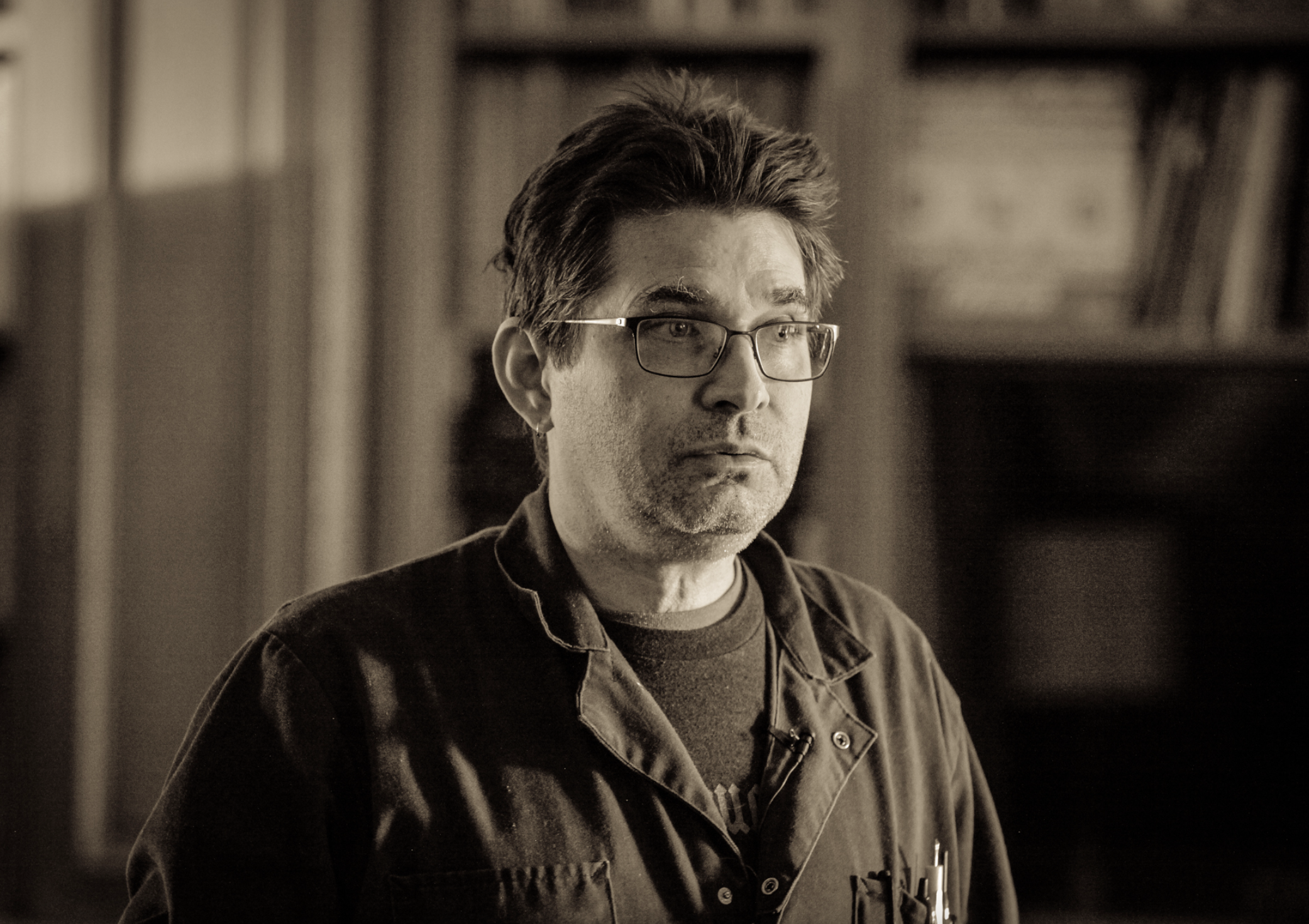
Whether you’re into '90s alt-rock, math rock or mixing and producing, chances are you’ve come across Steve Albini.
Mostly known for recording and producing Nirvana’s In Utero and PJ Harvey’s Rid of Me, Albini’s career was much more than producing some of rock’s finest albums of the 1990s and 2000s. He was also the guitarist and vocalist for bands Big Black and Shellac, as well as having unwavering opinions about the music industry and the process of making records.
Catch up on all the latest features and interviews here.
Big Black started as a solo project while Albini was studying journalism in Chicago and playing bass in a short-lived new wave act called Stations that featured a drum machine. He saw an advantage in using a drum machine because it could play fast without tiring and would follow commands exactly. Armed with this inspiration and a disdain for how punk was beginning to sound, Albini bought a Roland TR-606 and a guitar and began writing for his solo project Big Black.
Frustrated by the lack of people he could find to play with, Albini borrowed a 4-track tape recorder to produce Big Black’s first EP, Lungs, which he recorded every instrument on by himself. In 1983, Big Black expanded into a trio when Albini teamed up with Naked Raygun’s Jeff Pezzati, who played bass, and Santiago Durango on guitar. This line-up went on to record two full-length albums and three EPs. Stylistically, Big Black was lyrically confrontational, writing mostly about societal taboos. Musically, they were aggressive, relying on the harshness of their guitar sounds and programming the drum machine to accent the first and third beat of the bar instead of the conventional accents on two and four.
Shellac has been described as a minimalist trio, yet if you know any of their music, minimalism isn’t something that would instantly come to mind. They don’t neatly fit into most genres. While there are elements of rock, most of their songs defy traditional song structures. Another reference point is math rock, a genre fluent in odd time signatures, often leading to jarring changes. Shellac takes it and makes it groove. The minimal elements are Albini’s efforts on guitar – he rarely plays riffs and instead plays dissonant chords and rhythms with his signature metallic tone.
Albini’s guitar style and sound can only be described as abrasive. While he wasn’t known for incredible technique and proficiency, Albini developed a style that combined sharp dissonant rhythmic passages with a harsh trebly sound. Many have cited the Interfax Harmonic Percolator in front of an MXR Noise Gate as the secret to his sound. However, they often overlook the Tapco/Intersound IVP Preamp, which consists of four highly sculptable semi-parametric and two Baxandall EQ bands along with clean and drive channels. He would plug this combination into a Fender Bassman head through Marshall cabinets. His guitar of choice was a Travis Bean TB500, which is known for its aluminium neck.
As an engineer and producer, Albini approached recording a band like an engineering job instead of something creative. He would wear blue overalls and allow the band to have full creative control over how they sound. He would try to capture the audio as organically as possible, making the band play together and using mic placement and type instead of heavily relying on post effects like compression, delay and reverb when mixing. Yet these weren’t hard and fast rules, as every session was different.
Unlike many producers who get royalties from production credits, Albini would take a one-time fee for recording a band, as he didn’t see himself as being part of the band’s creative process.
In 1997, Albini opened Electrical Audio in Chicago, Illinois, which was an all-analog recording studio for its first decade of existence. He championed analogue tape as a recording method because of its ability to be stored for years and how easy it is to recall years-old sessions without the hassle or worry of it not being compatible with current digital recording platforms.
Albini’s producer credits deserve an article by themselves, and yet still that wouldn’t begin to explain the impact or how important Albini was to alternative music. Some albums to check out that featured him as a musician: Big Black’s Songs About F##king, Shellac’s Terraformer and To All Trains. As a producer (where to begin?): Dirty Three’s Ocean Songs, SunnO)))’s Life Metal, Low’s Things We Lost in the Fire, The Breeders’ Pod, Ty Segall’s self-titled. The list is huge and genre-varied. While having worked with some of music’s biggest names, Albini saw himself as an archivist for any independent band wanting to make a record. With this principle, combined with taking a one-time fee for the recording, Electrical Audio wasn’t financially stable. Albini would often have to sell equipment for it to stay open.
On May 7, 2024, Steve Albini passed away from a heart attack. He left a musical legacy that few could match. It is highly recommended to check out his music as well as the plethora of recordings he engineered.