Leo Fender never learned to play guitar, but his 1951 design would shape the sound of modern music for decades to come.
It’s Saturday night, you’re all dressed up in your finest and off to the dance. A big band jumps and swings, or maybe you prefer to shake it off to some frenzied bebop. Between the 1920s and 1950s, the clarinet, saxophone and trumpet were the kings of an exciting new American art form – jazz music.
Catch up on all the latest features and interviews here.
Learning wind instruments takes time and serious effort. They’re expensive to buy and typically require reading music notation and charts. If only someone could invent something cheap, reliable, and relatively easy to learn to play… enter Leo Fender.
Leo Fender’s early days in electronics
A former saxophone player himself, Fender became fascinated by electronics as a teenager. After graduating in the field of accounting, he opened an electronics repair shop, ‘Fender Radio Service’ in Fullerton, California, in 1938. Despite no formal training, Fender quickly became a skilled electronics technician. Around this time, he also made Public Address (PA) systems for dance halls. As the crowds grew, so too did the need for more powerful amplification and more controllable sounds at higher volumes.
During WW2, Fender met Clayton ‘Doc’ Kaufmann, musician and inventor, and for a short time, they began manufacturing basic guitar pickups used to increase the volume of Hawaiian steel guitars. By 1947, Kaufmann had moved on, and Fender quit his radio repair business to chase bigger ideas – the Fender Electric Instrument Company.
As WW2 neared its end, the cost of transporting big bands around the US became prohibitive, so the ‘swing era’ came to a close. As new technologies emerged, so too did music tastes change. Smaller groups playing Country, Honky Tonk and Western Swing began to popularise, and this marked the early emergence of the guitar as a lead instrument. Then, most guitars were arch-top designs, much like a violin: curved and hollow-bodied. Due to the body being hollow, primitive guitar pickups would cause feedback resonating inside the body when amplified, making the sound difficult to control. Some solid (non-hollow) body guitars began to emerge, but they were not widely accepted due to their lack of distribution and varying quality.
Birth of the Telecaster
Seeing a need for an affordable and reliable solid-body guitar that wouldn’t cause feedback, Fender developed the single pickup Fender Esquire in 1950. Soon after, he released a double pickup version called the Broadcaster. Gretsch already had a model with that branding, though, so Fender changed the name to Telecaster in 1951, inspired by the immensely popular new home appliance, the television.
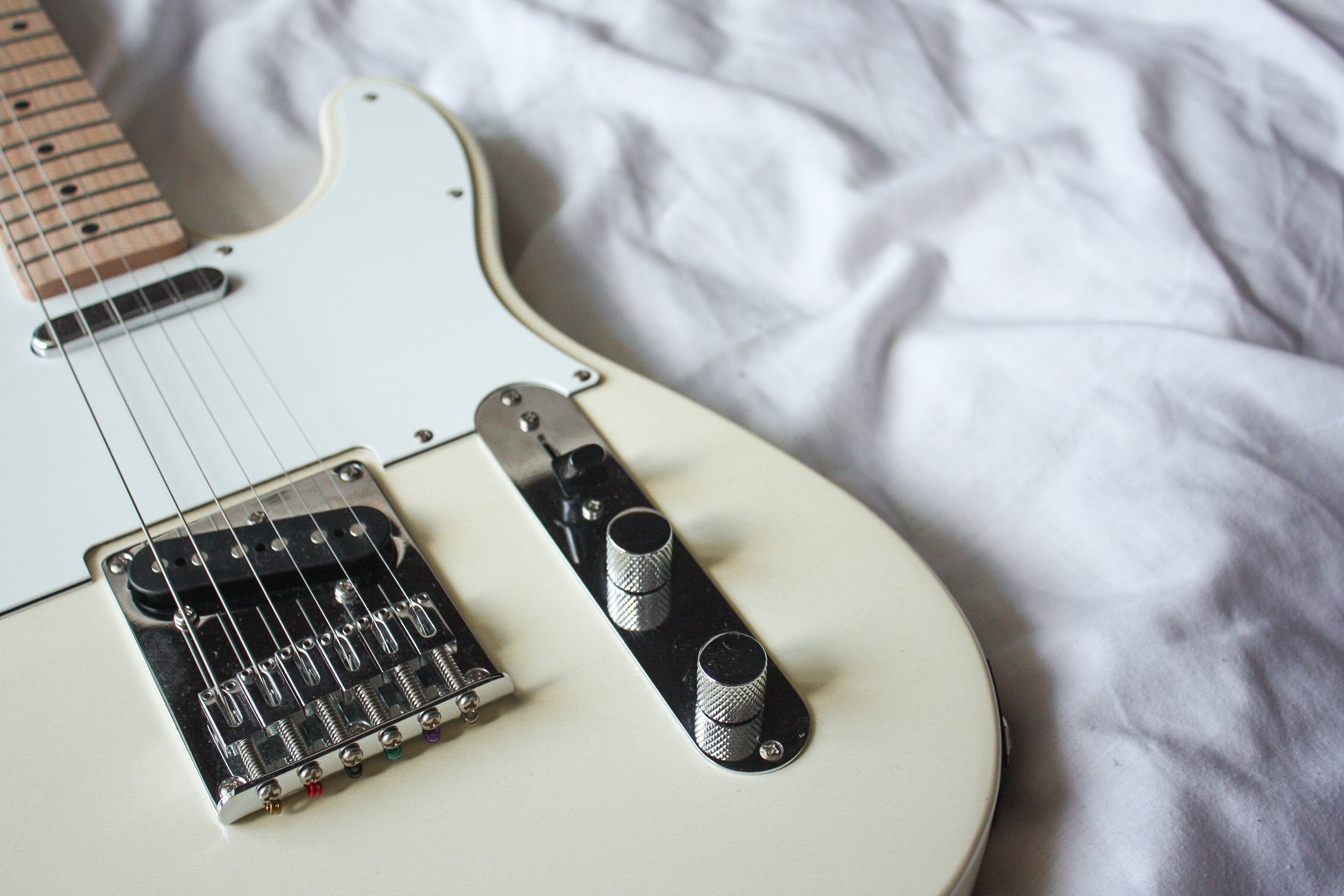
By 1952, the Telecaster’s dual pickups produced different sounds and were operated by an external switch on the body. The first pickup was at the neck and would have a more mellow sound. The other pickup was closer to the bridge of the guitar and could emit a more ‘twangy’ sound. Selecting the middle option of the switch would give the player a mix of the sounds of both pickups. This meant that one guitar could cover a range of sounds from smooth and clear all the way to the country and rock & roll ‘spank’ that the Telecaster is famous for.
The design of the new Telecaster featured a truss rod that ran inside the length of the neck to prevent warping under the tension of the steel guitar strings and also allowed for adjustment of the neck to suit the action, or string height, preferences of each player. As the body of the Telecaster was solid, this allowed it to be die cut instead of being hand-made like previous guitars. The neck was also bolted on, rather than glued, so that it could easily be removed for servicing or replaced entirely if it became worn down after heavy usage.
In 1952, a separate tone knob was added along with the existing volume knob, which allowed players to adjust the pickups from a dark, more bassy sound through to a brighter treble tone.
At first, all Telecasters were made in the classic blonde wood butterscotch colour with black pickguards until 1958, when you could pay extra to order custom colours. Due to their simplicity and the use of readily available ash or pine woods for the body and maple necks, Telecasters were easy to manufacture and quickly became the world’s first mass-produced solid body guitar.
Rise to the big stage
The new Telecaster was soon widely available and soon made its way onto popular recordings of the day.
Buck Owens, Tennessee Ernie Ford and Paul Burlison of the Johnny Burnette Trio all featured Telecasters. In 1957, Dale Hawkins released “Suzie Q”, a top 40 hit with a young James Burton’s classic riff ringing out on a Tele. Burton continued as a prolific session musician playing the Tele live and on recordings by Ricky Nelson, Frank Sinatra, The Beach Boys, Elvis Presley, The Monkees, Emmylou Harris, John Denver and countless others. You have likely heard a Telecaster on many popular recordings without even knowing it.
Other notable Telecaster players include Albert Collins, Jimmy Page, Keith Richards, Prince, Bruce Springsteen, Steve Cropper, Joe Strummer, George Harrison, Frank Black, Bob Dylan, Eric Clapton, Tom Morello, and Jeff Buckley. Countless musicians on innumerable recordings across genres have made the Telecaster one of the all-time most popular instruments in music.
With some minor variations, the Fender Telecaster guitar has remained largely unchanged since its inception, proving the old adage ‘If it ain’t broke, don’t fix it!’
Leo Fender’s enduring legacy
When Leo Fender passed away in 1991 at the age of 81, he left behind one of the most enduring and important legacies in the history of music. A street was named after him in Fullerton, California, where his career began. In 1999, he was awarded a posthumous Grammy Award for ‘Contributions of outstanding technical significance to the recording field’.
Not bad for a person who never actually learned to play the guitars he created. Not bad at all.