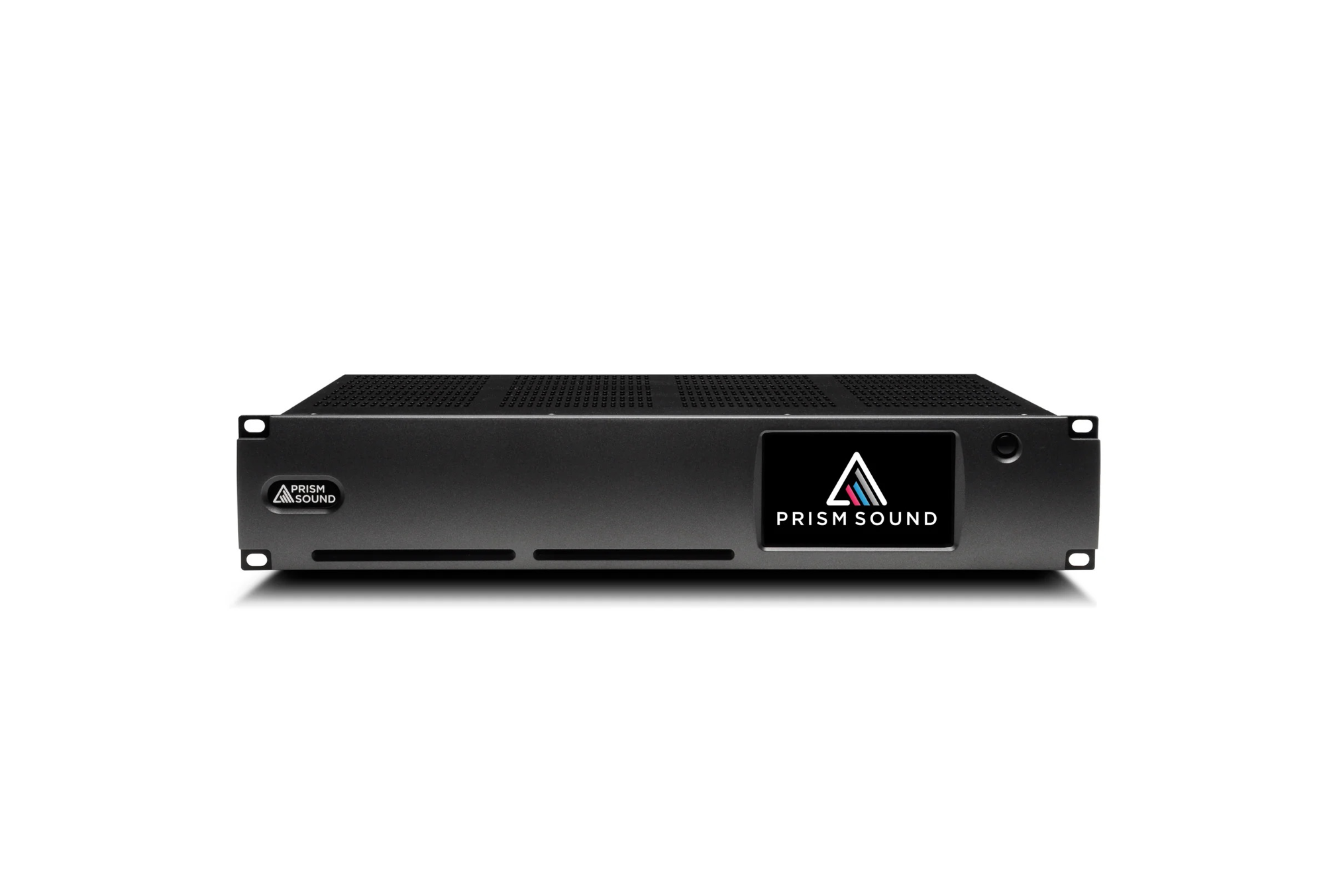
As an audio engineer and musician for over 45 years, it takes a serious set of features for any piece of equipment to impress me, especially in the digital-audio-related sphere. The new flagship from PRISM Sound is most certainly one of those examples.
Before going into specifics, let’s accept that the digital audio converter market is saturated. At the top end, a few stand-out companies are developing serious devices, including Lynx, DAD (AVID), Apogee, Burl Audio & a few others. If PRISM Sound wasn’t already a consideration for high-end gear, then it most certainly is now.
The basis of this review will be on the features and functionality of the DREAM-ADA, with a small shootout with other devices. These comparisons are always difficult to clarify, especially in print, so I have ventured to record the output of several converters with my DSD 1-bit recorder, boasting a sample-rate of 5.8MHz (yes, that’s MEGA!) This device is the final digital capture for all my analogue mixes and masters.
Getting back into the PCM (Pulse Code Modulation) format is via Daniel Weiss’ SARACON software, by far the most advanced set of codecs available in our industry.
I have then lined up these recordings (of the same excerpt of music) to the sample, inverted the Ø on the comparison unit, and then captured frequency maps of what remains from the DREAM-ADA.
This is an attempt to visually depict what I am hearing, rather than using a string of superlatives that never really translate from sound to text.
Catch up on all the latest features and reviews here.
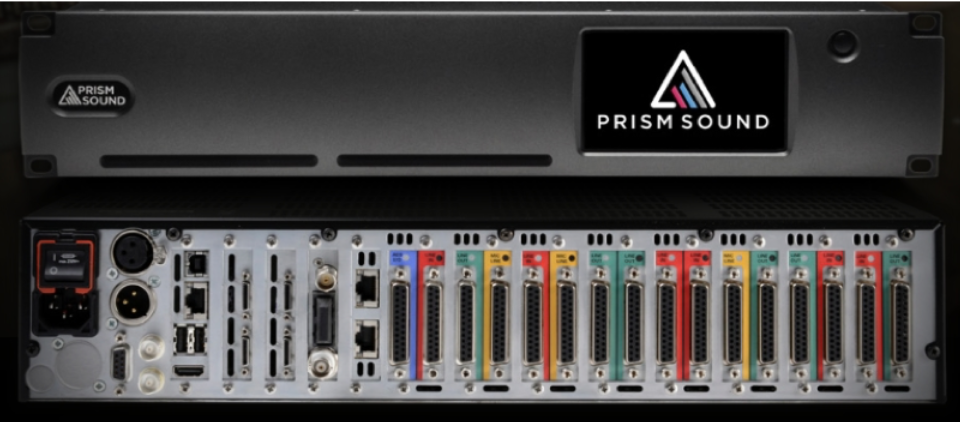
I’ll get to the frequency charts and sonic characteristics later. To begin with, let’s discuss the modular structure of the mainframe, or chassis of the DREAM-ADA.
The DREAM-ADA
These are entirely customisable across multiple audio transmission formats, then assignable to inputs and outputs from any of the format sections. These cover Dante, AVID HDX, AES-EBU, and Analogue, along with Mic-pre’s, if that is a module you’d also opt for. So, an input from a Dante device can be routed back out to another system running HDX, whilst then being routed to one of the analogue outputs – simultaneously. That’s a massive difference compared with practically anything else on the market for pro-audio, and where the DREAM-ADA really comes into its own.
Being able to bridge multiple systems through the one central conversion device is certainly the most attractive element to this behemoth. The system refers to each of these format sections as Domains.
The routing system is accessible either by software over an Ethernet connection or via the front panel, which I happen to find really simple to use. Often, the User is met with a clunky matrix- block, making routing to multiple destinations tedious; not so with the DREAM-ADA.
Select an input first, then merely select the output you wish to assign. Importantly, the output for each domain appears as separate, so multiple paths can co-exist and are represented on the front panel meters for each section.
I was also WORD-clocking my other interfaces from the DREAM-ADA and used it as the master-clock for any comparison sessions. All of the mainframe rear connections are clearly labelled and accessible, with DB-25 connection for all analogue and AES/EBU looms, WORD-clock, DANTE and HDX mini, depending upon your configuration.
The DREAM-ADA has a raft of internal adjustments, allowing the tweaking and alignment of outputs for your external devices, such as Course and Fine Trim levels, which is really handy when some attached analogue gear requires more or less headroom.
I focused on the use of the interface with ProTools HDX, being the main DAW at ToKwerX. For those who aren’t aware, AVID interfaces require a DigiLink license that flags to your system that one of their devices is attached; I sincerely wish they dropped this requirement.

For any third-party interfaces, such as the PRISM and my Lynx, the developers simply mimic an AVID device. This also allows control of sample rate and bit depths for attached interfaces directly from your ProTools session. Setting this up for the PRISM was very simple with an AVID Emulation setting within the HDX domain. Once set, I did not need to go back to the PRISM for any settings changes – sweet!
Although nearly all the settings for the ADA are available from the front panel, as I utilised for setup, there is an excellent software control option for the device. This is especially useful if the interface is not near the engineer in controlling the settings and merely requires that the ADA is on the same network as the remainder of your system. Whilst I had a look through this control software, I did not end up using it for my system.
The front panel and software interface look very similar, with ROUTING options on the bottom left, Inspection section for filter settings and various parameters, SYNC’ (clocking) settings, and unit STATUS that provides a constant temperature monitoring of all power rails and modules, SETTINGS for saving configurations and other system parameters, ALARM page for any temp’ or warnings or clocking issues, and a context-sensitive HELP menu. The front panel on the ADA is a touch screen, and I found it easy to access all my required settings from there.
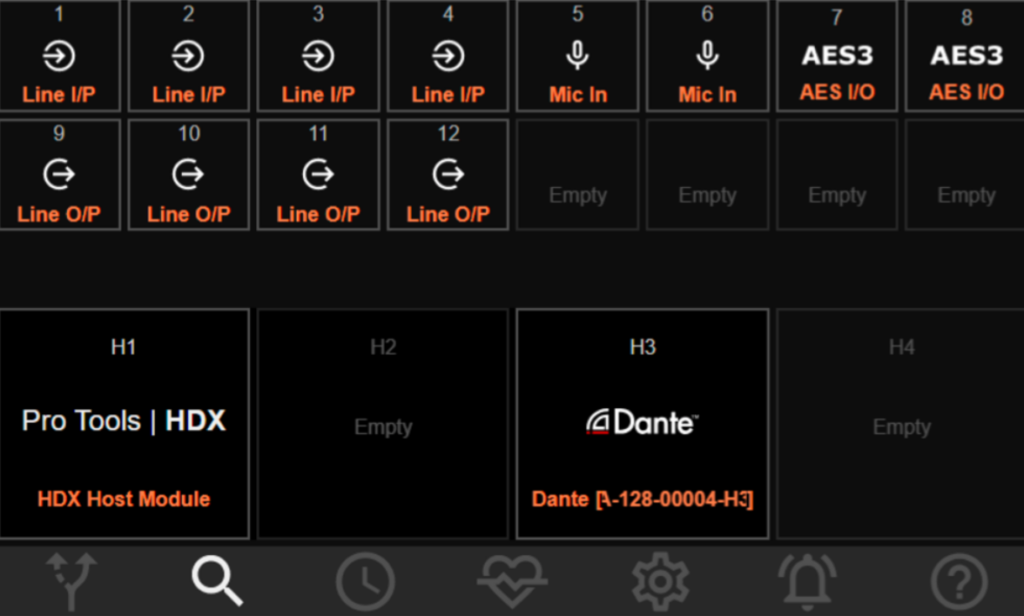
The Inspection page allows access to all the installed modules. The unit I reviewed did not have Mic-pre’s on board, but the input controls for the A-D (analogue to digital) conversion are excellent, with some unique adjustments from PRISM.
Individual channels on devices can be adjusted, so, depending on what gear you have attached to a particular port, the trimming of levels is easily accessible and fully controllable – an excellent addition that is quite convoluted on other interface software I’ve used.
In particular, PRISM’s OVERKILLER is something I’d like to spend some time discussing here. Most new-generation interfaces on professional gear can Soft-Clip the input levels into the digital converters if any overs are encountered. Whilst I am aware of some engineers even intentionally utilising clipping of converters, I am not one of those. If I want to apply clipping to a digitised signal, I will do that afterwards with plug-in processors. For the actual capture of my analogue signal, I always want to ensure I have adequate headroom.
Of course, audio-life doesn’t always happen that way, and when we find ourselves in recording situations that can compromise that ethos, having a system that can address clipping is certainly becoming an essential tool for engineers.
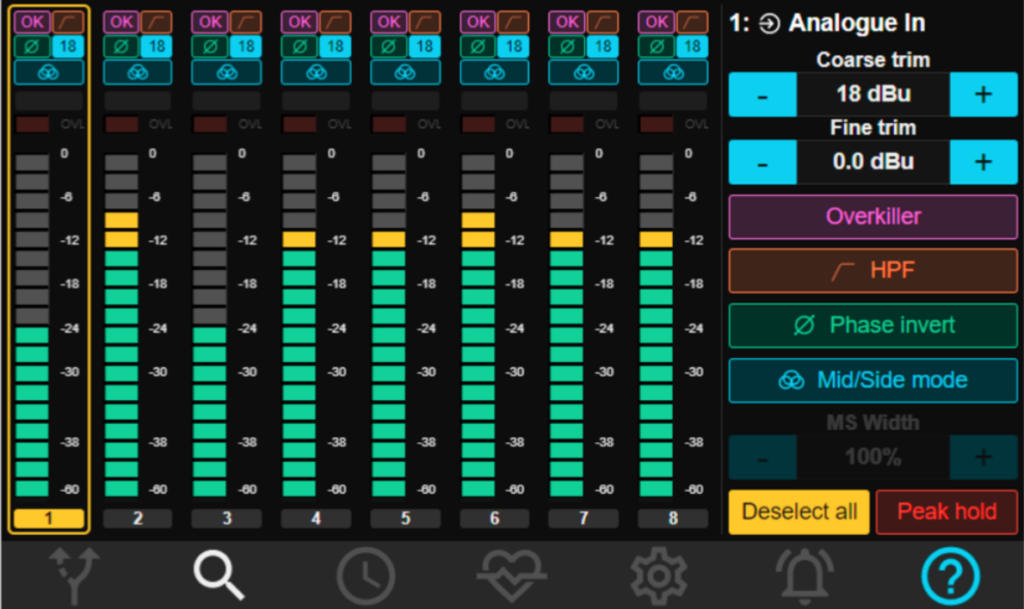
From the PRISM User manual:
“The PRISM Sound Overkiller acts in a uniquely progressive manner, which gives it unrivalled capacity to soak up large transient overloads without any noticeable distortion, whilst protecting the A/D converter from over-modulation.”
Each pair of analogue inputs also supports a Mid-Side mode, which is extremely useful when monitoring a pair of M-S microphone signals that will be automatically “matrixed” to appear as a Stereo signal; it’s ultra-cool having this on the actual conversion as opposed to having to do it once inside the DAW.
Included in this raft of features on the ADA is an AES/EBU Input Impedance setting, which allows correct signal load adjustments if you’re using a consumer-level SPDIF signal. The developers at PRISM really have not left any scenario unaddressed in the features of this flagship unit, and although I did not require the use of some, it is excellent to know that this piece of kit leaves no issue uncovered.
The Internal Clock for the ADA is also worthy of serious discussion here. The truth is, most consumer-level interfaces have extremely poor clocking, which presents with high levels of Jitter. Put simply, the more stable the WORD-clock, the better the timing between each sample of audio amplitude at the output of the conversion process.
I had a colleague purchase a stand-alone clock from a third party for his moderately priced system some years ago, and the sonic difference was immediately audible. PRISM does not take clock stability lightly, and the ADA’s internal clock is incredibly robust and stable. Given that any digital system has to have a single Master clock, you’ll be gratified that the
ADA’s is very likely the best in your system. For those who wish to dive deeper than this review, PRISM’s User Manual has some great insights and test results for their clocking that are readily available.
Sound test
So, how does it sound?
Well, I didn’t immediately think, “Oh my god, this is so much better than my Lynx.”
But, I was able to switch between their main outputs and A-B them by ear, and there is a difference that I will use descriptive language to explain, then I’ll use the graphic chart to attempt to show what I am hearing.
The ADA has a ‘presence’ and ‘clarity’ that is audible when compared to my Lynx – this is the Aurora 16, which is now close to 20 years old. I am assuming the newer Lynx (n) models are also an improved sonic footprint.
By ‘presence’ I don’t mean “brighter.” I mean, the entire sonic listening seems ‘unveiled.’
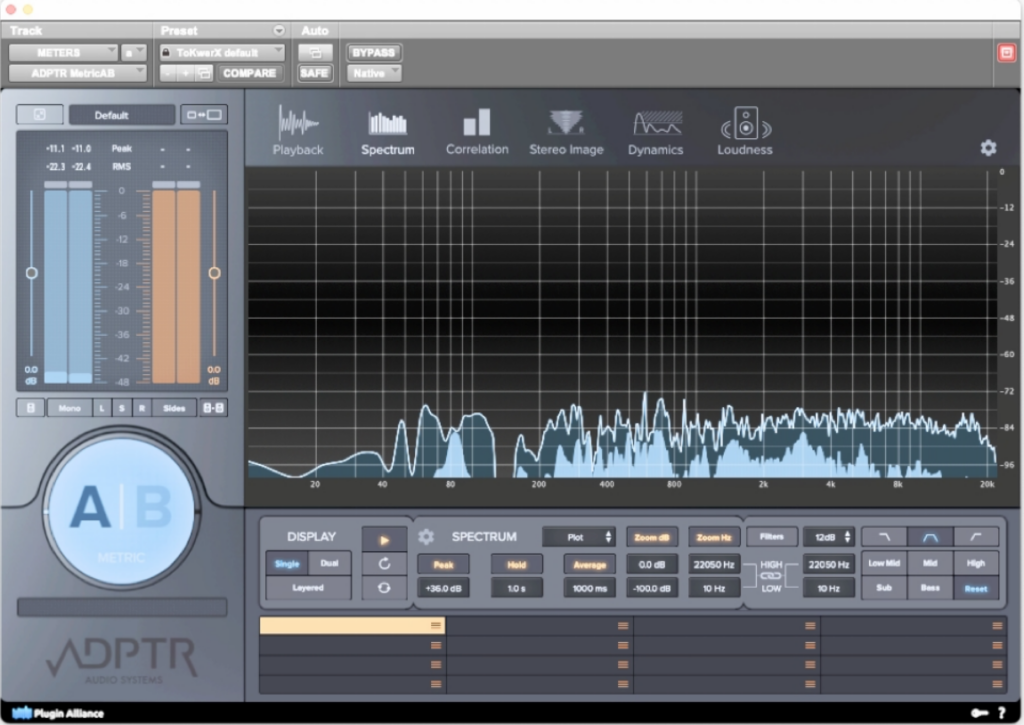
So, to try and express these terms graphically, please see below, a spectrum analysis of the two devices’ Output Conversions to Analogue, of the same piece of audio.
These were recorded at an extremely high sample rate on the DSD 1-bit recorder, running 5.8MHz.
Lined up (to the Sample), then Ø inverted the LYNX version; this is what I heard.
To ensure the reader is clear on what is represented here, the fairly wide spectrum of difference between the two is occurring at below -72dBFS (Full Scale), with the Histogram (Light Blue Solid) showing a series of significant peaks, but notably one crest in the 2-4kHz range – where our human hearing is most discrete.
Yes, these differences are seemingly minute and at a very low amplitude, but this test is able to graphically represent that there is a notable difference.
I would like to carry out this test across a broader range of “Mastering Converters” as they are marketed to determine a range of measurements, but suffice to say, the other unit I measured was not worthy of inclusion here.
I found the UA Apollo (early series) absolutely not a contender, with a chalk & cheese audible difference between the two output converters. With due respect to the UA range, the cost of these devices and inclusion of their UAD-DSP processing clearly states where they’ve cut corners for the market price.
The Danish Audio company (DAD: Digital Audio Denmark – a division of NTP Technology), which actually manufactures the AVID MTRX range of converters, is also considered a high-end converter and presents with a similar sonic footprint as the PRISM. I am currently using an MTRX Studio interface for the DOLBY ATMOS Suite at RMIT University in Melbourne, where I teach & lecture.
I was not able to get access to a vII MTRX device to accurately run any comparisons for this review.
What I can say about the management software (DADman) for the MTRX interface is somewhat convoluted in comparison to that of the PRISM ADA. The DADman took me a couple of sessions to set up, whilst the PRISM was merely an hour or so out of the box.
I am suggesting that the UI (User interface) of PRISM is currently more intuitive.
Both the PRISM and the DAD converters are expensive for the small studio owner-operator, but the DREAM-ADA presents an extremely powerful system for an entire production facility, allowing for connectivity of multiple systems across various software DAWs.
It also seems to have placed a serious contender in the marketplace for a worthy competitor to the currently MTRX-dominated market in Australia and New Zealand. I note that AVID have released the MTRX II versions, offering a similar modular expandability of the PRISM devices; nothing like a bit of serious competition to drive improvements!
I’d like to thank the PRISM distributors here in Australia, Amber Technology, for their kind and patient assistance in setting me up with what is definitely the most impressive A-D-A converter I have yet to utilise at ToKwerX.
In closing this review, I’d like to add that the entire PRISM range of interfaces, the LYRA, LYRA II, TITAN & ATLAS all use the same converters as their flagship DREAM-ADA, making this high-end digital audio quality available to all levels of studio and production facilities. I, for one, will be seriously investigating PRISM for the options when upgrading my interfaces.
For local enquiries, head to Amber Technology. Check out the DREAM-ADA here.