Fender Music Australia | RRP $2,299
Described as a vintage-style guitar for a modern era, the Vintera series was introduced in 2019 as a replacement for Fender’s Classic Series. Fender’s Vintera III series focuses on the “golden era” of Fender guitars with specifications ranging from the early 1960s to early 1970s, and includes a Bass VI, Jazzmaster, Jaguar, Mustang, and Jazz Bass.
Catch up on all the latest features and reviews here.
How is the Vintera III Jazzmaster different from the Vintera II Jazzmaster?
The Vintera III features a laminate rosewood fretboard, C-shaped neck profile, and ’60s pickups, as opposed to the Vintera II’s late-’50s C-shaped neck profile, slab rosewood (Pau Ferro) fingerboard, and ’50s single-coil Jazzmaster pickups. Both models feature the same-style chrome hardware.
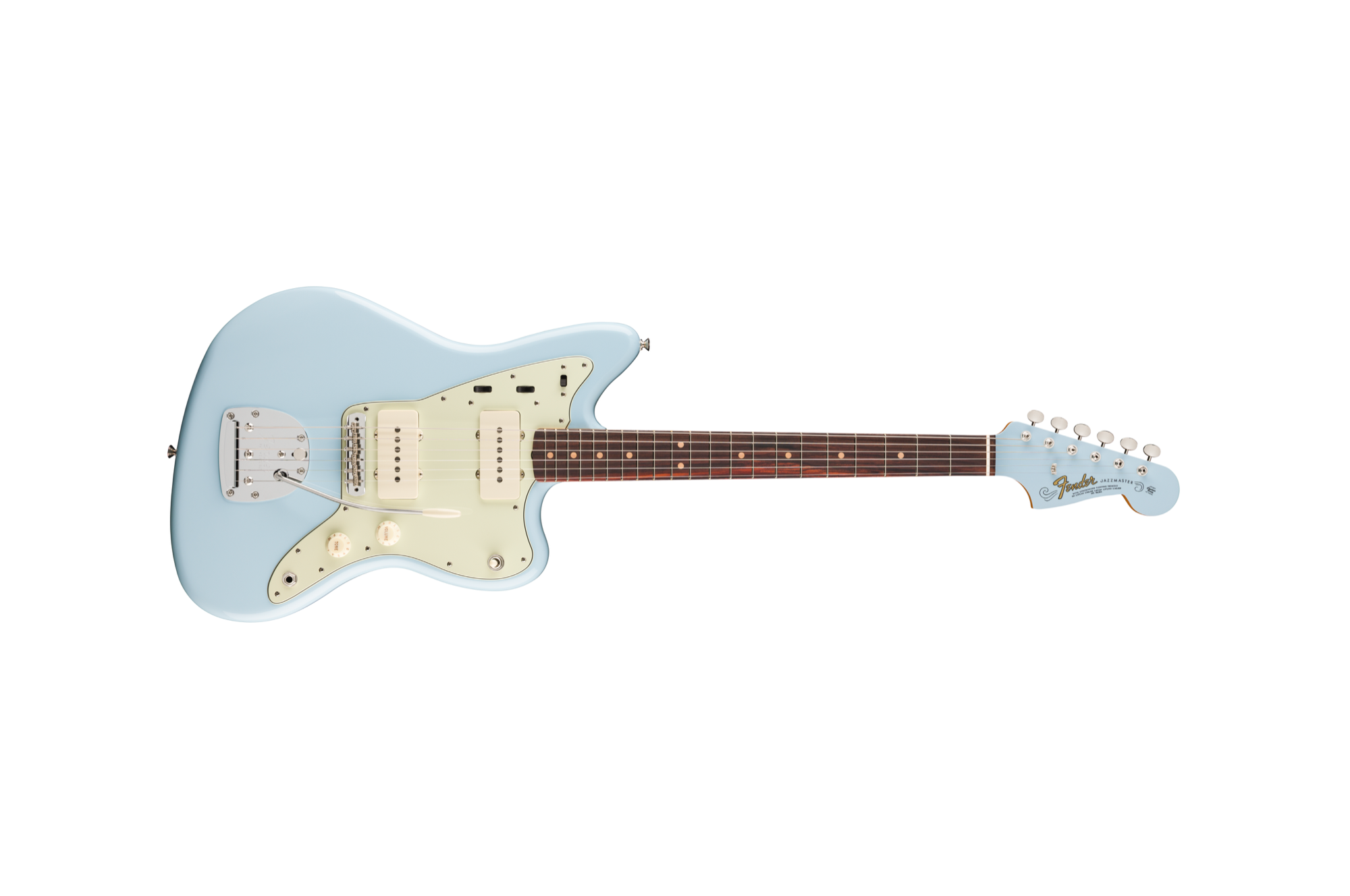
There are no other words to describe the Vintera III Jazzmaster other than stunning. Right out of the box, this guitar feels great to play and looks great in Sonic Blue, which originally was a custom colour.
Modelled after a mid-’60s (1964–1966) Jazzmaster, the Vintera III features a matching painted headstock but has no white binding around the fretboard, as Fender began adding binding in late 1965 when CBS took over from Leo Fender.
The neck is made from maple and features a gloss polyurethane finish with a rosewood fretboard, and what looks to be period-accurate clay dot inlays. The ’60s C-shaped profile feels comfortable and smooth, with a 7.25″ radius fingerboard and vintage-tall frets that contribute to that classic playing feel. The truss rod has period-correct access at the base of the neck and is bound to the body with four screws. The headstock features the CBS-era bold black-and-gold-style Fender logo with bookending scrolls, as well as Fender’s ‘custom body’ label, hinting at the non-standard paint finish, as well as vintage-style open-back tuners.
The body is made from alder. The overall weight is on the heavier side, but shouldn’t cause issues when holding it standing up. As someone who has a love-hate relationship with offset guitars, this Jazzmaster® is incredibly comfortable to play. The body’s comfort curves have been lovingly carved. The treble horn provides easy access to the high notes despite the block neck joint. The Sonic Blue finish is matched with a light mint-green three-ply pickguard and parchment-coloured pickup covers, volume and tone knobs, selector switch tip, and vibrato arm end tip.
The bridge consists of six-barrel-style saddles with multiple grooves to accommodate the strings and movement from the floating vibrato system. After hearing and reading about common issues associated with this style of bridge, I haven’t had any strings jumping out after heavy use or experienced any rattling problems. The saddles appear to have enough groove cut to keep all the strings from jumping out, despite my best efforts to try to replicate said problems.
Plugging in for the first time, I was instantly transported into surf guitar and rockabilly. The pickups have that classic punchy twang that the Jazzmaster is known for, as they are single-coil. Even with the tone at zero, these single coils are incredibly bright.
The Jazzmaster features one volume and one tone control, a three-way pickup selector, as well as the infamous rhythm/lead circuit. Often disconnected or the switch taped off in case of accidental engagement, the rhythm/lead circuit has got to be one of the most misunderstood and underappreciated features on any guitar. Allowing the player to preset volume and tone for the neck pickup, it offers a slight variance in tone compared to simply switching to the neck pickup via the three-way pickup selector. However, the tonal variance is negligible.
One of the most enjoyable things about this guitar is its vibrato/tremolo system. While it may not deliver the extreme dive-bombs of modern vibratos, it will scratch your surf guitar and shoegaze itches.
The action of the vibrato is wonderfully smooth, adding just the right amount of wiggle to notes and chords, and even under heavy use, the tuning holds rock solid. The vibrato arm pushes in firmly and snugly, with no unwanted flopping or rattling, and requires serious force to detach. The one minor gripe is that the vibrato lock doesn’t quite perform as intended, with either setting allowing both up and down movement, possibly due to insufficient spring tension. It’s a small niggle on an otherwise excellent system, and one that did little to diminish my enjoyment of it. I found myself reaching for the arm constantly, and whenever it wasn’t within reach, something felt distinctly missing.
The quality of this guitar is outstanding and would be a great option to consider for anyone wanting to upgrade from their first instrument. Having had the pleasure of spending a few days with it, along with trying out some other recent Fender releases, the Vintera III Jazzmaster is the only one I’m constantly playing. Everything about it is simply joyous.
Learn more at Fender.