Martin’s revamped 16 series brings a Blue Denim finish to one of its most beloved body shapes.
Since the early ’30s – and I mean the 1830s! – there has not been a more important maker of acoustic musical instruments than the C.F. Martin Co. of Nazareth, Pennsylvania. The structure, size and shape of flat-top steel-string guitars, with a few exceptions, all derive from the innovations of this company. It remains a family-owned business, and most of its output is still in Nazareth.
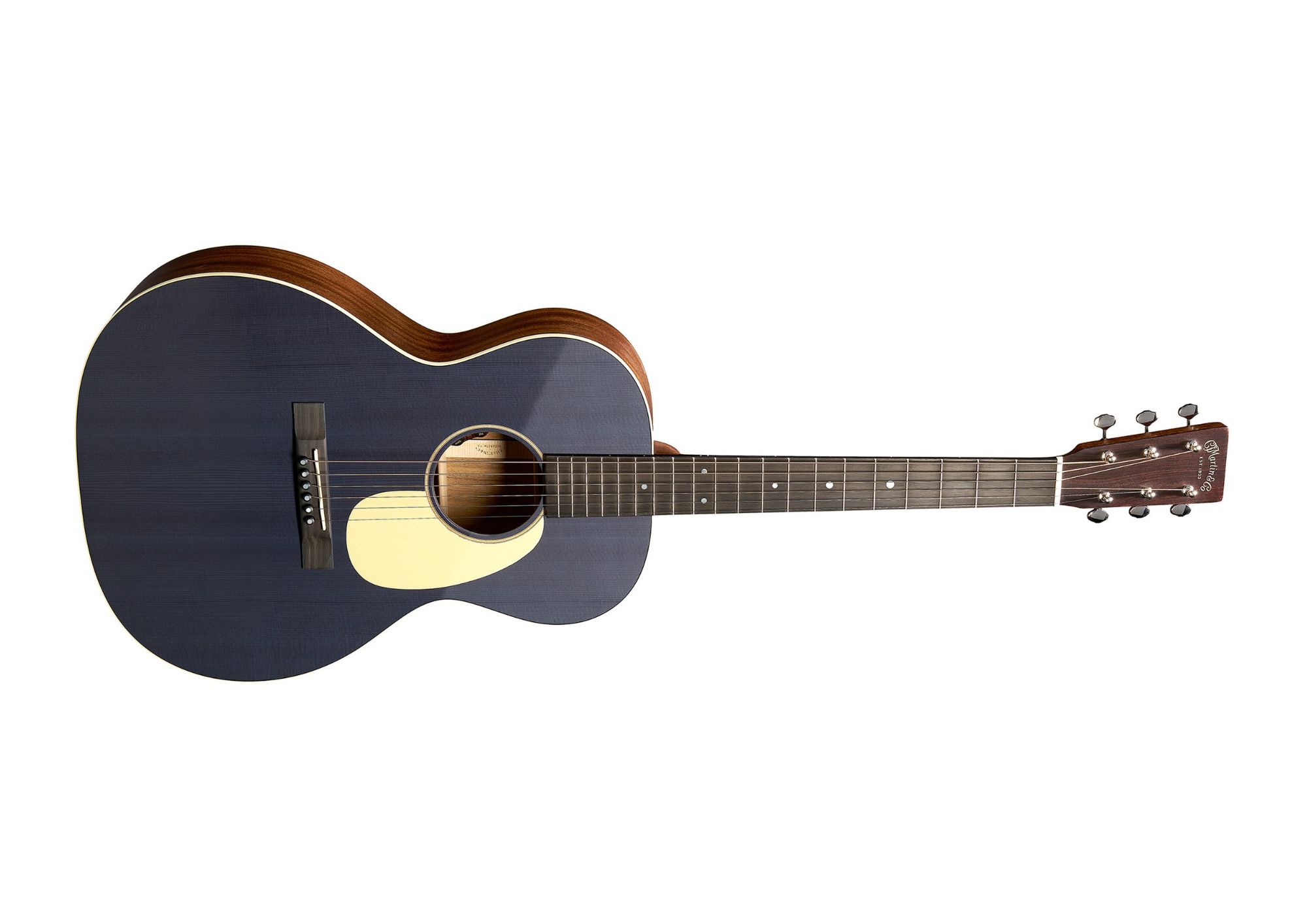
Martin’s 16 series used to be a more disparate range. The revamped line is a little more of a family: gloss tops, satin on rosewood or mahogany back-and-sides covering a Jumbo and Jumbo 12, a Grand Performance Cutaway, a D-size and the smallest, this 00L-16E. Apart from the 12 and the Cutaway, the others come in a surprising and striking range of coloured gloss tops, with black and sunburst common to all. Options include a cream top on the Jumbo, a fabulous ‘cherry cola red’ on the ‘D’ and a rich ‘denim blue’ on this gorgeous little 00.
Catch up on all the latest reviews here.
I owned something similar donkey’s years ago when a friend sold me a 1930s 00-18 that he’d found under a bed, beaten up and painted red by its owner. He’d rather badly stripped and repaired it. So this ‘un came as a welcome shock because it was so familiar. The neck feel, the mahogany body, the tightness of the sound. I confess I didn’t feel worthy of the instrument at the time, but it all flooded back.
The 00/Grand Concert body size fits between the Concert (0) and the Auditorium (000)/Orchestra Model (OM). The 000 and OM share a body, with scale length the difference between them.
A Parlour has a lot of definition and is great for blues; the 00 has a larger palette, with a more focused midrange and top. Mahogany is tight-sounding, much less expansive than, say, rosewood, and very ‘woody’. This guitar really shines under the fingers, though the attack a pick brought was really clear and musical too.
The big surprise is the coloured top. This intrigues me because I don’t recall coloured tops on Martins, or indeed on too many other production line acoustic guitars. When that master fingerpicker/singer Chris Smither bought an all-blue guitar in 1989, he said he was given more publicity for the guitar than his performances.
Coloured acoustics once had a reputation for hiding lesser timber, and good guitars back in the 1930s were sometimes coloured to disguise flaws when unblemished wood wasn’t available. That’s not the case here: on this 00 the spruce top shows through the colour – no visible flaws – and it’s set off nicely by a grained ivoroid pickguard and vintage white binding. The ringed rosette is pretty and allows a glimpse of the spruce underneath.

Gibson’s Everly Brothers model in the early ’60s was all black, and by the end of that decade coloured acoustic guitars became somewhat more common, which is unsurprising when you think of the explosion in electric guitars that were all coloured. Martin doesn’t seem to have strayed from woody palettes too often. Many of the independent luthiers that emerged in the ’80s built brightly coloured guitars on demand from clients, but maybe for Martin it was a philosophical thing too: the Jumbo 12 and the Grand Performance in this 16 series are described as having ‘more traditional, natural tops.’ I couldn’t have imagined a red D-18 at a bluegrass festival, could you? But in an electric band…
Let’s run through the specs.
The Martin 00L-16E is an acoustic-electric with a gloss Blue Denim top on spruce (Black Smoke and 1935 Burst are also available), mahogany back and sides, slope-shouldered with 14 frets to the body. The 00 size and mahogany focus the midrange (rosewood scoops the mids a little) and the slope shoulders tend to compress the bass ever so slightly. Great for recording.
It has an ebony straight-line bridge (an interesting deviation from the more common belly bridge), TUSQ saddle, and black polymer pins with abalone dots. Underneath, the top has scalloped X-bracing.
The neck is a modified low oval with ‘high performance’ taper and satin finish, with an ebony fingerboard and mother of pearl inlays. It sits very comfortably in the hand and plays easily up to the body. The scale length is the shorter 24.9 inches. Width at the bone nut is a Martin-standard 1.75 inches. The tuners are nickel open-gear with butterbean buttons, which have a really smooth grip.
The installed L.R. Baggs Element pickup system is excellent, making this machine fully gig-ready. The guitar is available for lefties and comes with a premium quality gig bag.
This is a guitar you could sit on the couch with for hours – the small 00 body sits on the lap like it was born there.
It’s a real little beauty, and while there are boutique builders out there (including the Martin Custom Shop) making great guitars, they’re at least two or three times the price. Typically, the build is excellent, it looks great and it’s an absolute pleasure to play. Martin is still the standard.
For local enquiries, head here