Crystal-clear highs, a hefty low-end punch, and a surprising amount of tweakability, the Series Five earns its place on any desk.
If you have been in or around studios for the past forty-plus years or so, chances are you’re familiar with the studio monitor brand KRK Systems. Known for having a full-frequency response, KRK has become an industry standard for both professionals and beginners alike. Recently, KRK released the latest version of the V-Series.
Designed for clear, accurate monitoring, the latest edition of the V-Series features custom-designed transducers housed in cast aluminium frames, optimised for low distortion and linear low-frequency performance. These monitors are packed with features for the modern creator.
Whether you want to create, mix, or listen to music in stereo or surround sound, the KRK Series Five Powered studio monitors are worthy candidates.
Catch up on all the latest news here.
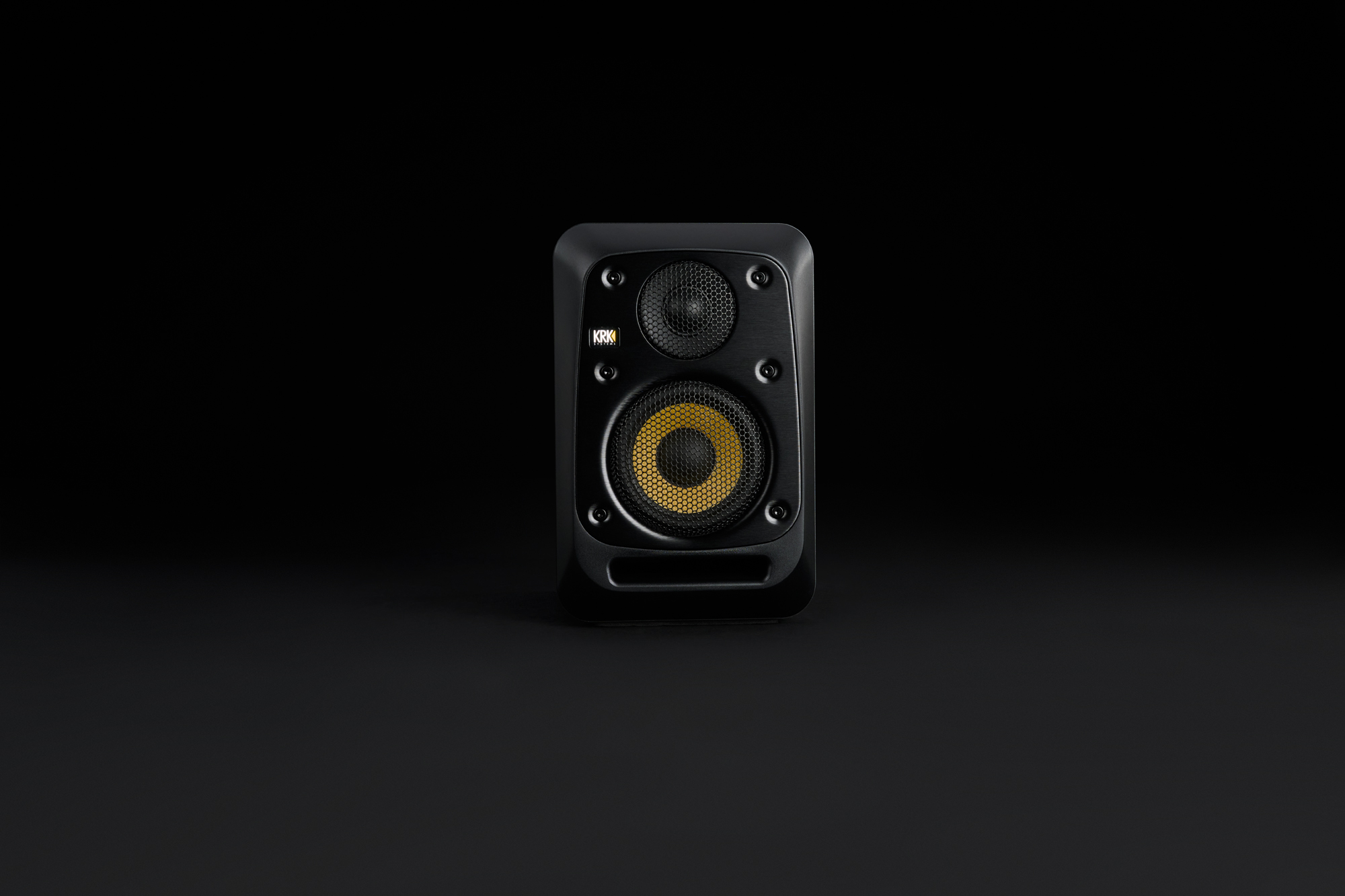
They come in four, six, or eight-inch low-frequency drivers made from woven Kevlar aramid fibre cone, shorting ring, ferrite main and bucking magnets, along with a one-inch high-frequency driver with a silk dome, copper cap, and ferrite main magnet with a large rear damping chamber. The cabinet is constructed from PVC vinyl-wrapped MDF with a die-cast aluminium baffle, and includes an optional metal grille to protect the speakers.
On the back panel, things have been overhauled for modern usage, featuring a balanced XLR / 1/4″ TRS/TS combo jack, along with a switchable option to use AES-3, which has replaced S/PDIF. It’s also worth noting that home theatre enthusiasts may find these hard to integrate into their systems, as there’s no HDMI port output — you’ll need a DAW interface or mix console to play audio through them.
There’s a USB-C service port for firmware upgrades, plus a screen with a rotary encoder that lets users control various parameters outside the KRK Control App. Connecting to power in different countries is made easy, with the IEC accepting anything between 100 and 240 volts AC, and all models carrying a maximum power rating of 455 watts.
KRK has designed these monitors to be multipurpose, whether for studio, theatre, art installations, or setting up a surround sound mixing and listening environment. The brand has integrated its “Mesh Technology,” allowing users to wirelessly control multiple monitors across multiple studios via the KRK Control App.
The Series Five gives users more control over how the monitors sound in their space, with twenty-five fixed boundary and tuning EQs, as well as seven pro parametric EQs, custom EQ curves, and delay compensation for more immersive installations.
One of the most intriguing aspects of these monitors is the adjustable EQ. They offer both low and high shelves, along with five bands of parametric EQ at ±6dB with adjustable Q curves — though there were only subtle differences when active in my listening environment, even at extreme settings. While there’s a good amount of tweaking ability here, the tuning EQ is designed to enhance audio in spaces that suffer from bad reflective surfaces or frequency null and boost spots, rather than to solve a lack of acoustic treatment in recording or mixing environments.
The menu screen offers various helpful set-up configurations. The input screen allows users to adjust the input type from analog to digital, depending on the connection, as well as the analog sensitivity between +4dBu and -10dBV. Each monitor can have its sound precisely delayed between 0.0 and 200.0ms, useful when running multiple monitors over a large distance. However, if you’re using a pair in a studio, or multiple monitors in a small environment, make sure all settings match — mismatched settings will cause phase cancellation and an unbalanced sound.
Downloading the KRK Control App makes setting up and optimising rooms with multiple monitors easy. Syncing monitors to the app is straightforward and painless, with the app scanning a fifty-metre radius to pick up any KRK monitors running Mesh Technology. Users can create custom monitor mapping from stereo through to 9.1.6 surround sound, all with individual monitor control. While the app allows wireless control over everything, there’s no option to send audio directly over Bluetooth — a handy feature KRK could consider for a future firmware update.
These are exceptional monitors for the feature set and price point. Despite having just a four-inch woofer, they pack a hefty low-end punch, with hardly any noticeable loss in sub-low-end information, and mids and highs that offer crystal-like clarity within an acoustically treated room.
They’re worthy of producing music, track referencing, or simply chilling out and listening to audio through, with plenty of volume for most applications. The Series Five has some genuinely exciting and surprising features to help with a plethora of circumstances. The past few days have been a joy spent listening to various types of audio through them, and the quality, clarity, and detail of the sound is remarkable.
For anyone beginning their studio journey, or wanting to experiment with surround sound configurations, the fifth-generation V-Series should be highly considered.
For local enquiries, head here.