The Noise-FM filter feeds noise into a resonant filter to modulate the cutoff, with Easy and Pro views, three effects and an envelope follower that reacts to what you play.
Catch up on all the latest news here.
Because the noise is doing the modulating, the character shifts with how hard it is pushed. Kept low, it’s a shimmer you feel more than hear, the kind of restlessness that makes a digital sound feel analogue. Further up it turns to audible grain, and pushed hard the texture takes over and becomes the source itself. It suits thin, metallic hi-hats, basslines that need to hold their ground against the kick without getting louder, and pads that would otherwise just sit there for eight bars.
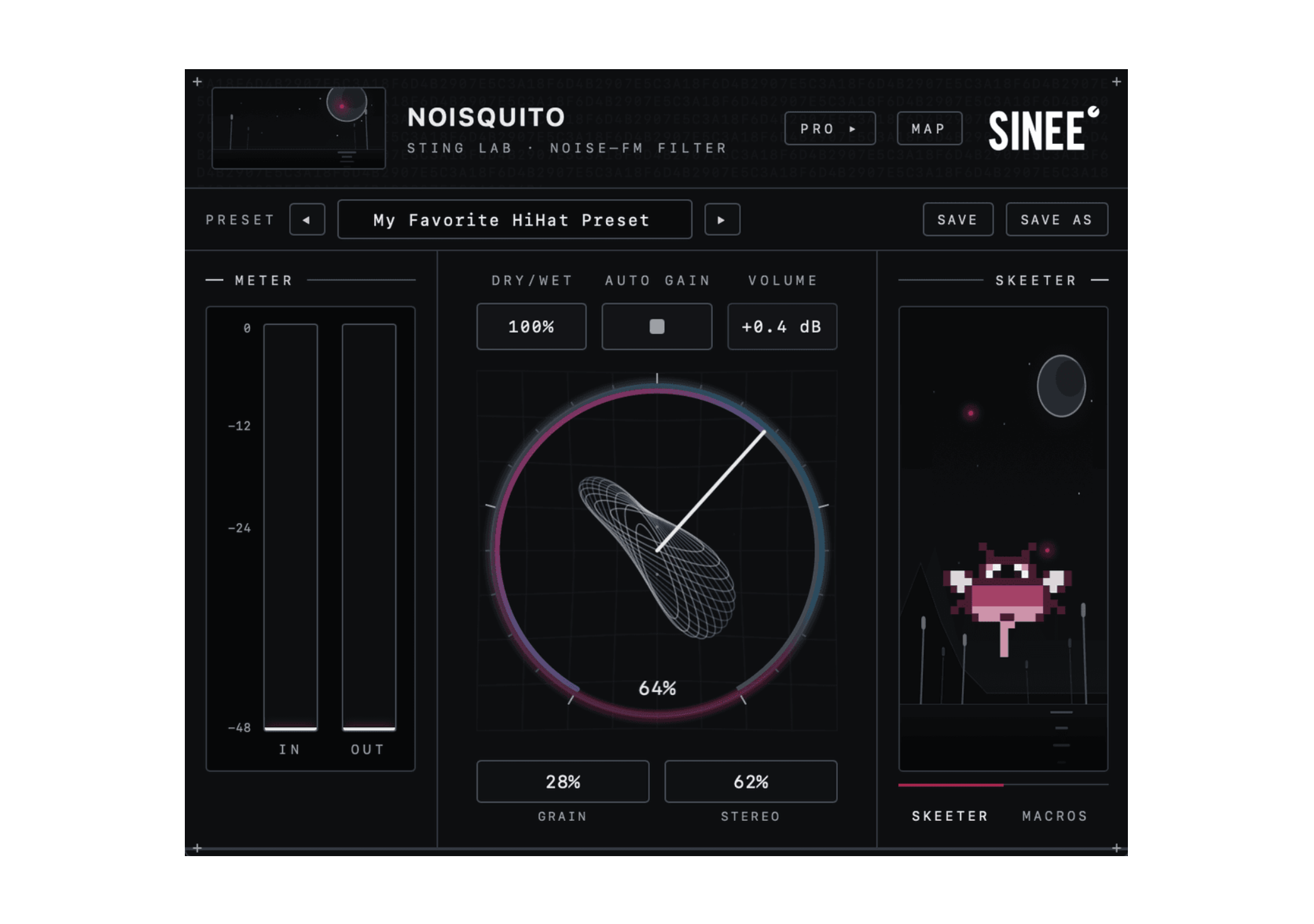
Noisquito splits into two views that share the same state. The Easy view keeps things to a preset and three macros, each labelled by the preset, so you can load one, turn a knob and hear something useful straight away. Switch to Pro and the full engine opens up, from the noise character between broad noise and tight grain to where it sits in the spectrum, with a filter whose cutoff, resonance, type and drive decide where the texture lands. Nothing is lost moving between the two.
Three effects sit after the engine, including Decay which works on a vocoder principle with the noise as carrier and an adjustable release that leaves a tail. Granular is a tempo-synced grain delay that spreads the texture across the beat, and Finish pairs a tilt EQ with an OTT-style compressor to hold it in the mix. Two LFOs and an envelope follower route to any parameter, and MAP mode marks every modulatable control with a click.
“Noisquito is a beast. It sits somewhere between Erosion and the Ableton Vocoder,” says Berlin techno producer Brian Sanhaji, who ran it during the beta.
Noisquito is SINEE’s third plugin after Chop Suey and Kikzilla, and it is out now in VST3 and AU for macOS and VST3 for Windows, with a 14-day trial here.