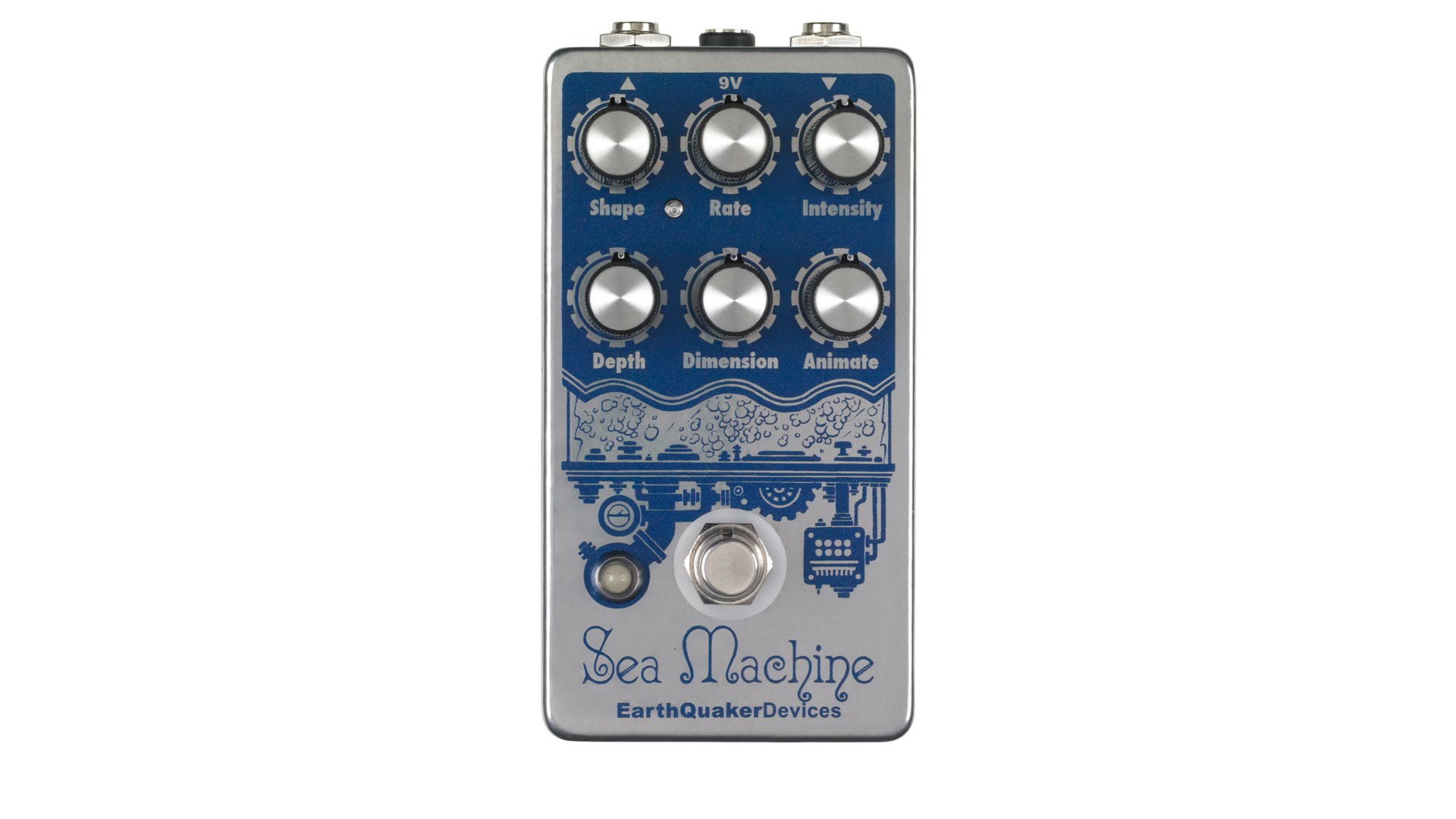
The heart of the Sea Machine is a short digital delay line, which features controls for Animation, Dimension and Depth. The Animation allows control over the delay time, Dimension adjusts the amount of spatial regeneration and the Depth adjusts the mix of he modulated wet signal against the dry analogue signal. The LFO section of the Sea Machine is comprised of Rate, Intensity and Shape. The Rate adjusts the speed of the oscillator, the Intensity adjusts how much the LFO modulates the delayed signal and the Shape transforms the wave from a soft triangle to a hard square wave. Included is a small LED, which shows the speed and shape of the LFO, even in bypass. With this mix of standard and unique controls, everything from subtle warble, classic Leslie, seasick pitch bends to strangled alien sounds, stunted arpeggiations and many more far out sounds are on tap. The Sea Machine also was designed to work well following fuzz, distortion or overdrive without getting muddy, reducing volume or breaking up. When engaged, the transparent buffer leaves the all-analogue dry signal unaltered and crystal clear. The Sea Machine is true bypass and made by human hands with the highest quality parts in shimmering Akron, Ohio.
EarthQuaker Devices The Sea Machine