Ian Beveridge has looked after Dave Grohl’s in-ears for more than three decades. He explains why Spectera’s digital, bidirectional system won him over before he’d even heard it.
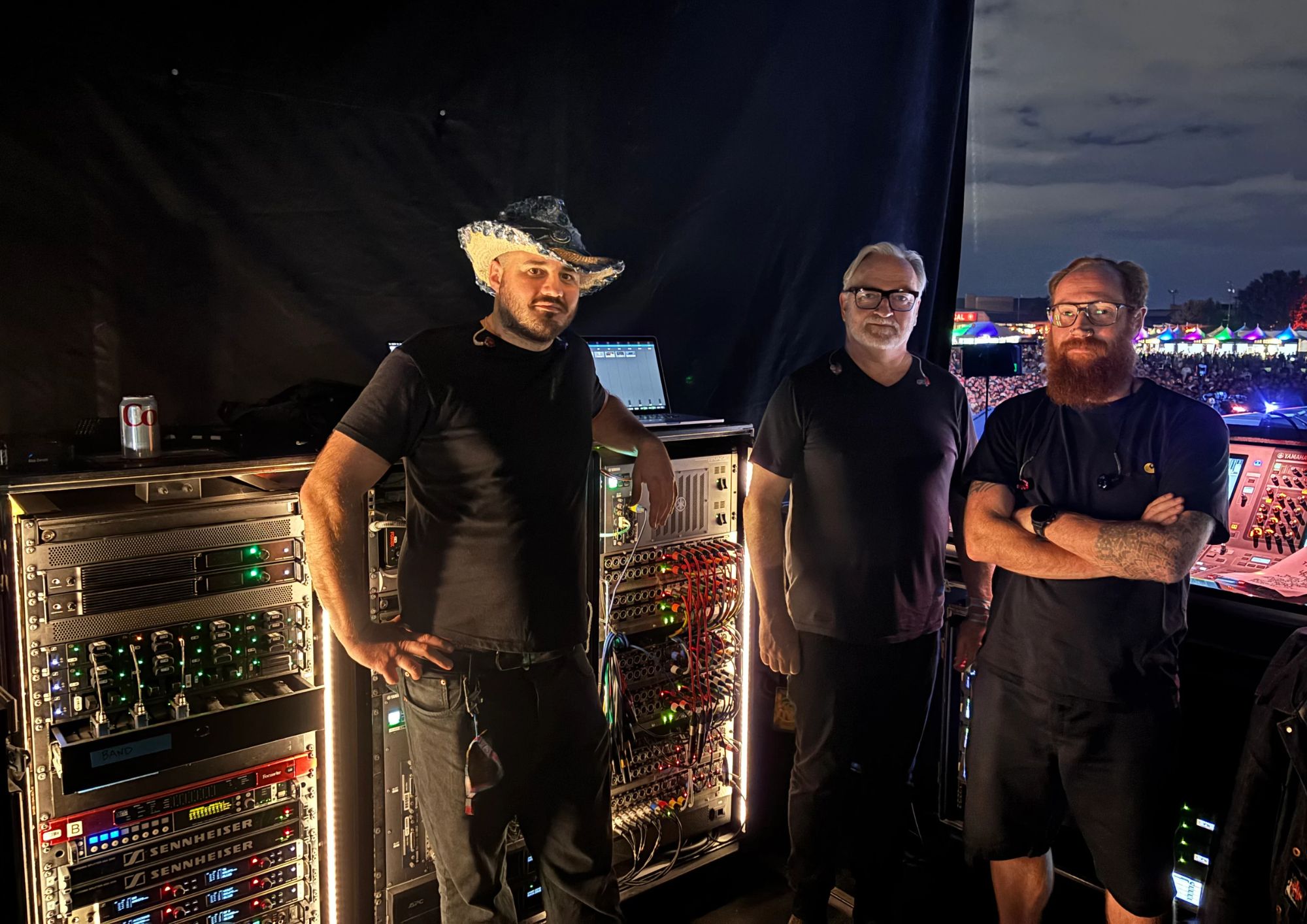
Foo Fighters’ monitor engineer Ian Beveridge has moved the band’s in-ear rig over to Sennheiser’s Spectera wideband wireless system. In the process, monitor world’s radio rack has shrunk from a five-foot cabinet to a 2U space holding two base stations and a laptop.
Beveridge has looked after Dave Grohl’s monitors since the Nirvana days, having first toured with that band in 1989 behind Bleach. Narrowband systems meant swapping gear to suit each region’s frequency rules, and years of that on world tours had him sold on Spectera before he’d heard a note of it.
Catch up on all the latest news here.
“Traveling all over the world, swapping out narrowband systems for different geographical areas – it becomes a royal pain in the neck,” Beveridge says. “When Spectera became available, I pulled the trigger without even hearing it.”
Spectera’s digital transmission matters for the mix as much as the logistics. Analogue FM stereo in-ear systems encode left and right through multiplexing, so stereo separation can slip as RF conditions get worse. That’s a problem for a band with three guitarists who rely on panning to be heard.
“With the Foo Fighters being a three-guitar band, the only way to create space so you can actually hear everything is by panning them,” he explains. “If that stereo width collapses, your levels shift, everything steps on each other, and all that mixing just goes to hell.”
The system’s first outing came at the band’s SNL UK appearance in London in April, a notoriously crowded RF environment. Even with the base station’s meters showing interference, Beveridge walked a bodypack through corridors and brick walls and out past the production trucks without the audio faltering.
Because Spectera is bidirectional, every pack is controlled from software. That lets Beveridge give the lead singer the lowest-latency link while crew packs run on less demanding modes. It also takes the panic out of a last-minute frequency change, something the crew has had to do as the band walked on stage.
“With Spectera, you change it in the software, and without anyone touching a single bodypack, they automatically jump to the new TV channel together in about 20 seconds,” he says.
Grohl is still singing into a Sennheiser MD 431, which Beveridge keeps on stage partly because it’s kinder to a frontman’s teeth than the heavy brass boutique mic one engineer once pitched. Foo Fighters’ Take Cover stadium tour reaches Australia this week, starting at Brisbane’s Suncorp Stadium on 5 November.
For more information about Spectera, head here