From heavy metal beginnings to a design philosophy built on Bauhaus and Art Deco, the duo behind Duesenberg open up on hardware, heritage, and the artists who've shaped the brand.
There aren’t many guitar brands you can identify at a glance, but Duesenberg is one of them. Instantly recognisable hardware, semi-hollow bodies built with genuine tonal character, and a client list stacked with some of the most respected names in music; Duesenberg has spent four decades building a reputation most brands never manage.
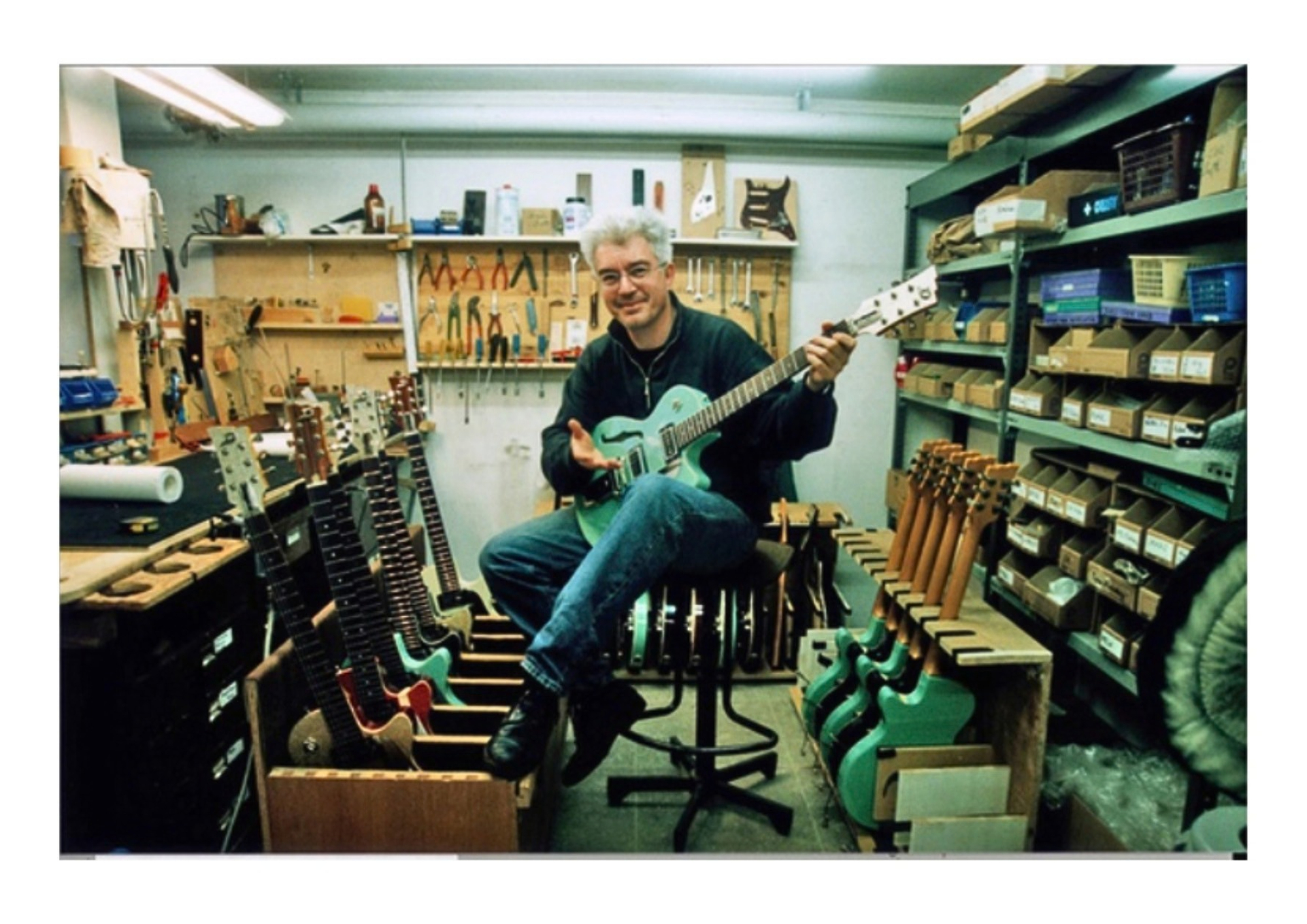
Duesenberg’s story starts not with a guitar at all, but with parts. In 1978, Dieter Gölsdorf opened a small business producing and selling guitar parts and kits, an operation he’d later run under the name Rockinger. It was here that Gölsdorf built the foundation for everything that followed. “My company at the time, Rockinger, produced guitar parts and kits for guitars and basses,” he explains. “Over time, I felt the desire to create my own line of guitars and design them according to my own ideas and approach to design. It was especially important to me to use only the highest-quality components, preferably ones I had designed myself. By that point, I already had plenty of expertise.”
That expertise built over the better part of a decade eventually gave Gölsdorf the confidence to strike out on his own entirely. “We were already producing our own necks and bodies back then,” he recalls. “So what could have been more natural than to start creating our own guitar designs with the same level of care? Even today, I still come up with new ideas almost every day.” In 1986, that vision became Duesenberg.
Read all our latest features and gear columns here.
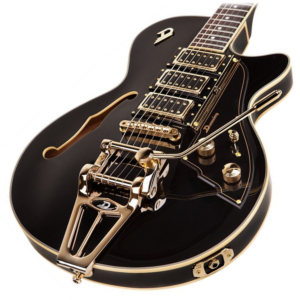
Interestingly, the brand that would go on to become synonymous with sophisticated, semi-hollow instruments actually began life orientated toward heavy metal, before shifting direction around 1989 as Gölsdorf’s own design sensibilities took over. Those design sensibilities, as it turns out, owed as much to architecture and industrial design as they did to other guitar makers. “I’ve always had a fundamental interest in design and the way lines and shapes work together,” Gölsdorf says. “Automotive design, the Art Deco era, as well as Bauhaus and Memphis, were all major influences for a long time. There are very few brands that, in particular, make their hardware design part of an overarching design philosophy. That has always been a very appealing approach to me.” That philosophy is exactly what gave rise to Duesenberg’s now-instantly-recognisable three-step hardware design — a visual signature that has stuck around through decades of new models specifically because it was never treated as decoration, but as design language.
Then, in 1995, the guitar that would define Duesenberg’s identity arrived. The Starplayer TV was designed to have a voice of its own, look stunning, and be a reliable companion on stage. It quietly found its way into the world without any great fanfare, before going on to become the first of more than ten distinct guitar lines built in the decades since.
Central to that identity is Gölsdorf’s insistence on designing every piece of hardware in-house, right down to details like hidden string ends inside the tuner shaft. “Using third-party components, especially parts that are freely available to everyone, doesn’t really get you anywhere if you want your instruments to have an identity of their own,” he says. “And I’ve always looked for the best possible solutions. To this day, we are constantly improving whatever can still be improved.” It’s a philosophy that extends to how he sees himself within the process entirely. “I don’t really see myself as a ‘builder,’ but rather as a ‘producer.’ To me, an instrument has always been a complete work of art, not just a body shape.”
That philosophy extends to construction methods, too. Where solid-body guitars have become the industry default, Duesenberg has built its reputation largely on semi-hollow construction instead. “Building a solid body is extremely easy. Everyone can do that. It’s not a challenge these days,” Gölsdorf says. Ingo Renner, who has since taken over daily business operations and become Gölsdorf’s design partner, explains the appeal in more detail. “For a long time, the Starplayer TV was the model Duesenberg was best known for. Quite simply, that was because we ourselves had always loved the tone of this type of construction. The way the instrument develops its tone and responds to the player is very special, and many artists feel the same way. Today, however, we build a number of solid-body and chambered models, which also have their own very distinctive character.”
Renner’s involvement in the company traces back to 2000, when Gölsdorf approached him directly. At the time, Renner was working in the guitar department of a music store, and the pair already knew each other a little. “After he explained everything to me over currywurst, oysters and beer, a rather unusual combination but very typical of Dieter at the time, I was quickly on fire,” Renner remembers. “Back then, the company was still very small. But I immediately saw so much potential that I decided to join him. Even though we are two very different personalities, we quickly realised that we shared the same values and passions. Above all, that included a drive for perfection and a love of good food.”
That shared drive has shaped Duesenberg’s design process ever since, turning it from Gölsdorf’s singular vision into a genuine collaboration. “Over the years, I’ve learned a great deal from Dieter, although we’ve always agreed on the fundamental principles,” Renner says. “That includes not only our love for distinctive design or P90 pickups, but also the belief that perfection should only just be good enough. Even in the early days, we would consult each other when it came to shapes, sometimes discussing differences of just a millimetre on a guitar body. I think we’re both visionaries, and for me the most important thing has always been that I personally have to like what we create. That’s why I also see it as a great gift when Duesenberg instruments are well received in the market. It means that other people share my vision and appreciate what we’re doing.”
Production itself is split between two locations, a setup that came about somewhat by circumstance. “At the time, one of our main guitar builders in Hannover had to move back to his hometown of Varaždin for family reasons,” Renner explains. “Since we were already working on optimising our production processes, it made perfect sense to continue working together. We started with just three people in a small facility, initially focusing only on improving the construction of the Starplayer TV bodies. Over the years, we gradually moved more and more processes to our production facility in Varaždin, particularly CNC-controlled operations. Today, in addition to the woodworking itself, we also have two finishing lines there, which means we can send fully finished ‘blanks’ to Hannover, where we carry out all the remaining stages of production with a dedicated team of fully trained luthiers.”
Duesenberg’s reputation has, over the years, spread well beyond insider circles into the hands of some of the most recognisable guitarists in music. Ronnie Wood, Mike Campbell, Bob Dylan, Joe Walsh, John Mayer, Robbie McIntosh, and Johnny Depp have all played the brand’s instruments, alongside the late Chris Cornell, who once said of the brand: “When you play a Duesenberg, you quickly find out why so many artists play it.” Renner takes the responsibility of designing for players like these seriously. “Every guitarist has different requirements when it comes to tone, appearance and handling. But one thing applies to all of them: the instrument has to feel perfect, and the technology has to be absolutely reliable,” he says. “Beyond that, I always know who I’m creating something for. That means I need to know the artist so that I can understand the way they think and feel. Only then can I create something that is truly right for them.”
Asked to single out particular highlights from those relationships, Renner points to a handful of names. “If I had to name three people, they would probably be Mike Campbell, Johnny Depp and Joe Walsh. That said, Ron Wood, Billy Gibbons, Bob Dylan, Malcolm and Angus Young have all had a major influence on me. And when I saw Johnny Diesel holding a Duesenberg back then, that was an incredible moment for me as a fan!”
That focus on solving real problems for real players runs through much of Duesenberg’s engineering philosophy, too. Among the achievements Renner is proudest of is a piece of hardware that finally solved a problem plaguing guitarists for decades. “There are many, but creating a classic Top-Mount Tremolo that actually stays in tune has done a lot of good to the world, I think.”
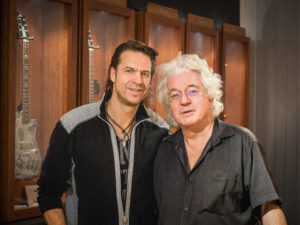
These days, “Three Steps Ahead” has become central to how Duesenberg presents itself, and Renner is refreshingly candid about what that actually looks like day to day. “For visionary people, that kind of thing feels quite normal and doesn’t really seem particularly remarkable. Ideas come to me the way melodies come to a songwriter, and that’s simply ‘my normal,'” he says. “I have fantastic teams in Hannover and Varaždin. There are visionaries there as well, and they increasingly bring their own ideas and perspectives into the company. For quite some time now, it hasn’t just been Dieter and Ingo. One of our ‘Three Steps’ has always been to involve other people, so that Duesenberg can continue to evolve and doesn’t one day have to come to an end with Dieter and me.”
Looking back at everything from those early parts-shop days to where Duesenberg sits now, Gölsdorf offers a piece of advice he’d give his younger self without hesitation: “Keep an eye on the money, spend even more time and patience on developing new things and don’t forget making love and drinking Cava.”
For local Duesenberg enquiries, visit Amber Technology.