We spoke to production manager Aiden King about how TISM's most ambitious show yet came together at Melbourne's PICA.
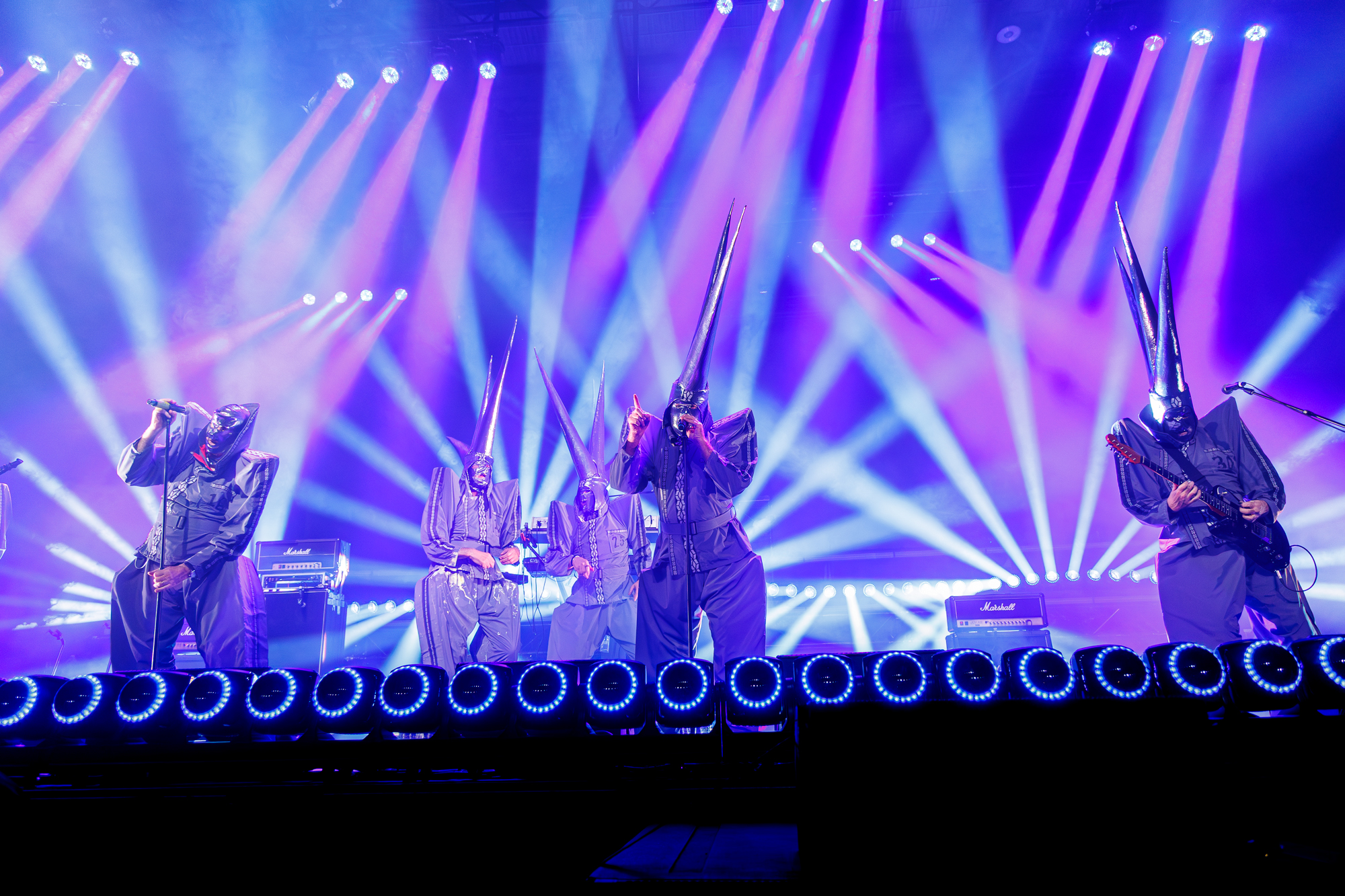
When two halves of the crowd face opposite stages while waiting for the headliner, you expect a bit of confusion. People look around, unsure which stage to focus on – and if you’re standing in the middle, you’re likely completely oblivious to what’s happening at each of the barriers. With the main stage lit up and ready to go, TISM inevitably takes their place on the second, smaller stage.
Despite the initial uncertainty, the crowd does what TISM crowds do: they boo, they chant “TISM are wankers” – something of an endearment for the enigmatic Melbourne band now very much resurrected from the ashes.
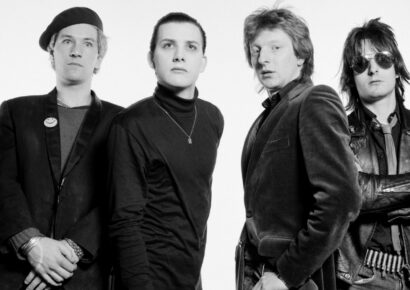
TISM are no strangers to the Australian music scene. Formed in Melbourne in the mid-’80s, the band are known for absurdist humour, sharp political satire and anonymity, guarded by their pseudonyms: Ron Hitler-Barassi, Les Miserables II, Vladimir Lenin McCartney II, Humphrey B. Flaubert, Jock Cheese, Eugene de la Hot-Croix Bun and Jon St Peenis II. They quietly went on hiatus in 2002 and came back just as quietly, with hush-hush headline shows under (more) pseudonyms and secret support slots. Their cult following stuck around and welcomed the TISM revival with open arms and loving insults.
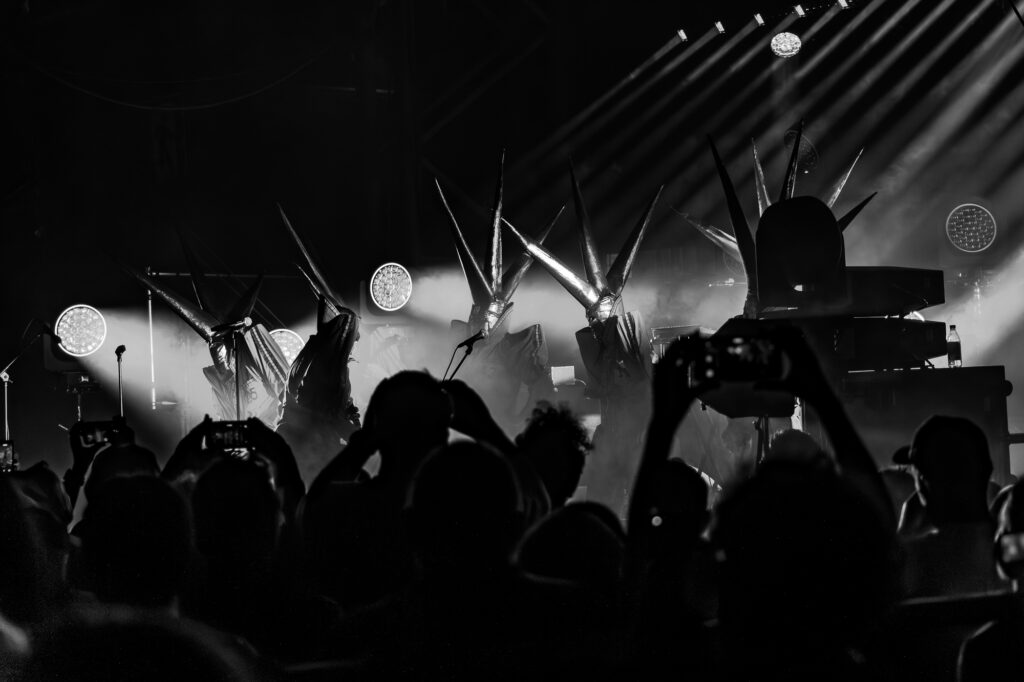
Photo: Rohan at Blowfly Photography
Catch up on all the latest features and interviews here.
There’s usually a level of secrecy to a TISM show, and that feeling was very much present at their one-off Melbourne performance, Wankers of the World, Unite!
The concept was TISM vs. TISM vs. TISM – a battle of the bands, except all bands are the same band. There’s also three independent stages, eighteen band members, three complete PA systems and three lighting rigs, all inside a single venue and all firing at once. I spoke with Production and Tour Manager Aiden King before TISM hit the stage – or should I say, stages – at Port Melbourne’s PICA.
“The idea of doing the three stages is something TISM did back in the 90s, but they felt they could do it better now,” he tells me when I ask where this idea came from. Aiden is referring to TISM’s legendary show at the Palace, which had two stages. This show, however, is on an even bigger scale.
“On paper, it’s just a ridiculous concept,” Aiden tells me. “But I guess that’s kind of why we’re at PICA.”
Pulling something like this off required the right room. “It’s the only blank canvas venue that isn’t an event space,” he says. PICA sits in an industrial pocket of Port Melbourne – a hardware store closed on weekends on one side, the Western Highway on another, and fields beyond that.
“The thing I’ve always loved when I’ve attended shows here is it’s amazing how loud it can get in here, and it’s still not a problem at the boundary.”
For a show designed entirely around three PA systems firing directly at each other inside the same room, that’s no small feat, and putting the show into action isn’t either.
“I sketched the layout, got it through the venue, which got it through the council, all those sorts of things,” Aiden tells me. “In terms of the physical lighting designs, that’s Bryce Mace – he’s the lighting director. He did all the design on that side, and then Front of House Productions, who are the in-house audio supplier, took our brief and came back to us with the design. Both departments have been an absolute pleasure to work with – as a production manager, I was made comfortable enough to lean on them for most of it.”
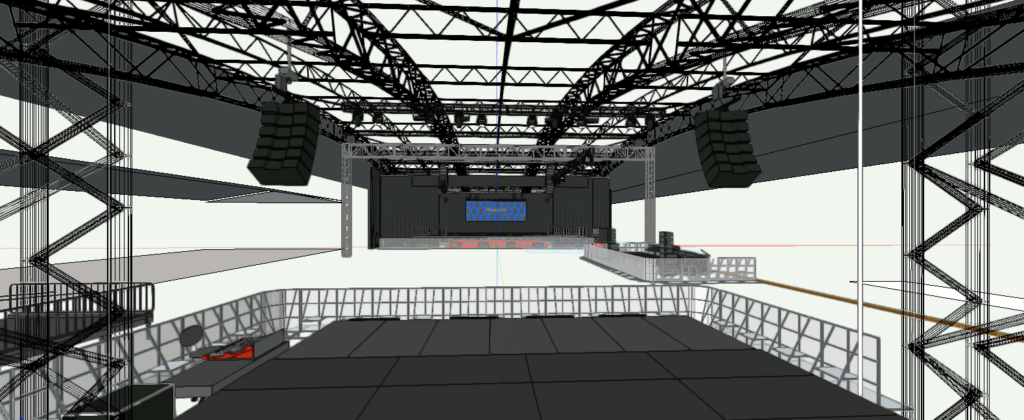
Front of House Productions did the CAD drawings for the entire layout, which meant the team had a virtual understanding of the space before setting foot in it. Issues could be ironed out with suppliers before the trucks left the warehouse.
The original venue capacity sits around five and a half thousand, but once the footprint of three stages was factored in, that number had to drop pretty significantly.
“They came back to us and said we can fit three and a half thousand.”
That meant a full redesign. Stage three moved to the other side of the room, and the bar closed off to reclaim floor space.
Designing crowd barriers for a three-stage show with no fixed focal point has to have its own logic. “I’m less worried about the traditional rationale for a punter barrier, as TISM fans are relatively low risk. However, TISM band members are a bunch of cut snakes who display fairly high-risk behaviour – so the punter barrier is one of the safest methods to launch from. As I’m always told, you can’t plan these things.”
Every fan who made it to PICA would agree that all the work was worth it. The show is designed to disorient, and disorient it did. The main stage is lit and dressed and waiting, drawing the crowd’s attention – and then TISM walks out on stage two.
“There’s a song where they’re playing two songs at the same time, one with a three-second delay – and then there’s one where all three stages are playing different songs at the same time.”
Aiden says hearing this for the first time during soundcheck is basically how you would describe anxiety, followed by “it’s something I never want to hear ever again.” Which, of course, makes me want to hear it more. It’s chaotic, bizarre and very TISM.
“It’s like a train crash, but if you actually just sit there and don’t try to listen to the train crashing, and instead think ‘this is a train crash’, then you can let the wave crash over you.”
TISM has twelve guest musicians performing across five different versions of the band, all interchangeable and all still anonymous. Even in pre-production, more and more concepts kept arriving. The whole show required a specific kind of mental reset from the production side.
“It’s a lovely brief to be like: apply no polish. Only chaos, only confusion,” Aiden says. “This has been a really challenging one to walk into, for the fact of just deleting everything I’ve learnt about how to produce a show. It’s very much a blank canvas when it comes to production – which is like a production manager’s dream.”
The dream came with a brutal timeline. The venue hosted a separate event the night before, which meant Aiden and the crew couldn’t get back in until 7am. Doors were at 2pm. For a show this elaborate, that’s tighter than tight. In that window, two additional stages were built from scratch, two lighting rigs programmed, and a decent soundcheck squeezed in.
“I’ve managed festivals before. This is more production than a community festival with seven stages.”
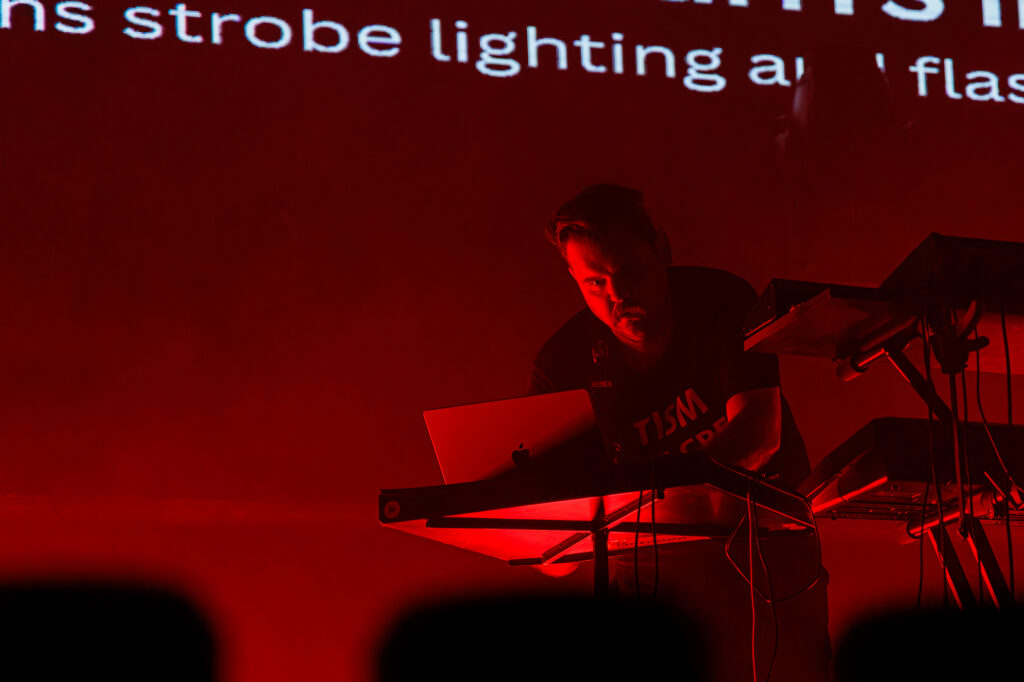
When I ask whether the brief of total chaos takes the pressure off, Aiden is pragmatic.
“For every problem that popped up and needed to be fixed, you can basically just go – well, that’s the concept. If the brief is chaos, you’re going to get chaos problems.”
To make it work, decisions that might otherwise have been made weeks out had to be made in real time. The console setup was one of them – originally an S6L at front of house alongside two DiGiCo SD10s running the venue stages, and nine consoles across the three positions at one point. It didn’t survive contact with the bump-in.
“Ali Smith (FOH) ended up ditching the S6L, mostly because the returns needed to go everywhere. The count was just getting ridiculous,” Aiden explains. They stripped it back to six consoles, two per stage. This meant less flexibility and less room for error, but critically, less time to check and troubleshoot before doors.
The stage setup alone presented its own set of obstacles.
“They have only just introduced in-ear monitors to four of the members,” Aiden says. “Stage volume dropped. For this show specifically, in-ears weren’t just a comfort measure – they were structural. If you’re playing on a stage and you’ve got another stage firing back at you – it’s a nightmare.” With three PA systems pointed at each other across a single room, wedge monitoring is a spoon in a knife fight, on top of all the abnormal reflections.
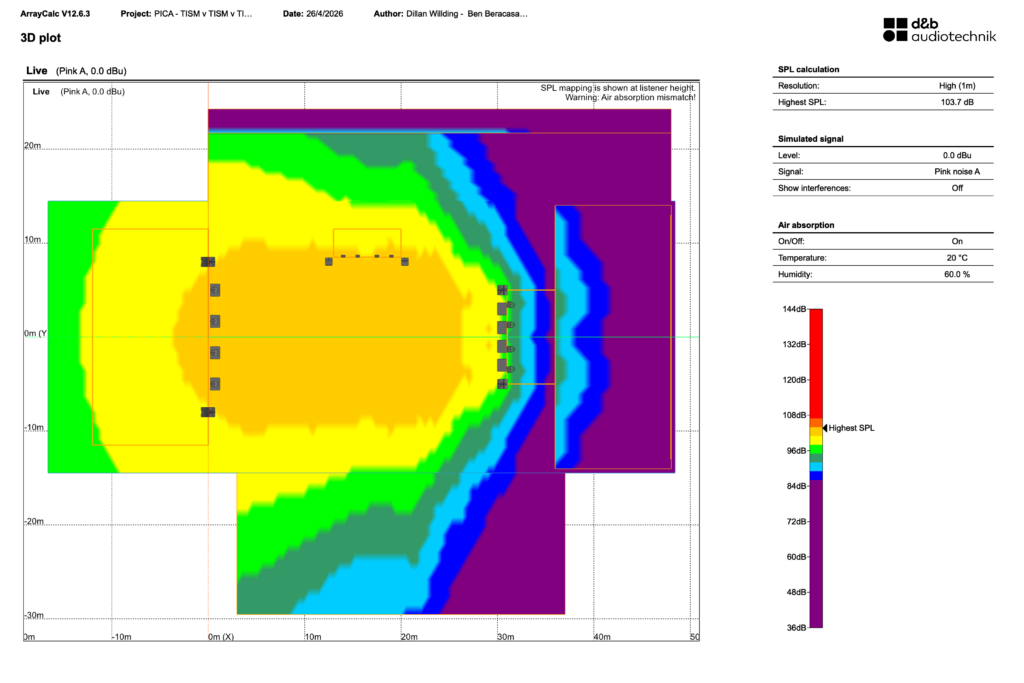
Accounting for all of this from the ground up fell to Front of House Productions’ Head of Audio and System Designer Dillan Willding, with Systems Technician Benjamin Beracasa handling deployment and optimisation on the day. In Dillan’s words:
“Deploying three PA systems all firing toward one another within the same venue created a series of immediate and obvious challenges. Fortunately, as a d&b audiotechnik production house, we had the right tools available for the task.
A fortunate starting point was the venue’s existing d&b audiotechnik KSL System installation, which effectively solved Stage 1 from the outset. The next challenge was designing the remaining two systems. The venue itself introduced additional complexity – essentially functioning as a large tin shed – meaning uncontrolled low-frequency energy and excessive reflections could quickly become problematic. To minimise the venue structure rattling while maintaining clarity and impact on the floor, we focused on deploying systems that concentrated as much energy as possible toward the audience area while reducing spill and reflections throughout the room.
Taking those factors into account – alongside weight restrictions and the need for cardioid behaviour – deploying a second d&b audiotechnik KSL System for Stage 2 became the obvious solution. Stage 3 introduced another set of challenges, again driven by time constraints, noise management requirements and the previously mentioned rigging limitations. We needed a system with a small physical footprint while still delivering comparable sonic characteristics, clarity and output power. Given the available inventory, a ground-stacked d&b audiotechnik V-Series system became the ideal deployment choice.
Finally, due to space limitations within the venue, the mix position ultimately had to be located behind Stage 3. To compensate, d&b audiotechnik Y7P loudspeakers were deployed as a nearfield reference system, providing the front-of-house – or perhaps side-of-house… rear-of-house – engineers with a monitoring environment that closely matched what the audience was experiencing across the room.”
Aiden notes that throwing this hugely ambitious show in his hometown of Melbourne helped enormously. “I’ve been doing this for 15–17 years. A lot of these suppliers I’ve known since day one. So I can twist some arms.”
“If I were to go and do this in Japan or India, where I don’t have those trusted suppliers, I would be very, very nervous”
The timeline was intense on paper, but Aiden had a trick up his sleeve. The team came in on the Sunday before the show to hang and time-align the PAs, then packed everything down, loaded it into the truck and stored it until bump-in day. No one from the TISM camp was present for the first hang – it was Front of House Productions making sure the systems were tuned, time-aligned and sounding good before the chaos of the actual bump-in began.
“Even though we had a limited six-hour bump-in, we’ve actually done like a ten-hour bump-in because we did a portion of it last weekend.”
All up, the show required seven semi-trailers worth of production for seven or eight hours of show, in a venue that already exists. ‘Pretty silly,’ Aiden admits.
This is no standard show, yet soundcheck had to be short and sweet. “Nothing more than the hour,” Aiden says. Between council compliance, barrier placement and the reality of three stages being stood up in a matter of hours, the luxury of multiple soundchecks wasn’t on the table.
Aiden is clear about the sustainability of a show like this. “We can’t do this over and over again. This is a terrible idea.” But that’s also what makes TISM shows what they are – a one-shot-kill with a high-quality history.
“This is the sort of environment where I can actually ask for all these favours and lean heavily on suppliers – I know that the relationships are super important.” That extended to the venue itself. The volume of communication with venue manager Jason Rooney in the lead-up would have been unusual on a typical show, but this wasn’t a typical show. “I’ve worked with Jason for 15 to 20 years, shoulder to shoulder at many gigs. He’s sort of been the brains behind all the production here.”
Beyond the professional investment, everyone involved wanted to be there. “Everyone’s a huge TISM fan. Everyone just wants to be a part of it.” The emotional stakes ran alongside the professional ones in a way Aiden says is rare. “Even the big dogs of the production world are now reaching out and checking in.”
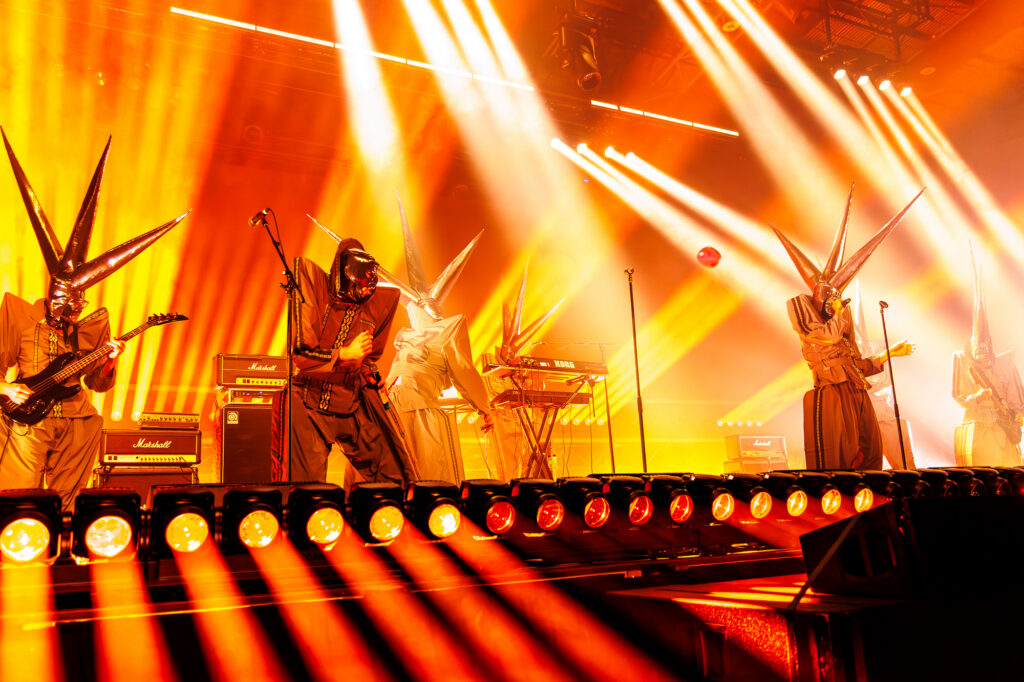
Photo: Rohan at Blowfly Photography
For a band that spent years on hiatus, the gravitational pull they exert on the Australian production industry says a lot.
“It definitely feels like, even for me, TISM are becoming that sort of band that is like a production level of excellence.”
Before the show, Aiden told me he’d be a different person once it was all done. The week after, he describes opening his laptop to a bit of an absence of dopamine. Anyone who works on or plays gigs knows the post-show blues.
What impressed him most was the sound. For a room essentially functioning as a large tin shed, with three PA systems going at once and overlapping songs bleeding across the floor, the KSL systems held their own. “We didn’t even really need to monitor the boundaries.”
The only stress of the day, surprisingly, had nothing to do with the concept. One of the band members emulates a vintage poly synth through Logic MainStage as a duplicate rig for the multiple stages, and during line check, it wasn’t making any sound.
“I’ve never even touched his laptop before,” Aiden says. With about a minute to go, he got in and started checking I/O, running through the usual troubleshooting steps as we are seconds away from showtime. “Fortunately, all it was – there were 17 autosave sessions open, all cancelling each other out, which was an easy fix and the final piece before green lighting the show”.
Asked what he’d do differently, there’s really only one thing: “I didn’t foresee that the emergency exit doors would be wide open, so you could see their 3ft tall headpiece silhouettes walking past from stage to stage.” For anyone already looking in the wrong direction – which was most of the crowd, since there was no real right direction – the mystery of where TISM would appear was only slightly compromised.
Everything else ran to plan. The moment all three stages needed to fire simultaneously was signalled by a visual cue: each stage raised its hand, confirmed over the radio, and all three fired at once. “That all landed perfectly.”
There were fans in the crowd running between stages trying to catch every version of TISM. It was, as Aiden describes, “smoke and mirrors” in the best and most TISM way possible. He had brought along some friends from New Zealand who’d seen an earlier TISM show and weren’t particularly sold. He convinced them to come to this one. “They were like – that was the top three performances I’ve ever seen in my life.”
“A band like TISM to do this to people’s eyes and ears – it’s such a crazy concept,” Aiden says – and I have to say, my eyes and ears were lucky to catch it.
Fortunately for you, if you feel like you missed out (you did, sorry), TSIM (yes, TSIM, not TISM) are set to do their first national tour in over 30 years.
TSIM No Mistakes tour dates:
- Friday 10 July – Adelaide Beer & BBQ Festival
- Saturday 22 August – Darwin Festival
- Wednesday 7 October – Forum, Melbourne
- Thursday 8 October – Forum, Melbourne
- Saturday 17 October – Fortitude Music Hall, Brisbane
- Wednesday 21 October – Canberra Theatre, Canberra
- Saturday 24 October – Metro City, Perth
- Friday 30 October – Enmore Theatre, Sydney
- Saturday 31 October – Enmore Theatre, Sydney
Grab your tickets here.