Guitarist Bill Kelliher takes us inside Mastodon's new album Marrow Deep, their first since the death of Brent Hinds.
There’s something reassuringly old-school about the way Bill Kelliher describes writing a Mastodon record. In an age where songwriting can involve laptops, production teams and endless digital possibilities, Kelliher’s process still begins with the simplest possible building block: a riff.
“It just all starts out with riffs,” he tells me. “It’s just riff after riff after riff after riff, and then it’s sort of throwing them at the guys.”
His phone is packed with them. So are his Pro Tools sessions and hard drives. Some start as half-remembered ideas hummed into his phone before bed, only to be rediscovered the next morning with the inevitable reaction: what the fuck was that? Others grow into something substantial through the back-and-forth of rehearsals and recording. The important thing is that Kelliher doesn’t seem particularly interested in deciding whether an idea is good or bad too early.
“I never judge anything until we’ve got all the lyrics and vocals on stuff,” he says. “So I’m always very optimistic about every song and every riff.”
Catch up on all the latest interviews and features here.
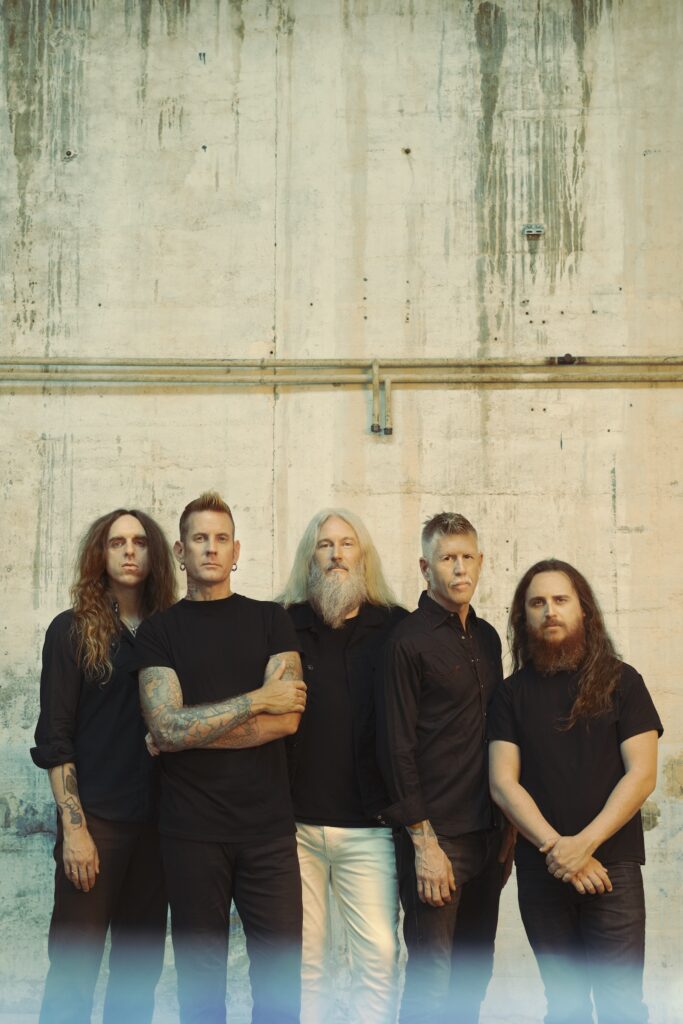
Photo: William Lacalmonite
That optimism seems particularly appropriate for Mastodon’s forthcoming album, Marrow Deep, which Kelliher describes as a major undertaking after the longest gap the band has had between album cycles, and the first since the death of founding member Brent Hinds. There was a lot of material to sift through, but that abundance is part of what makes the process work.
Kelliher compares it to the Earth cooling, or the ancient supercontinent Pangaea before everything began separating into individual continents. He’ll bring in an enormous mass of riffs, and then he and drummer Brann Dailor begin figuring out which pieces belong together.
“By the time that Brann gets in with me and we start parsing off, like, okay, this goes with that, this goes with that, all of a sudden it’s like, hey, we’ve got fucking songs.”
That process is beginning to evolve, though, particularly with the arrival of guitarist Nick Johnston. I’ve known Nick for years, going back to my time working with Seymour Duncan when Nick was part of our video demo team, so I was particularly interested in hearing how his distinctive voice had found its way into the Mastodon machine.
Kelliher admits that, on this album, much of the writing was already well underway when Johnston joined. But there are already glimpses of what the future might hold.
Nick and keyboardist João Nogueira have increasingly become part of the creative conversation, rather than simply adding colour to songs that have already been written. Kelliher describes Johnston as someone with a huge reserve of ideas who nevertheless approaches them with characteristic humility.
“He’s such a unique player,” Kelliher says. “And he has such a unique sound.”
That difference is valuable in a band where Kelliher has traditionally been one of the principal riff generators. He describes himself as an entirely unschooled musician, and there are moments on the new record where Johnston and João have been able to take a relatively straightforward idea and look at it from a more theoretical or compositional perspective.
Kelliher jokingly refers to himself and the other riff-driven members of the band as “cavemen” who are essentially feeding on riffs, before passing an idea over to the more musically inclined members of the group.
You can hear that approach in tracks such as ‘They’re Coming for You’, while ‘He Goes to Ghost Again’ and ‘Poisonous Weapons’ also feature sections where Johnston and João helped reshape or expand Kelliher’s original ideas. On ‘Three Fates’, meanwhile, the trio’s extended trading of parts at the end of the album became something Kelliher simply couldn’t bring himself to cut.
“At first we were thinking, wow, that’s fucking badass, but it’s too long,” he says. “But the more I listened to it, I was like, nah, fuck that. Every single note is amazing.”
Another highlight is ‘Moth and Bone’, a haunting, textural piece that began with Kelliher writing on acoustic guitar in an unusual tuning following the death of Dailor’s mother. Producer Patrik Berger helped expand the song into something considerably more adventurous, with delayed guitar and keyboard passages weaving around Kelliher’s original acoustic foundation.
It was also the first time Kelliher experienced such immediate songwriting chemistry with another guitarist. “I’ve never really had this with another guitarist,” he says.
And then, inevitably, the interview gets to the part where two guitar nerds stop pretending we’re talking about anything else and start talking about gear.
Kelliher used his familiar collection of Gibson and ESP guitars, including his ESP Viper baritone, several Les Paul Customs and an ESP Ron Wood. The ESP is one of his secret studio weapons, often doubled with a humbucker rhythm part to add extra midrange and twang.
Amplification came from his Friedman amps, an old JMP used on Leviathan, a Silvertone and a Fender Vibro-King. He also discovered the joy of a Hiwatt for the first time on record, using it for the clean parts of ‘Ruins’.
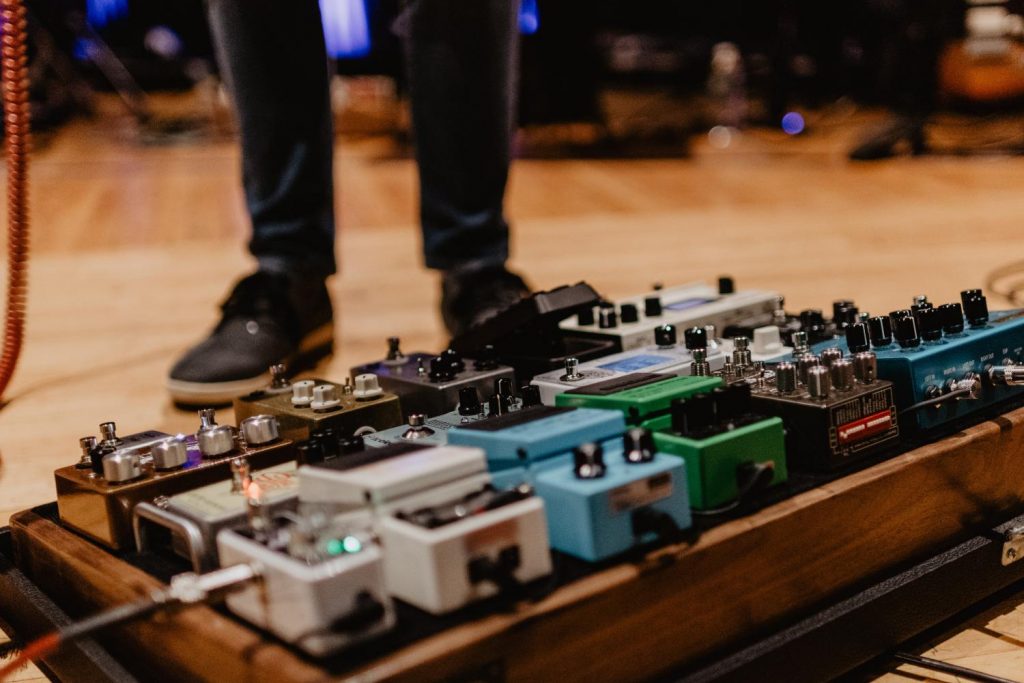
But perhaps the most revealing part of Kelliher’s approach is how brutally simple he likes to keep his signal path. He wants the guitar to sound like the guitar, rather than some heavily processed approximation of it.
“If I’m in control, I do,” he says. “I want it to sound more raw, like the way it sounds when I put my ear to my own speaker cabinet.”
That pursuit of rawness seems to sum up the whole Mastodon process. Start with riffs. Throw them at each other. Follow the interesting paths. Keep the weird parts. And when something sounds alive, don’t overthink it.
Sometimes the best way forward is simply to trust the riff.
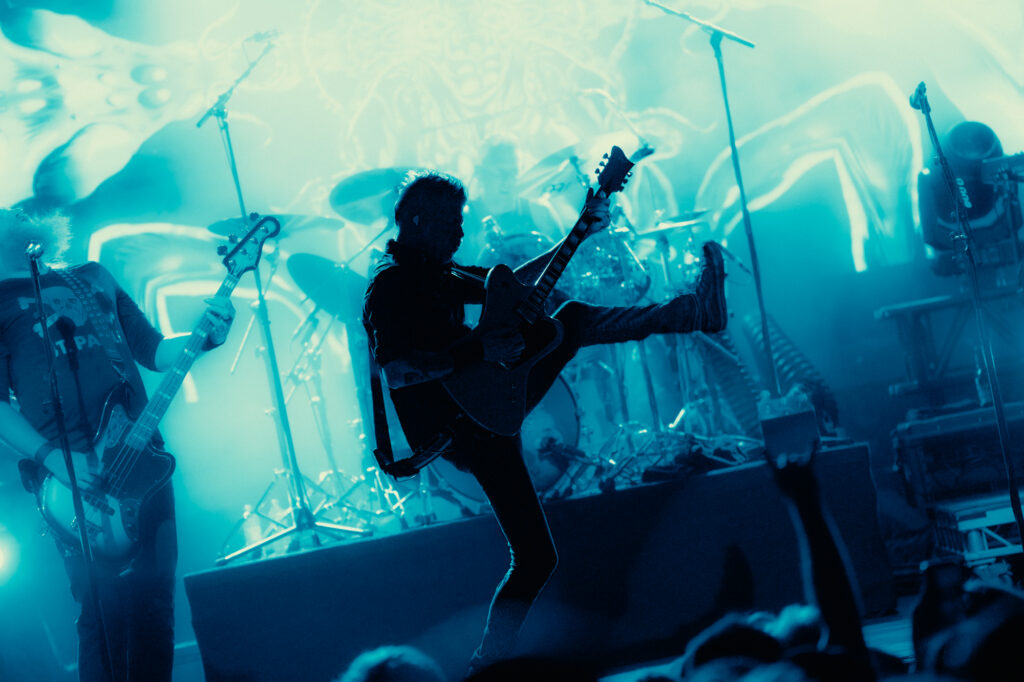
Photo: Errick Easterday
Marrow Deep is out 28 August via Loma Vista Recordings.