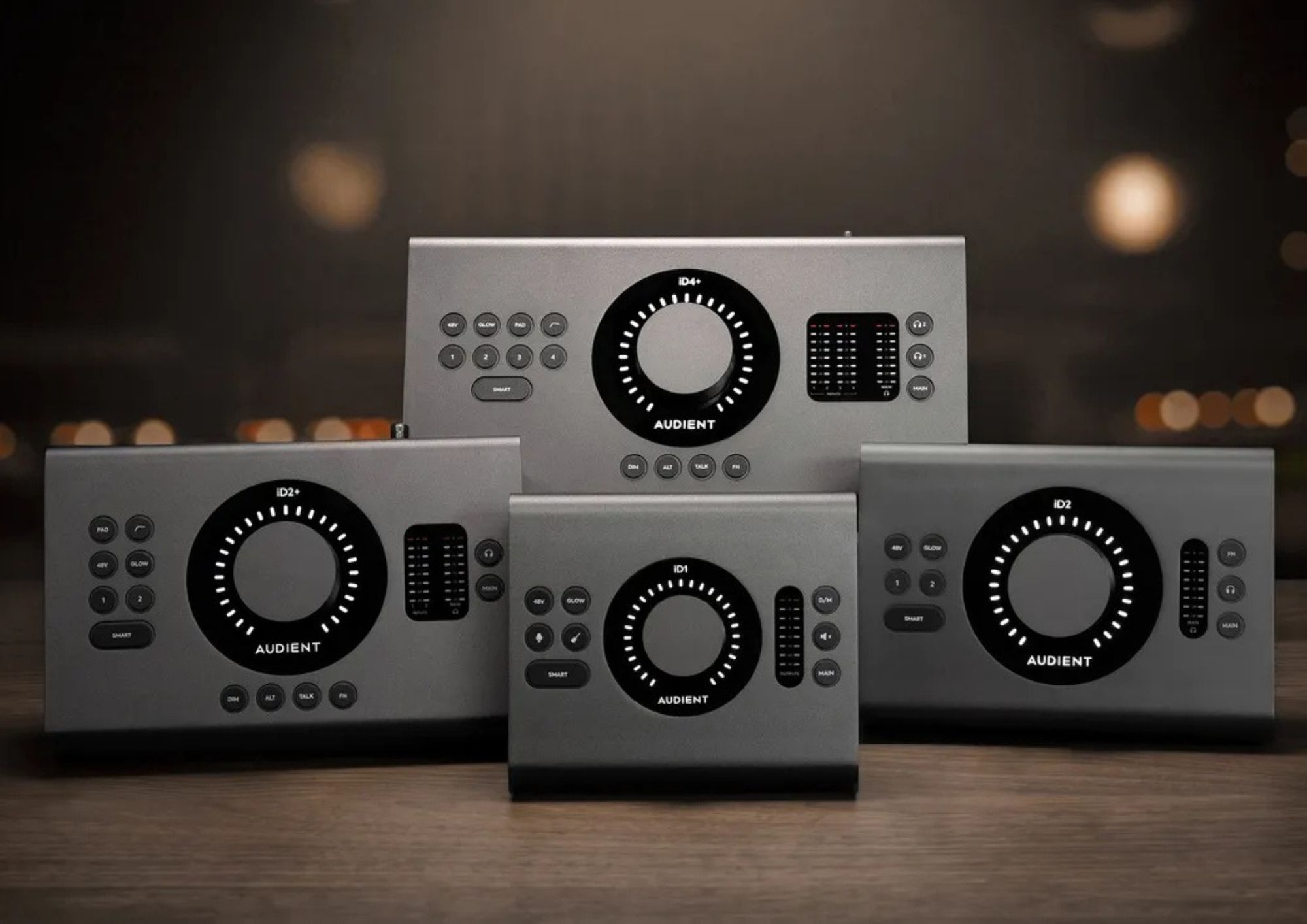
The third-generation desktop interfaces pair console-derived preamps with onboard DSP, RoomTune monitor correction and a new Analogue Tone Suite across four models.
Audient has rebuilt its iD desktop interfaces from the ground up for their third generation, adding onboard DSP, built-in room correction and a set of analogue tone controls to the console-derived preamps the range made its name on.
There are four models, renamed by how many mic preamps each one has, and every one replaces an existing interface. The iD1 takes over from the iD4, the iD2 from the iD14, the iD2+ from the iD24 and the iD4+ from the iD44, with the plus models adding balanced hardware inserts, ADAT output and more advanced monitor control. All four are bus-powered over USB-C.
Catch up on all the latest news here.
“With the next-gen iD range, we’ve built a range around four things most interfaces in its class can’t offer: real analogue preamps, built-in RoomTune™ Monitor Correction, onboard DSP FX and a discrete Analogue Tone Suite,” says Audient Chief Product Officer Andrew Allen. “This isn’t a spec refresh – iD is a completely new technology platform built on our Analogue Intelligence Platform.”
RoomTune is the biggest addition. It measures your room and adjusts the signal going to your monitors to compensate for its acoustics, with the correction stored on and run from the interface’s DSP, so it applies to everything coming out of the speakers rather than only inside a DAW. Calibration needs Audient’s RM1 reference mic, which comes in the box with the iD2+ and iD4+ and is sold separately for the two smaller models, and headphone correction is due in a future update.
The preamps still use the discrete Class-A design from Audient’s ASP8024-HE console, now with up to 75dB of gain, while the Analogue Tone Suite changes the preamp’s character before conversion. Orbit Control, borrowed from the Horizon range, adjusts the preamp’s impedance to change how a mic sounds, HMX adds harmonic saturation, LIFT adds high-end sheen and GLOW combines the two. The DSP also handles EQ, compression and reverb on the inputs with no latency and no load on your computer.
At a glance
- 32-bit conversion with 128dB dynamic range, up to 192kHz
- Smartgain automatic level setting and digitally recallable preamp settings
- iD1: 2-in/2-out, one preamp and a JFET instrument input
- iD2: 10-in/6-out, two preamps, ADAT in and two speaker outputs
- iD2+: 10-in/14-out, two preamps, two hardware inserts, eight channels of ADAT in and out
- iD4+: 20-in/24-out, four preamps, two instrument inputs, two inserts, 16 channels of ADAT and two headphone amps with up to four cue mixes
The iD2, iD2+ and iD4+ are available now, and the iD1 follows in early 2027.
For more information, head here