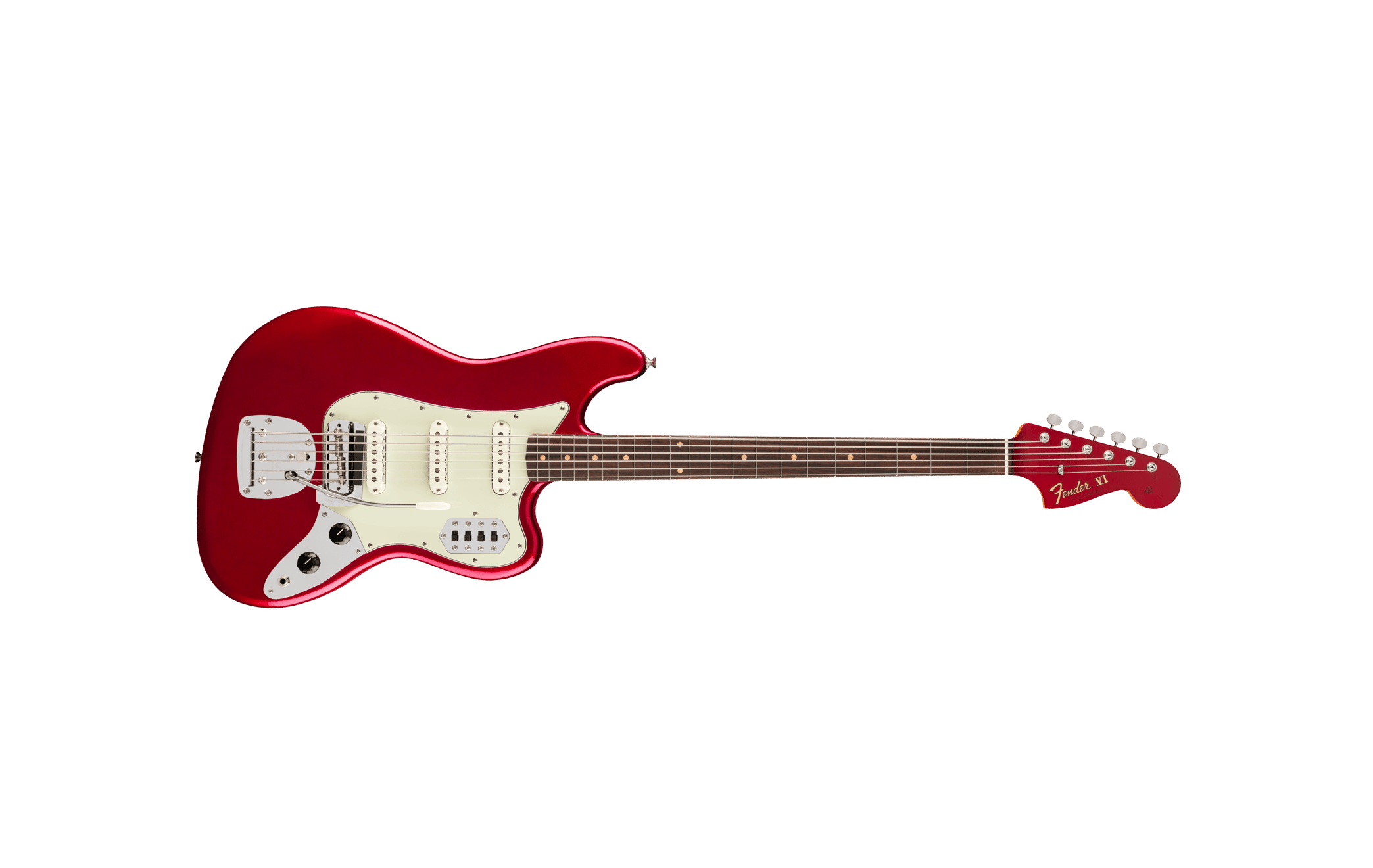
From the moment I lifted it, I knew I was handling the prestige of an instrument in a league of its own. So different yet so familiar, the Fender Vintera III Early ’60s Bass VI looks like what you’d get if an alien civilisation tried to reverse-engineer a guitar from a blurry broadcast signal, then built it to survive the journey home.
Alas, the original Bass VI was an earthly invention – but in 1961, when Fender first introduced it to a world hungry for deeper tones, it must have felt just as alien.
Catch up on all the latest reviews here.
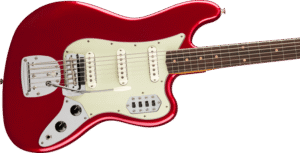
This particular Vintera III Early ’60s Bass VI comes in a slick Candy Apple Red, the offset body a clear nod to its Jaguar and Jazzmaster roots. It caught the afternoon sunrays with its warm, uranium-white tinted plate detail that reads as unmistakably faithful. One, of course, doesn’t need eyes to tell this is a Fender; their philosophy has always been that form follows function, and that’s tangible in every way. The hardware sits flush, the controls are solid underhand, and they reserve any roughness for the incorporeal character.
At a balanced mid-range weight of 4.4kg, it’s substantial enough to feel serious without fatigue creeping in over long sessions. The alder body pairs with a maple neck and a 7.25″ radius round-laminated rosewood fingerboard dotted with classic markers, all of it replicating the look and feel of an early-’60s Fender with conviction. The early ’60s “C”-shaped neck scoop is smooth and immediately familiar to anyone who has spent time with vintage Fender instruments – one of the most ergonomic profiles out there.
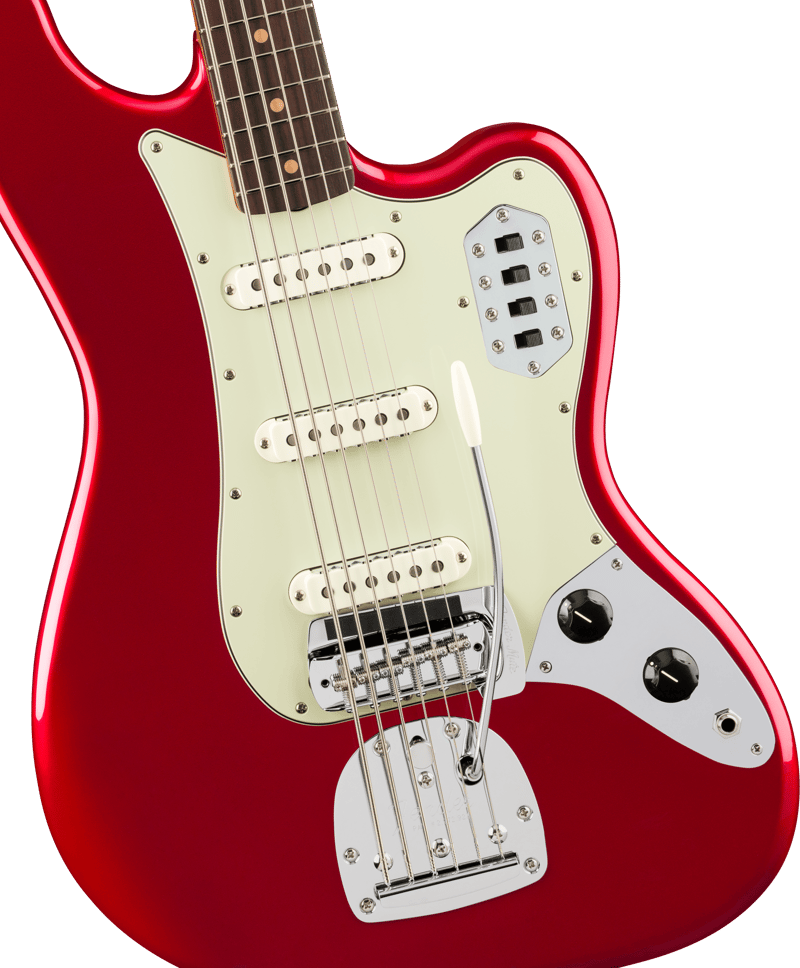
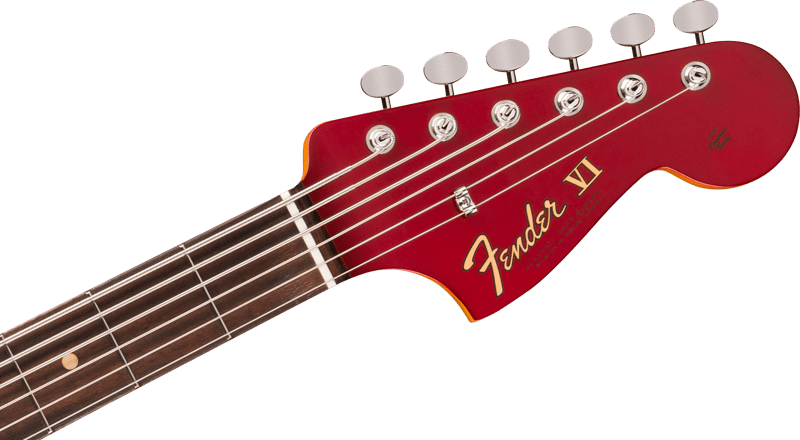
The addition of vintage tall frets adds a slight lift that improves precision and gives bends a more responsive feel. Throw in a vintage-style floating tremolo and a sizable whammy bar, and you’ve got the entire spectrum of frequencies to sweep through with both hands. Locking in the foundations are the era-accurate 1″-wide tuning machines and bridge controls, offering finer pitch accuracy and intonation adjustment than most modern alternatives.
So it’s a bass with some extra strings, right? Not quite. I wouldn’t call it a baritone guitar either. Tuned just one octave below a standard guitar across six strings, it turns that identity ambiguity into its greatest strength.
Strummed or plucked, the pitch range normally divided between bassist and guitarist suddenly becomes accessible to a single player.
The tone is simultaneously dark and jangly, precise and punchy, with satisfying resonance. It’ll accommodate whatever approach you take at first, but forces an evolution as your fine motor skills adapt. You’ll find yourself drawing on techniques from both guitar and bass, emerging approaches in service of something that neither player could pull off alone.
The toggleable Jaguar-style single-coil pickups deliver a broad array of caramel-ish responses, capable of staying clean and articulate at lower volumes or sizzling with a beautifully stressed character when pushed. ‘Djentle’ is the most appropriate term I can think of that frames the chug potential. Lava-like low-end attack would satisfy players coming from a modern metal context, while the twang sits high enough in the mix to cut through dense, progressive arrangements.
The Bass VI Mute bridge is no mere ornament. It’s the tool responsible for those classic tic-tac tones – that percussive, damped pluck heard across countless surf, spy and country recordings. Applying just the right pressure mid-performance is a technique that rewards time with the instrument. The sweet spot emerges the more you wear it in – and once it does, it’s deeply satisfying.
Want sub-redux? There’s the strangle switch. A high-pass filter built into the instrument’s original design, throwing a blanket over the low frequencies to let the top-end bite through with a distinct Bass VI sharpness. Try it out on a clean amp, and the instrument takes on an almost sitar-like character; add some grit to the signal chain, and you’ll understand immediately why this thing ended up in so many iconic recordings. It’s the sound you’ve heard without knowing what made it.
The Bass VI has always attracted the best of us. The Beatles used it extensively during the White Album sessions, and it can be spotted in the Hey Jude promotional film. Melissa Auf der Maur of Hole and The Smashing Pumpkins made it sing as a lead instrument, blurring the role of bass entirely. John Barry’s Bond soundtracks, the Cocteau Twins, Stefan Olsdal of Placebo – they each found in the Bass VI a tonal identity and expressive range that a standard bass or guitar couldn’t emulate.
For me personally, it’s Robert Smith’s use of the Bass VI across The Cure’s Disintegration that sits as the most resonant example of what it’s capable of: that low-register rattle underpinning some of the most emotionally devastating guitar phrases ever recorded. The Bass VI was hiding in plain sight – responsible for defining an atmosphere that shaped me long before I knew what was making it.
The Vintera III Early ’60s Bass VI is a loyal remake of a groundbreaking design, and I’d argue it is for everyone. For harmony-seeking bassists or guitarists looking to expand their role in a mix, it’s a martial aid. For producers, it’s a primary weapon equally capable of matching percussive blows or carrying complex melodic expressions in an unoccupied register.
Fender assures that every cent is justified by longevity, playability, spec accuracy and a proven personality. Some instruments make me change the way I play. This one made me rethink how I write.
Check out the Fender Vintera II Early ’60s Bass VI here.