Distributor: CMC Music | RRP: $2295
In the words of David Bowie, “whatever I’m doing won’t be boring.” The Bongo has been described as unconventional, and that’s not wrong by any stretch. Upon first look, this bass certainly isn’t boring – and that’s a compliment.
Having first landed at NAMM back in 2003, the Bongo was dreamed up by Ernie Ball’s Sterling Ball alongside Music Man’s R&D team and BMW’s Designworks studio. The brief was to ignore all the rules for what a bass should look and feel like, and some of the early concepts did just that. One wrapped around the player’s body to do away with the strap entirely, and the team even tested a “wood” made of compressed wheat that, by their own admission, sounded terrible. What ended up making the cut was a lightweight, ergonomic and unmistakably modern instrument, and the first Music Man bass to carry 24 frets.
It’s since earned its place as a favourite of players like Dream Theater’s John Myung. Until now, though, owning one meant paying premium American prices. Sterling by Music Man is Ernie Ball’s more affordable line, so this new version is a big deal. The release brings the Bongo to a far more accessible price point for the first time without losing what makes it special.
Catch up on all the latest reviews here.
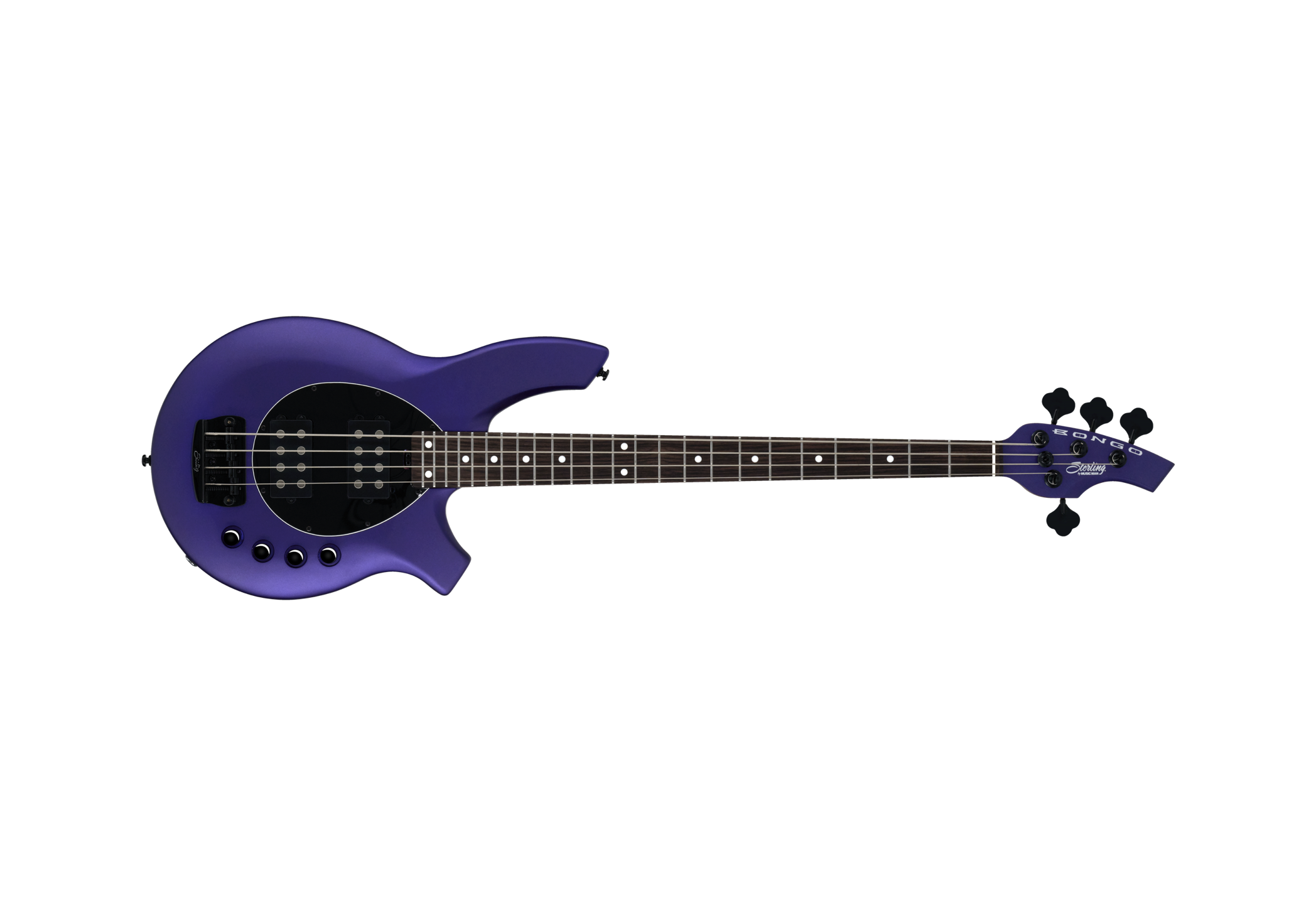
The four-string in Firemist Purple Satin is the model I had the chance to play. The finish is pretty eye-catching – a deep, matte purple that feels lovely in the hand and contrasts beautifully with the roasted maple neck. A black headstock and pickguard give it an unmistakable Music Man look. If purple’s not your thing, the Bongo also comes in a Stealth Black.
There’s a bit of weight to it, in a solid, reassuring way – the mahogany body feels like a real, sturdy instrument, not a toy. Contoured and deeply cut away, it’s comfortable to play seated or standing, with great access all the way up the 24-fret neck. It’s clearly been designed with ergonomics front of mind, which makes sense given who was in the room when it was thought up.
The roasted maple neck is smooth and fast, with a slim 41mm nut that makes it easy to move around, even at the top end. Straight out of the box, the Bongo comes strung with Ernie Ball Super Slinkys, which had a light tension and felt really smooth and lovely to play on.
Under the hood are two ceramic humbuckers, a pickup blend control and a two-band active preamp. The American original made its name on neodymium pickups and an 18V preamp, and while this Sterling take keeps things simpler, there’s still plenty of grunt. The low end is gorgeous – deep, warm, punchy and full – and the controls are laid out intuitively, so your fingers find their way.
The blend knob moves you between the two pickups, and the two-band EQ shapes things from there, so it’s quick to land on a sound that works. Each pickup has its own character. The neck humbucker is warm and round but still articulate, filling out the bottom of a mix, while soloing the bridge tightens and brightens things, with more punch and definition for cutting through. Somewhere in the middle is a full, even tone. There’s plenty to work with – fat and warm or clear and defined.
For its weight, the Bongo balances nicely on a strap, with no neck dive to speak of. Little touches like the six-bolt neck joint keep everything feeling solid.
If you’ve always wanted a Bongo, this is your moment. It’s comfortable, it sounds great, it’s well built and its aesthetic will earn you some street-cred points, for sure. Bold, ergonomic and silky smooth, the Sterling Bongo is one of the more distinctive basses out there, and for anyone after something with real character, it’s well worth a look.
For local enquiries, head here.