There's always been something a little supernatural about wireless audio.
Unseen signals drifting through the air, voices disembodied from their source, frequencies colliding and slipping past each other like ghosts in shared space. For years, engineers have been trying to tame that chaos, conjuring order from interference and clarity from the unseen.
With the EW-DX series, Sennheiser edges further into that realm – not just refining wireless, but attempting to master three things we’ve been chasing for decades: control over the spectrum, transparency of sound, and freedom of movement.
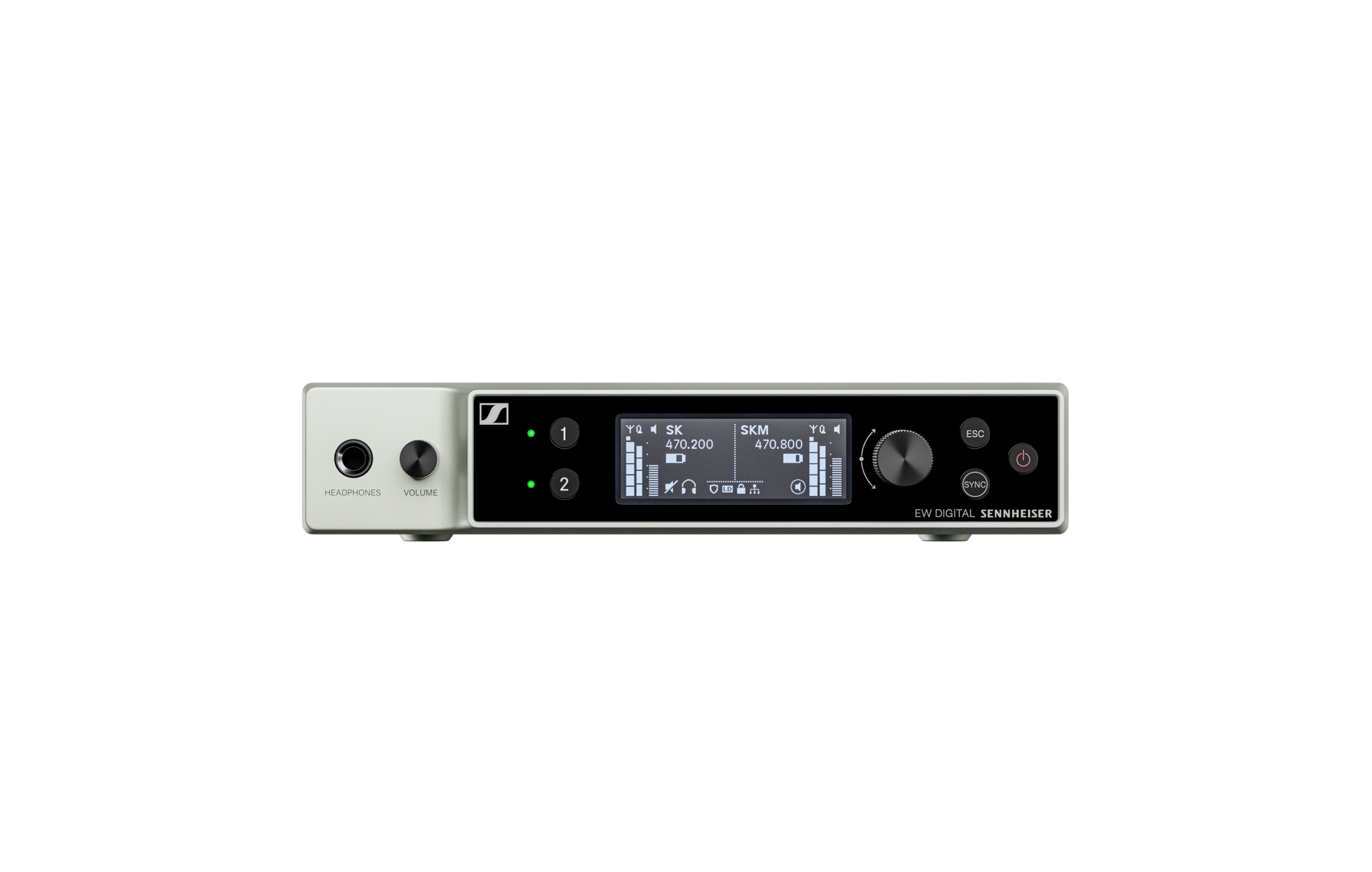
On paper, it’s a compelling ritual. Built around the Sennheiser EW-DX EM 2 Dante Receiver, the EW-DX SKM-S Handheld Transmitter, and voiced through the Sennheiser MMD 835 Capsule, the system promises to make the invisible not just audible, but dependable.
Catch up on all the latest reviews here.
First impressions
What I expected to be a lengthy, tutorial-laden unpack and calibration process was a seamless plug-and-play. The familiar, robust feel of the SKM-S transmitter quells novelty. Twist-locked with the MMD 835 dynamic microphone module and powered on, it instantly paired with the devilishly understated, dual-channel EM 2 Dante unit. I went blind menu-diving with its intuitive panel controls and quickly discovered intelligent sound, connection, and test settings that humbled my network engineering vocabulary.
“Fire,” I murmured into the capsule, over invisible airwaves, back to myself through my headphones with imperceptible latency. The initial clarity invited a vocal plosive and sibilant barrage, but for all my efforts, it never shattered.
Sound & performance
The EW-DX SKM-S with an MMD835 capsule carries a focused cardioid character with a presence lift – reliable in the best sense of the word. Switchable low-cut options run between 30–120Hz, and a digital audio trim of -12dB to +6dB in 1dB steps helps battle ambient reflections and a wide variety of vocal applications. Want a different character? Swap capsules. It’s one of the system’s quieter strengths. There are 14 different capsule variants from evolution all the way up to the professional range, including compatibility with Neumann.
Latency is handled very well here. With 88MHz of bandwidth at around 1.9 milliseconds, it’s effectively transparent up to 100 metres, unlikely to be perceived even when integrating into larger, typically headache-inducing signal chains.
Combine the wide dynamic range of 134dB with Sennheiser’s proprietary Performance Audio Codec (SePAC) and the system minimises the need for constant gain adjustments. Performers or speakers with wildly fluctuating dynamics won’t easily clip, and quieter moments translate without a creeping noise floor. It’s practically set-and-forget. I tried to break it at maximum +42 gain, but it just wouldn’t budge.
Smart features
This is clearly a workhorse tuned for consistency across a wide range of voices and venues. I booted up the companion EW-D app, synced with the unit, and within five minutes, it had automatically scanned for the most interference-free RF channels available. It’s a significant time-saver for multi-channel deployments, removing the traditional trial-and-error of wireless setups.
EW-DX wireless systems are available in 3 frequency variants in Australia: R1-9 (520-608MHz), S1-10 (606 – 694MHz) and the handy Y1-3 (1785 – 1800MHz) range, helpful in applications where you need a system completely away from the 520-694MHz region. These frequency ranges cover the entire Australian Free-to-Air spectrum and comply with ACMA regulations. For most users, the R1-9 band sits comfortably within a widely usable spectrum, making it a practical default.
The Dante difference
Here’s what truly makes this model a professional upgrade over similar standalone systems, including its more analogue-aimed sibling, the EW-DX EM 2.
It’s in the name ‘Dante’ (Digital Audio Network Through Ethernet), a protocol developed by Audinate enabling digital audio transmission and reception across a shared network. The potential is significant: you can daisy-chain wireless units, manipulate signal chains, and monitor link quality, battery status, and signal health remotely via networked devices.
For theatre productions, corporate AV, and broadcast environments, this level of oversight and expansion isn’t just convenient – it’s essential. And with AES-256 encryption on board, signal security is robust enough for government or corporate environments that can’t afford interference.
The EW-DX system is an investment. What separates the EW-DX EM 2 Dante from entry-level and mid-tier systems isn’t just build quality, but the depth of what you can actually do with it.
Features like Dante, PoE via the control port and remote management are powerful, and they do assume a certain level of technical literacy. For engineers already fluent in networked audio, that’s no obstacle – and for those still building that knowledge, the depth here gives you plenty to grow into.
The EW-DX carries an undeniable allure; Sennheiser’s ergonomic workflow design. With just enough twinkle in your eye, the EW-DX portfolio stops looking like just another wireless mic system and starts looking like a sandbox; something you can build around, expand, and bend to your will. For creatively inclined engineers, that’s the real draw – a system capable enough to reward wherever your imagination takes it.
To learn more, head here.