Distributor: Fender Music Australia | RRP: $4999
Fender has been so busy lately with guitar reissues, re-creations, reinventions and anniversaries that it would not surprise me to see a Fender-branded lyre in the next sword-and-sandal movie epic.
Fresh in the catalogue is another in the Fender Telecaster 75th Anniversary series of excellent guitars catering for diverse musical needs and at differing price points.
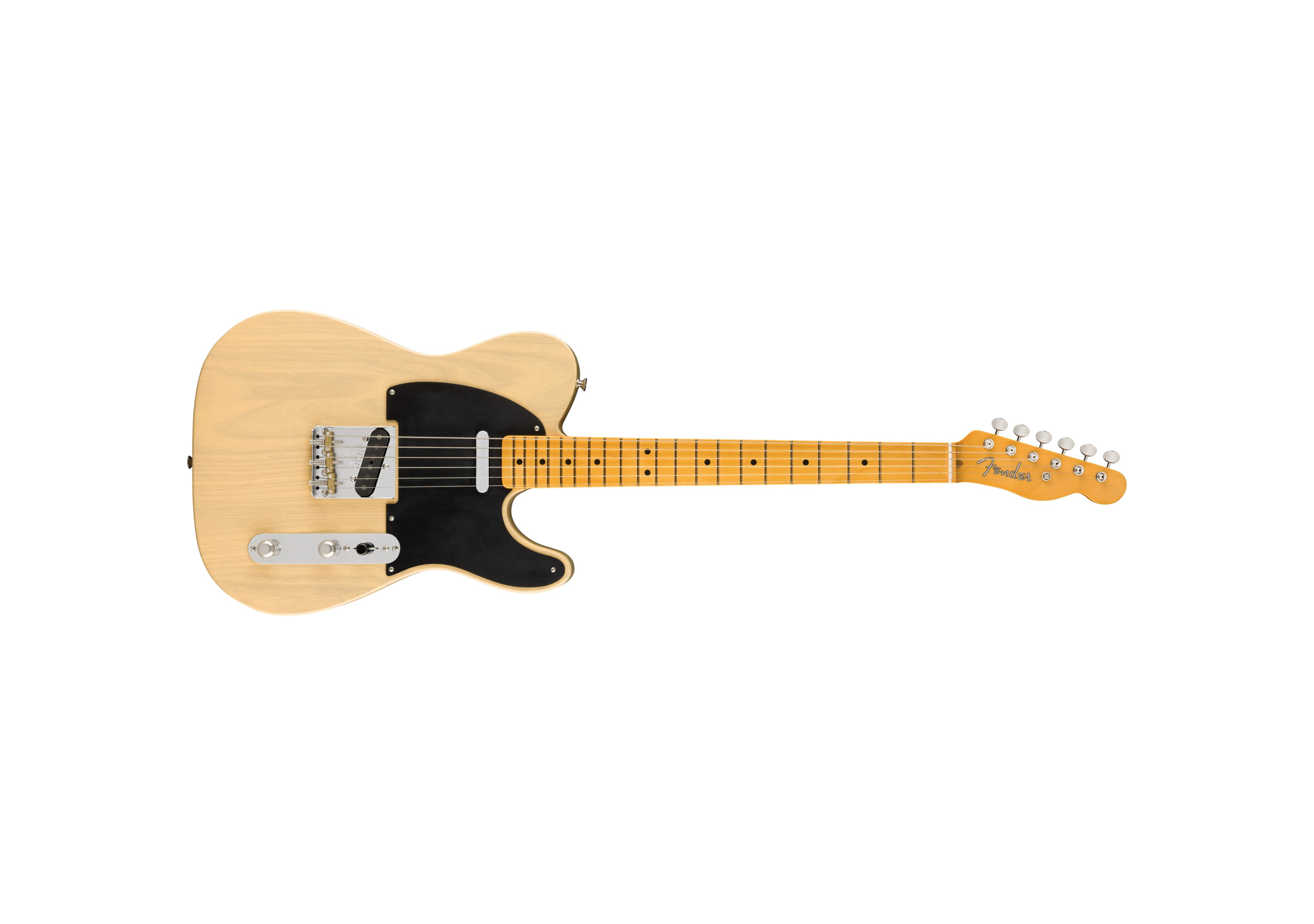
The American Vintage II is said to be an absolutely faithful-to-the-original 1951 blonde Nocaster, and I would have to say straight up that I could not put this guitar down once I started playing it at a session. Whatever its claims to authenticity, it just played great.
Catch up on all the latest reviews here.
First came the Esquire around June 1950 followed by the Broadcaster later that year. February 1951 saw the Broadcaster name withdrawn from the peghead due to legal threats from Gretsch over their similarly named drum kit. A month or two later – no-one seems sure of the date – it was rebranded the Telecaster, a name influenced by the popularity of TV. That batch with no name, collectors later called the Nocaster, which Fender subsequently trademarked.
A down-to-the-original-screws reincarnation is a bit tricky, though. Who, for example, would want the earliest truss-rod-less Esquires that kept being returned to the factory? The earliest two-pickup Fenders also had a tone knob that served as a blend function between the two pickups with a bass filter. This became redundant when the Precision solid body bass was introduced later in ’51. A friend and I both had ’52 vintage reissue Telecasters at one time and he kept that original circuit on his as a historical quirk. My own was modded to the standard we all salute: three distinct pickup selection positions, as does this Nocaster. Much more useful, despite not being quite as ‘authentic’.
Cosmetically, it looks fantastic, the maple neck complementing the blonde ash body, the grain of which is revealed through the ‘Heirloom’ nitrocellulose lacquer finish that looks naturally aged, without the synthetic ‘road-worn’ pretensions so common these days. It has many small authentic details such as the round string tree, the Fender Deluxe tuners, a flat pole pickup at the bridge, the one-ply black phenolic pickguard with five slot-head screws, knurled dome knobs, barrel-style switch tip, vintage strap buttons and even the attention given to the fret dots. It has the ashtray pickup cover and a good Fender tweed case.
We’re used to necks with a layered fretboard these days but this has a one-piece hard rock maple neck and it feels terrific. It has a 7.25″ radius fingerboard and vintage-tall frets that play easily and allow secure bends. It’s a ‘U’-shaped neck that feels momentarily strange if you’ve come off a modern ‘C’ shape, but it sits comfortably in the hand and has been so well smoothed as to be almost frictionless right up to the top notes.
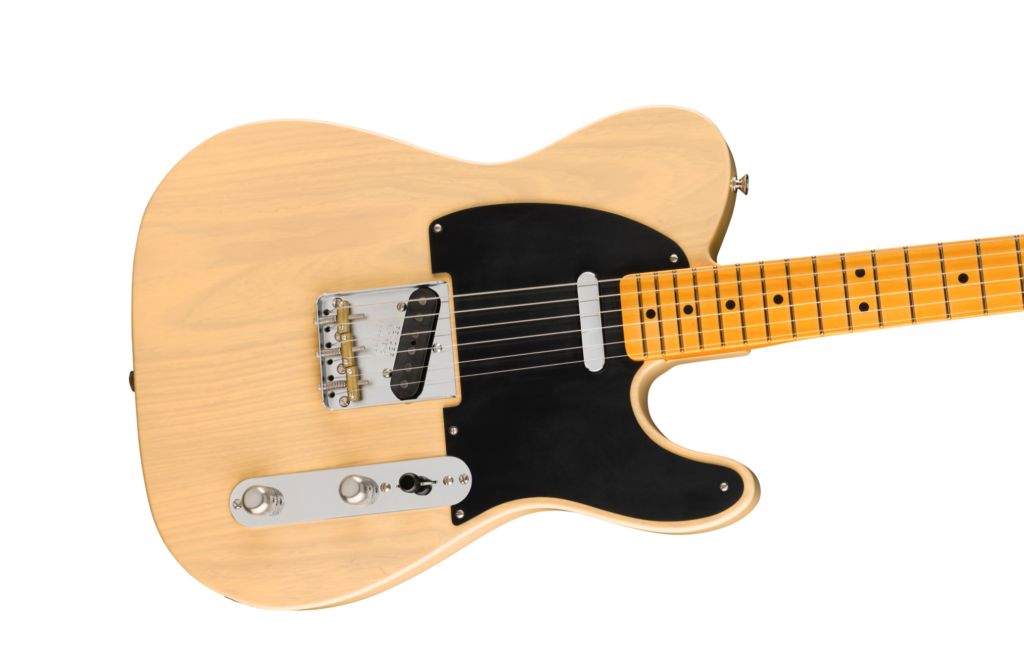
It’s a hefty neck and a somewhat weighty body at almost 7 lbs (around 3 kg) but, combined with the triple brass saddle bridge and a bone nut, it produced very musical acoustic sounds which always give me a small thrill of expectation before plugging in. No disappointment: there are classic Tele tones to be had.
The pickups are 75th Anniversary Blackguard single-coils and said to be period-specific, but whatever that means, these are truly glorious. The neck pickup is rich, deep and chiming; the bridge has spank and twang, but no icepick-y or thin tones up high. The combination sounds like a genuine amalgam, with noticeable evenness of volume when switching between them, an irritation on guitars with pickups that jump around in volume when switched.
I found rhythm strumming sweet and solid and the excellent note definition worked a treat for hybrid/fingerpicking. Digging in harder, there was grit and gristle for lead lines. All this before any pedals except for a little reverb. Add some dirt, push the amp and it roars. There are good reasons the Telecaster is found across most music genres and you won’t find too many limitations here.
It was only a few years ago that we had a period-correct ’51 Telecaster reissue, and there have been Custom Shop and Masterbuilt versions of the Nocaster, but this must be the first, albeit limited, production-line run under the (no)name. It’s interesting to compare some of the more innovative recent additions in the 75th Anniversary range to the very template for those decades of Telecaster production, a guitar that remains a fundamental electric instrument. Switching options, pickup variations and innovations, neck shapes, woods, colours, you name it. All good. Then have a play of the Nocaster, back to the basics of a no-frills guitar with three switching positions, a tone and volume control that just insists you make music and enjoy every moment of it. You feel the history in this Nocaster and you can sense what the earliest players must have felt as they adopted it so readily under the re-badged Tele moniker.
It’s expensive, of course; the detail and being a limited edition inevitably make it so, but it really is a superb instrument, looks great and plays great. A keeper. Go to your favourite shop and play one just for fun. But be warned: like me, you’ll have trouble putting it down.
Check out the Nocaster here.