Gear Rundown: Geese
Few bands have risen as quickly as Geese. The Brooklyn group formed in 2016 while its members were still in high school, rehearsing in drummer Max Bassin’s basement, and signed to Partisan Records in 2020. With 2025’s Getting Killed, they became one of the most talked-about bands in the world, with performances on Jimmy Kimmel Live and Saturday Night Live along the way, and they’ve now been announced as one of the headline acts for Golden Plains Nineteen, making their Meredith debut in March 2027.
It’s a fitting stage for a band whose songs refuse to sit neatly in one genre. Golden Plains is an independent, sponsor-free festival held on the Nolan family farm in Meredith, and with only one stage and no clashing sets, everyone on the hill will be watching the same band at the same time. Next year’s bill is as wide-ranging as ever, putting Geese alongside electronic pioneers Underworld, desert blues legends Tinariwen and Peter Garrett & The Alter Egos, and that kind of company suits a group that has made unpredictability part of its appeal.
Frontman Cameron Winter, guitarist Emily Green, bassist Dominic DiGesu and drummer Max Bassin have been a four-piece since guitarist Foster Hudson left at the end of 2023, with keyboardist Sam Revaz joining them live. Their sound mixes jagged guitars, driving rhythms and big keys, so here’s a look at what each member uses to get there.
Read all the latest features, columns and more here.
Cameron Winter
Winter’s main guitar is a modified Gibson SG Junior fitted with an extra single-coil pickup in the neck position, including a Lace Sensor. He runs it through a mix of amps, from the big, clean headroom of a Fender ‘65 Super Reverb to a smaller Vibro-Champ and the chime of a Vox AC30 Custom Classic, with a Keeley Compressor Plus keeping his tone even and punchy. A Roland GK-5 pickup and GM-800 guitar synthesiser add synth textures straight from the strings, and on vocals he uses an sE Electronics V7 dynamic mic. When he moves to the keys, his rig includes a Sequential Prophet-10 polysynth, a Nord Lead and a Nord Stage 4 88.
Emily Green
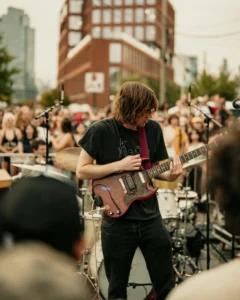
Green’s guitar of choice is a short-scale 1956 Silvertone Stratotone Newport, which she picked up at RetroFret Vintage Guitars in Brooklyn, and she also plays Reverend guitars. Her amps are Fender through and through, with a ‘65 Deluxe Reverb Reissue and a Hot Rod Deluxe both associated with her setup. Her pedalboard sits on a Pedaltrain Classic 2 and is packed with character, including a ZVEX Vexter Series Fuzz Factory, DigiTech Whammy, Pearl PE-10 Parametric EQ, Source Audio ZIO, JHS 3 Series Harmonic Tremolo and a Boss DD-5 Digital Delay.
Dominic DiGesu
DiGesu plays a Höfner 500/1 violin bass, the lightweight, hollow-bodied design best known for its warm, round tone. He’s left-handed and also plays a Fender American Professional II Precision Bass and a brown-finish Fender Jazz Bass. His low end comes from an Ampeg SVT-CL Classic head through an SVT-410HLF cabinet, while his pedalboard is loaded with a Tech 21 SansAmp Bass Driver DI, Electro-Harmonix Bass Big Muff Pi, MXR Phase 90, Boss SY-1 Synthesizer, Boss ME-80 and a Boss TU-3 tuner. He also plays LP Generation II bongos on the Getting Killed tour.
Max Bassin
Bassin plays a Ludwig Classic Maple drum kit and is an Istanbul Agop cymbal artist, using 15″ Xist Brilliant hi-hats, 22″ Mel Lewis and Traditional Medium rides, and a 20″ Traditional Original crash ride. Two Remo Roto-Toms sit alongside his regular tom for extra pitched colour. In the studio, his drum mics include a Sennheiser MD 421-II, Shure SM81 and a Coles 4038 ribbon.
For more information about Golden Plains, head here
Mike Stringer on Spiritbox’s tranisiton from bedroom moshers to arena headliners
A lot of people used the pandemic lockdowns to reset their lives; whether it was a career change, focusing on fitness, or expanding a skill set, the forced lockdowns at the start of the decade acted for some people as a circuit breaker of sorts.
For the genre of Metalcore, that circuit breaker was a crop of new and established artists taking things stadium-sized.
Read more interviews, columns and features here.
By the 2010s, the style was bogged down in a tried, tested, and tired formula of verse-breakdown-chorus-breakdown; the 20s saw the emergence of a wave of new metalcore that was leaner, chorus-driven, and more willing to lean on poppier sensibilities.
Canadian-based quartet Spiritbox were at the forefront of this exciting new wave; emerging from the ashes of mathcore weirdos iwrestledabearonce, husband and wife duo Mike Stringer (guitar) and Courtney LaPlante (vocals) founded the project in 2017.
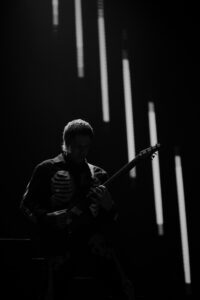
For its first couple of years, the band existed as a mostly online entity; however, as momentum was building, lockdowns struck. It was from the depths of isolation in June 2020 that the band released the chart-topping single “Holy Roller”, and the subsequent downtime allowed it to assemble the final pieces for debut LP Eternal Blue, released in 2021 and hailed as a modern classic.
In less than half a decade, Spiritbox had gone from semi-viral bedroom moshers to arena-fillers – changing the lives of its four members beyond recognition.
“We’re in a place of reflection now,” says Stringer, speaking to us from a hotel room in Frankfurt in the middle of the band’s arena tour across Europe.
“I had a lot of material for (first album) Eternal Blue – I had years to bank a lot of stuff – but because of that, my relationship with that album was almost too intense because it was just our lives for years.”
“When it came out, not only was there this online machine hyping the record so much when we didn’t even have the proper capacity to go and do it live, which then led to all this expectation and stress and pressure… I was obviously very fulfilled and relieved that the record went the way that it did, but I decided I wanted to then do the polar opposite.”
That ‘opposite’ was follow-up album Tsunami Sea (2025), an uglier and heavier endeavour which still somehow managed to sound tailor-made for stadiums, in keeping with Limp Bizkit, Linkin Park and Bring Me The Horizon.
“Doing that album really scared me ’cause like… every band’s second album, especially if you do have a big debut, is so important,” Stringer said.
“Ultimately it came down to trusting our gut and deciding ‘we need to put out something cathartic and something for ourselves’, and if people identify with it and they can hear where we’re coming from with it, and especially if they can see a part of themselves in it, then mission accomplished.”
In keeping with the modern trend of constant content, since first emerging with Holy Roller, there’s never been a defined period of silence for Spiritbox.
After Eternal Blue came the Rotoscope EP (2022), followed by The Fear of Fear EP (2023).

With the addition of a scattering of feature appearances on singles – including a ‘rock remix’ of Megan Thee Stallion’s “Cobra” – the Spiritbox machine appears to constantly be churning out material.
The latest offering was the September standalone single “Mourning”, a radio-ready rock anthem showcasing their melodic side. However, there’s no indication (yet) that the song is the first fruits of a new body of work.
“That’s a brand new one – it was just a song we felt really compelled to do,” Stringer said, adding that the song reminded him of the reliability of a good old six-string guitar.
“ I’ve been playing within the same sort of like range and using the same seven-string instrumentation, and it just dawned on me after I was messing around that ‘Oh, actually six strings are cool, and Drop C# is cool!’”
“There’s a reason why when I was a kid I used to love all this stuff; it was really born from wanting to move everything in a new direction, but not really knowing where that’s gonna go.”
“That’s the beauty of the band existing for so long… we only put out stuff that we’re compelled to put out. It’s not anything that’s a master plan. There’s no strategy. For me, it was always stuck in my head, and Courtney really wanted to move forward with it because she wanted to write something about it.”
“I hate to overuse this, but because Tsunami Sea was so just angry and pissed off on many, many levels, I feel like “Mourning” is kind of the answer to that… it’s extremely heavy, but in an accepting kind of way.”
“It’s kind of where we’re at with our mindsets right now.”
Australian fans will get their first chance to see Spiritbox since 2023 when they arrive down under in December as part of the stacked Good Things Festival.

When they first toured here with Knotfest in 2023, they were a buzz band in the scene; now, they’ll return as leaders of the new(est) wave of metal taking the world by storm.
‘“To come back on this scale and to be playing these slots, it’s really surreal,” Stringer said.
“We’ve just always, always wanted to come back, but it’s unfortunately not made sense in the last little while until this came about.”
“We’re absolutely over the moon about it, ’cause like, what a way to come back!”
“The only hard thing is freight costs; I would normally be showing up with a full set up of four guitar amp rigs and cabs and pedals… but I think we’re gonna do something a little more conservative, and I’m gonna tone-match everything that I have.”
“I’ll have all the tones digitally dialled within my Fractal, and I’m still gonna have a smaller board, because I need it to play a couple of our songs like “Soft Spine” – if I don’t have the [Earthquaker Devices] Rainbow Machine pedal I physically can’t play that song.”
“It’s gonna be a little more conservative, but it will sound like our usual selves thankfully.”
Spiritbox play Good Things Festival in Melbourne on Friday, 4 December, Sydney on Saturday, 5 December and Brisbane on Sunday, 6 December.
Review: Lee Sklar Precision Bass
The name Lee Sklar may not have the same recognisability as the people he has worked with, unless you’re someone who’s an avid reader of the musician credits on the back of albums. If you have listened to any of music’s greatest songwriters from the past five decades, chances are you’ve heard him and his bass. He has played bass for artists like Linda Ronstadt, Carole King, Dolly Parton, Hall & Oates, Phil Collins and, most notably, James Taylor. Sklar has amassed 4,000-plus recording credits over his nearly 60-year career. He has stated that his ‘Frankenstein’ Precision Bass has been on roughly 85% of those recordings.
Catch up on all the latest reviews here.
If you have an eye for detail, you might think the bass has a closer resemblance to a Jazz Bass than a stock Precision Bass. This is intentional, as Sklar started on a Jazz Bass and didn’t like aspects of the Precision. Sklar had acquired a neck from a 1962 Precision and happened to show it to luthier John Carruthers, who suggested they put a bass together. Sklar bought an unfinished blank Precision body from Charvel. While they were putting it together, Sklar wanted to take the pickup placement and neck profile that a Jazz Bass has and apply them to this bass. The reason why the bass has split P-style pickups is because EMG were a new company and hadn’t started producing J-style pickups. This is the first known bass to have the split order reversed, with the first pickup coil positioned under the D and G strings and the second coil positioned under the E and A strings, giving more clarity to the note. When Carruthers was reshaping the neck, Sklar asked if he could put mandolin gauge fret wire instead of jumbos, as he liked glissando but didn’t like the clack sound that jumbo frets made when sliding over them. Carruthers initially thought that mandolin frets wouldn’t work on a bass.
The body is made from alder and has a satin heirloom nitrocellulose lacquer finish. Fender has spent a lot of time detailing the years of wear on Sklar’s original. The only difference to Fender’s model is that there are no signatures. The maple neck is modelled after a 1962 Jazz Bass ‘C’ profile with a 7.25″ radius laminated rosewood fingerboard.
Hardware wise, this has to be one of the most kitted-out Precisions that Fender has ever offered, featuring a Badass II bridge and Gotoh Reversed-Open Gear Tuners with a Hipshot BT3 Bass Xtender on the E string, allowing players to easily tune to drop D tuning. Pickups and controls are heavily inspired by the classic Jazz Bass layout of volume for each pickup and master tone. Instead of one centred split-coil pickup, the bass has two EMG active Lee Sklar P Pickups, which are individually powered by two 9V batteries. While these are active pickups, the bass does not have any built-in pre-amp or EQ.
It was quite an exciting opportunity to be able to play this bass. As someone who is familiar with it, one of the most curious aspects is the mandolin gauge fret wire, as this is not common on any style of bass. Picking up this bass for the first time felt like reuniting with an old friend. Everything from the positioning of the controls to its cutaways has a familiarity. Playing this bass is simply joyous and takes minimal effort. This has to be one of the easiest basses to fret a note and slide up and down the neck on. The neck is the only element of the bass that feels and looks new. However, despite appearances, this neck falls into the Goldilocks zone as it has the right amount of chunkiness of a Precision neck and narrow roundness of a Jazz neck.
The 34″ scale and light weight is incredibly comfortable to hold and play. The combination of the Badass II bridge, brass nut and active pickups gives an excellent sustain, evenness and clarity to each note, no matter where you’re playing on the fretboard.
Tonally, this bass leans towards a P-bass rather than a J-bass, despite the pickup positions. While the neck pickup is slightly above the traditional centre position, there is not a great amount of tone shift, and it still has plenty of midrange growl and sub-low depth that Precisions are known for. The bridge pickup adds a pleasant hi-fi quality when the two pickups are blended. On its own though, the bridge pickup still has the midrange-focused Precision sound, while it does have slightly more treble, it does not have the classic honk of a J-bass bridge pickup. Overall, this bass is its own thing. While the P and J sounds are both present, countless tonal possibilities lie in between.
This is one for the serious bass player and fan of Lee Sklar. Fender has done a spectacular job at recreating one of the instruments that has shaped the sound of pop music for over five decades and been lusted over by many a bassist. Everything about this bass is the culmination of years of experiments, adding new technologies (for the time) and playing experience. This bass is one of those rare instruments that you’ll never sell if you buy one.
For more information, head here
LEWITT Mic of the Month: LCT 440 Pure Stereo Pair
A stereo pair is only as good as the agreement between its two microphones. When one channel runs hotter or darker than the other, the image leans to one side and no amount of mixing quite fixes it. LEWITT’s answer is the LCT 440 Pure stereo pair, two large diaphragm condensers measured at the factory and matched before they ever reach the studio.
Catch up on all the latest features here.
At a glance
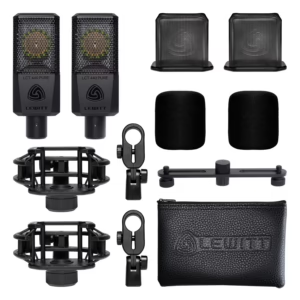
- Factory-matched pair of 1″ true condenser mics with gold-sputtered Mylar diaphragms
- Cardioid polar pattern, 20 Hz to 20 kHz frequency response
- Self-noise of 7 dB (A), dynamic range of 133 dB (A), max SPL of 140 dB
- Every mic is measured for frequency response and sensitivity, then paired by algorithm
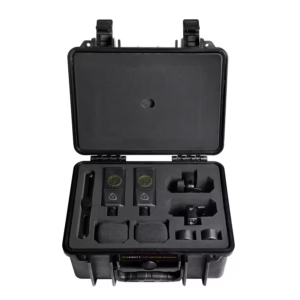
- Mil-spec transport case with shock mounts, mic mounts, windscreens, magnetic pop filter and stereo bar
The capsule at the heart of each mic is derived from LEWITT’s flagship designs, and the numbers show it. A self-noise rating of just 7 dB (A) keeps quiet sources and room ambience clean, while 140 dB of SPL handling means loud sources won’t overload the capsule. That 133 dB (A) dynamic range lets one signal chain cover delicate and punchy material alike.
The matching is what sets this set apart. LEWITT measures the frequency response and sensitivity of every LCT 440 Pure it makes, then lets an algorithm group the closest siblings together. Because the process is automated, the pair costs the same as buying two singles, so the matching comes free.
Stereo work is where the pair earns its place: drum overheads, room mics, piano, choirs and acoustic guitar all benefit from a balanced, coherent image. It also isn’t a one-trick set. Drop either mic on a shock mount with the magnetic pop filter and you have a capable vocal mic ready to go.
Everything arrives in a sturdy mil-spec transport case with room for the lot: both mics, shock mounts, mic mounts, windscreens, the magnetic pop filter and a stereo bar.
For local enquiries on LEWITT, head here.
Want to win a Strum Buddy Pro?
Built for practice, writing and lessons, the palm-sized Strum Buddy Pro runs six watts, with cabinet-modelled EQ and up to 3.5 hours of battery. Whether you’ve only got five minutes to play, don’t own an amp or just want to get something down before the moment passes, the Strum Buddy Pro makes it easy. For something so small it packs plenty in, with a 45mm speaker and onboard effects for clean, chorus, distortion and reverb. Headphones plug in for silent practice, and the USB-C battery runs up to 3.5 hours.
Catch up on all the latest news here.
“The idea is to remove the little obstacles that stop people from picking up the guitar,” said Kenneth Rustad, Partner and Sales & Marketing Director at Fluid Audio. “Strum Buddy Pro is ready in seconds, works quietly with headphones and is small enough to stay with the instrument. It gives players one less reason to put off practising.”
The Strum Buddy Pro is a practice amp that clips straight to your guitar – and thanks to Fluid Audio, we’ve got three to give away. Nothing to set up, no cables across the room, ready to play in an instant – if that sounds good to you, the Strum Buddy Pro is your new best friend.
Three winners will each take home a Strum Buddy Pro (RRP $129).
Entries close the 28th Oct and the winners will be announced 29th Oct. Only open to Australian residents.
You can buy the Strum Buddy Pro here
Electro-Harmonix introduces the Wailer Wah Pro, a rugged inductor-free wah
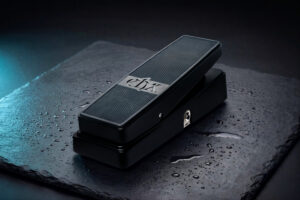
Electro-Harmonix has introduced the Wailer Wah Pro, a new wah pedal built to withstand the road and stage while keeping the tone of the original Wailer Wah.
Catch up on all the latest news here.
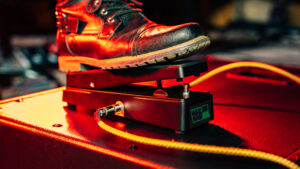
Wah pedals are among the first effects guitarists used to add expression and emotion to their playing, and the Wailer Wah Pro continues Electro-Harmonix’s funky wah tradition, which is rooted in the 1970s. The big change is the housing, an aluminium alloy die-cast chassis that’s solid underfoot but light enough not to weigh down a pedalboard.
The pedal was developed by David Cockerell, the designer behind Electro-Harmonix’s POG, HOG, Bad Stone, and Crying Tone. It’s built around an inductor-free circuit, which Electro-Harmonix says eliminates unwanted feedback and stage noise at high gain settings while keeping the tone clear and smooth throughout.
Cockerell has a long history with the brand. Electro-Harmonix was founded in New York City in 1968 by Mike Matthews, who launched it with a booster called the LPB-1 and followed it with the Big Muff Pi fuzz, which became one of the most recognisable pedals in guitar history.
Cockerell’s first design for the company was the Small Stone phase shifter, released in 1974, which went on to outsell even the Big Muff. The 1970s also brought the Memory Man delay and the Electric Mistress flanger, and the company has weathered bankruptcy in the early 1980s, a period during which Matthews rebuilt his business around Russian vacuum tubes, to remain one of the best-known names in effects.
The Wailer Wah Pro features true bypass and ships with a 9V battery, with an adapter available as an option.
For local enquiries, head here.
EMEREE talks laughing, travelling and dancing to fuel her creative process
EMEREE a powerhouse vocalist, a label that is only rivalled by her growing list of productions for both herself and other artists. Focused on the song and capturing ideas rather than being bogged down in the equipment used to make it, she’s a collaborator and songwriter, playing enough of a handful of instruments to get the ideas down, using Ableton as her pen and paper.
Read more interviews, columns and features here.
EMEREE’s work takes her all over the world, as she introduces herself to us from London.
Can you introduce yourself a bit and explain what it is you do?
My name is EMEREE, and I am a producer/artist and engineer. My primary job is producing and mixing for other artists, but I also produce and mix a lot of my own work. I sing, play flute, guitar, keys and anything else needed for the track (but not that well).
Can you explain a bit about your music-making process?
I don’t have ‘one way’ that I make music. Sometimes it comes so organically, sometimes I am in writing sessions with other writers/producers, and sometimes I start with a beat and write to that. I love to be really flexible with the way I make music. It’s really nice to be able to write with pen and paper (that’s how I wrote when I was a kid), but also to be able to transform that into something unique as a producer.

Tell us about what equipment you use to make music!
I travel a lot for my music, so I’ve made myself as portable and flexible as possible. Learning Ableton is what helped me be able to create on the go. I love being able to create anywhere, but I also love to record real sounds and run them through cheap cassette/tape machines. I love using nice microphones, but honestly a lot of my favourite sounds have been created with my iPhone mic and a bunch of cheap cassette machines.
How does all this transition to performing live?
I love to think about my live show, especially since I do a lot of my music direction myself using Ableton. I love to re-work songs and create interludes, and make my live show dramatic, exciting and fun. I don’t always think about it during the writing process, because sometimes the intentions for live can be a bit much to fit into a recording. When I’m adding a song into my live show, I love to sit and be really intentional with making interesting choices for the live version.
Who inspires you? Why?
As much as I hate to admit it – time off to just exist and spend time laughing, travelling, dancing and feeling fulfilled in other ways. I am so bad at not overworking, but I really notice how much more fuel I have when I am rested and fulfilled in other aspects of my life. I’m working on it!
Have you got a desert island piece of equipment?
Very specific answer coming for you here – Battery Operated UK ‘Mini Mello V2’. I freaking love this thing and it’s always sold out. The way you can manipulate loops and sounds would keep me entertained forever!
Learn more about EMEREE here
For more information about Ableton, head here
Harry the Hirer Productions adds JBL VTX A Series to its PA inventory
Harry the Hirer Productions has added JBL’s VTX A Series to its audio inventory, buying 24 VTX A8 line array elements, 20 VTX B18 subwoofers, and four Crown VRack amplifier systems through MadisonAV, JBL Professional’s Australian distributor. Each VRack is fitted with three Itech 4x3500HD amplifiers.
The purchase adds a second line array brand to Harry’s offering rather than replacing an existing one. It also came after a more rigorous process than most PA buying decisions, which tend to rest on a reputation, a spec sheet, and a demo in someone else’s room.
Catch up on all the latest news here.
The conversation started within Harry’s audio team, which had been weighing a new line array and flagged the VTX A Series as worth a proper look after meeting the MadisonAV team at ISE this year. Senior account manager Rob Nickels called MadisonAV’s head of tour sound, Peter Kubow, and a demo rig was in Victoria within two days.
“He flew down and tuned it with us, basically flat out of the box, so we could hear what we would be buying,” Nickels said. “We set up and tuned an existing rig next to it. We were both surprised and happy to hear the overall performance when comparing both systems.”
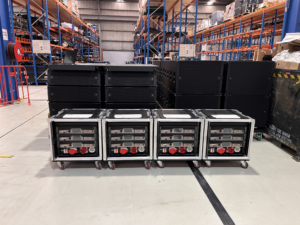
The warehouse test settled the sonic question, but Harry’s wanted a live trial before committing. “We agreed that if we’re going to proceed with this purchase, let’s first get it into a production environment where we can use it, hear it, and get to know it for real,” Nickels said.
That environment was Hyrox at Sydney Showground, a five-day event across six halls plus the Dome that drew more than 28,000 visitors. In Halls Five and Six, Harry’s ran a left/right system of eight VTX A8s per side, with one flown B18 and three ground-stacked B18s per side in cardioid mode, with Kubow on hand for deployment. Nickels was also taken with the rigging. “The JBL design team have taken the time to ask themselves if there’s a better way to hang a PA,” he said. “They’ve really thought about it and made it as simple as possible, which is a massive benefit. The rigging is next level; it’s so quick and easy to use.”
With the trial a success, the order was placed. Six Harry the Hirer Productions staff were then trained and certified on the VTX A Series through HARMAN-approved training led by Kubow and Grant Embury.
A week after the PA and training were delivered, the new stock was bumped in at the AFL Grand Final Toyota Footy Fest. The festival takes over most of Yarra Park around the MCG, hosts around 65,000 people on game day, and is the start and finish point for the AFL Grand Final Parade the day before. Harry’s has provided production for the event for years, and the 2026 brief grew late in the planning process, with more locations needing PA. MadisonAV supplemented Harry’s new stock with a VTX A12 and A8 system for the Main Stage.
The Main Stage ran eight VTX A12s per side, four A8s as front fill, 14 B18 subwoofers, and an eight-element A8 delay hang behind front of house. Two Parade sites, at Grand Slam Oval and Birrarung Marr, each ran six A8s and three B18s per side, handling announcements, presentations, and a performance by The Wiggles.
The Main Stage system went up on Monday. “Within two hours, the whole thing was up,” Nickels said. “Pete Kubow from MadisonAV then joined our team to do some testing and tuning. That was around another hour and a half, and then the whole system was up and running.”
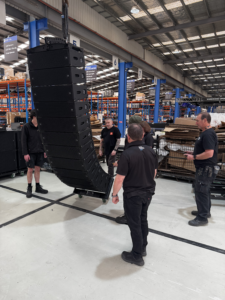
Front of house engineer Will Petts mixed the Main Stage, has worked Footy Fest before, and was in front of the VTX A Series for the first time. “We’ve had background music, a lot of announcements, MCs, and roaming microphones downstage right underneath the arrays,” he said. “We’ve had zero issues. I’ve left the system basically flat since deployment, and it’s been beautiful. The biggest standout for me is that the throw is incredible. Without the delay array on, we went for a walk, and how far it carried was beautiful.”
Nickels said the A8 fits into Harry’s inventory exactly where it’s needed. “It’s a good-looking, neat and tight box. It’s very clean, and it’s very discreet, and it’s precisely the right price point.”
For MadisonAV, Embury, its national performance audio sales and business development manager, pointed to Harry’s process as the model. “Put it next to what you already own, tune both flat, and listen. Then take it to a real show,” he said. “VTX A Series holds up to that scrutiny, and our job is to make sure the customer gets to apply it.”
For local enquiries on JBL, head here.
ESP LTD expands its 200DX Series with the M-207DX Baritone seven-string
ESP LTD has expanded its popular 200DX Series with the arrival of the LTD M-207DX Baritone, a seven-string guitar aimed at players exploring lower tunings and extended-range performance. It’s available in two finishes, Crimson Satin and See Thru Black Satin, and is positioned as delivering premium specifications at an accessible price.
Catch up on all the latest news here.
The 200DX Series itself was introduced as what ESP called a high-quality yet affordable introduction to the ESP playing experience. It launched with six guitars across three shapes, the EC-200DX, M-200DX, and TE-200DX, each offered in two finishes. The range is built around poplar bodies, figured wood tops, black chrome hardware, and ESP’s LH-150 humbuckers, and the M-200DX, the new baritone’s closest relative, pairs a bolt-on roasted maple neck and rosewood fingerboard with a 25.5-inch scale. It’s a fitting home for a more specialised instrument, since affordable guitars are what ESP’s LTD line is all about, and making existing designs play and sound better has been part of the company’s identity since it was founded in 1975. The M-207DX Baritone takes that formula and stretches it, with a seventh string and a longer scale.
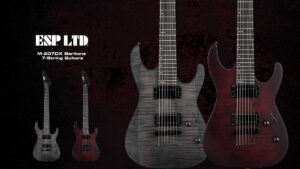
At the centre of the design is a 27-inch baritone scale length, which ESP says offers the string tension and clarity needed for aggressive downtuning. The body is poplar, topped with a figured flamed maple, while the neck is roasted maple with an Extra Thin U profile, designed for comfort and fast playability. A rosewood fingerboard carries 24 extra-jumbo frets.
Electronics come from a pair of ESP LH-150 humbuckers, which ESP describes as punchy and versatile. A push-pull tone control splits the coils for single-coil sounds, adding flexibility beyond straight high-gain tones. A TOM bridge with string-thru-body construction rounds out the hardware, aimed at sustain and tuning stability.
The ESP LTD M-207DX Baritone is available to order now, with stock expected in late October or November.
ESP is distributed locally by CMI
In Focus: Fender American Professional Series
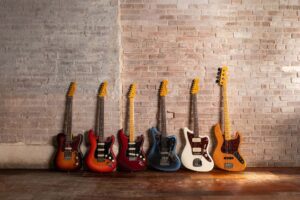
Fender has unveiled the next evolution of its flagship American Professional series, bringing new pickups, bridges, electronics, and neck profiles to ten electric guitars and basses built on some of the most recognisable shapes in music.
As we all know, Fender builds instruments for players of all stripes, with accessible guitars at one end, rare one-off custom pieces for collectors at the other, and an array of models in between. Somewhere in the middle sits the American Professional series, precision instruments worthy of the road, designed for the working player and the professional musician. Each design carries a distinct identity shaped by its sound, its feel, and the artists who have made it their own.
Read more interviews, columns and features here.
The new lineup spans the Stratocaster, Stratocaster HSS, Telecaster, Hotshot Telecaster, Jazzmaster, Jaguar, Precision Bass, Precision Bass V, Jazz Bass, and Jazz Bass V. All are handcrafted in Corona, California, and are available now through authorised Fender dealers and Fender.com.
The update arrives in Fender’s 80th anniversary year, and the company stresses it hasn’t changed things for the sake of it. “You don’t evolve an instrument like the Strat or Tele by changing things just to make them new,” said Justin Norvell, Fender’s chief product officer for guitars and basses. “We balance modern, useful improvements with the familiarity of what has made them iconic. In the same spirit as Leo Fender, we create tools for musicians by listening to what they need.”
That listening starts with players, and with how they’re playing today and what they’re asking for. It reflects the changes plenty of musicians already make themselves, like adding a humbucker to a single-coil guitar or fitting a refined bridge to a vintage favourite, and the new series builds some of those ideas in from the factory.
The headline change is a new generation of pickups. The V-Mod III single-coils, custom voiced for balanced output, string-to-string clarity, and touch sensitivity, appear in the Stratocaster, Telecaster, Jaguar, and Jazzmaster. The Stratocaster HSS gets a redesigned V-Mod III humbucker in the bridge position for more push, while the basses receive new Jazz Bass V-Mod III pickups and a V-Mod III split-coil for the Precision Bass.
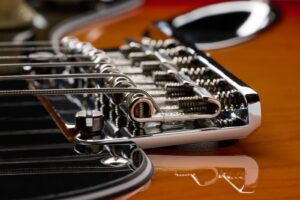
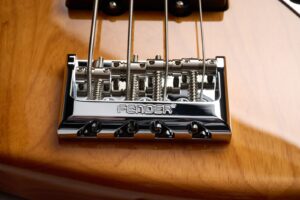
Bridges have been reworked across the range, aiming for better resonance, sustain, comfort, and stability. The Stratocaster now has ClassicGear Radial bent-steel saddles designed to sit comfortably under the palm, along with an upgraded two-point tremolo. The Telecaster gets a new top-load or string-through bridge with compensated brass bullet saddles, while the Jaguar and Jazzmaster pair a ClassicGear J-Bridge with a Panorama tremolo. Both basses move to a redesigned HiMass Modern Bridge for added resonance and sustain.
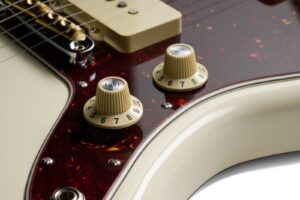
Under the hood, ClassicGear Precision potentiometers offer improved taper and tension, and every guitar now has a Push-Push tone control that puts extra voices one click away. Necks have been updated too, with a Deep “C” profile on the guitars, a Medium “C” on the Precision Bass, and a Slim “C” on the Jazz Bass.
The heritage runs deep across the range. The Stratocaster, Telecaster, and Precision Bass families trace back more than 70 years, while the offset Jaguar and Jazzmaster and the Jazz Bass go back more than 60. The aim throughout is to keep each instrument’s voice intact, from the bell-like chime and warmth of the Strat to the twang, snap, and snarl of the Tele and the sparkle of the offsets.
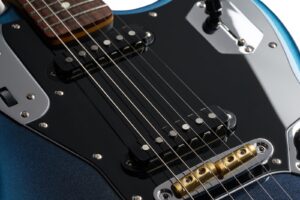
Some of the models pick up extras of their own. The Hotshot Telecaster adds a V-Mod III Stratocaster pickup in the middle position and five-way switching, with staggered pole pieces designed to follow the fretboard’s radius more closely and consistently. Both Telecasters get a newly sculpted heel. The Jaguar has a 24-inch short scale, and both it and the Jazzmaster feature a tap function on the bridge pickup alongside the Rhythm Circuit.
The basses get the same treatment. The Precision Bass and the five-string Precision Bass V carry V-Mod III pickups aimed at the punch and growl that define the P Bass. The Jazz Bass and Jazz Bass V use V-Mod III Jazz Bass pickups, aiming to hold on to the punch and clarity that define the Jazz Bass.
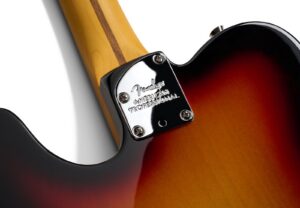
Bodies are alder or ash depending on the model and finish, with ash suiting some of the more transparent finishes, where it offers a more attractive grain, takes weight off, and nudges the tone slightly. Contemporary shades such as Dark Night and Oxblood sit alongside classics like Natural, Olympic White, and 3-Color Sunburst, and every model ships with a deluxe moulded case.
The launch also serves as a centerpiece of The One. For All., Fender’s latest campaign celebrating the artists and communities who continue to make these iconic instruments their own, featuring Dinosaur Jr., American Football, They Are Gutting a Body of Water, Snail Mail Steve Gunn, Marc Ribot’s Ceramic Dog, and Thurston Moore.
Last month, Fender and Dinosaur Jr. brought that idea to life with The One. For New York., a series of intimate performances across New York City celebrating the artists, neighbourhoods and communities that continue to shape music today. Go behind the scenes and watch the full film of The One. For New York. on Wednesday October 15th exclusively on Fender.com.
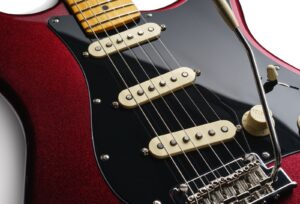
Fender chief executive Edward “Bud” Cole said the series reflects a combination of player insight, experimentation, and craftsmanship. “They listen to players, test ideas and work through the details to make meaningful improvements for players,” he said. “The American Professional series reflects that combination of player insight, experimentation and craftsmanship as we continue to push ourselves to make great instruments even better.” Left-handed versions of the Stratocaster, Telecaster, Precision Bass, and Jazz Bass will follow in spring 2027.
With a guitar or bass for just about every kind of player, the growing American Professional series really is The One. For All.
For more information on the American Professional series, head here
Dressed For The Occasion: Troy Van Leeuwen on his Squier Paranormal Telecaster XII
There are guitarists who seem to approach their instruments as tools, and then there are those who understand that every part of the package contributes to the overall picture. Troy Van Leeuwen has always struck me as belonging to the second family. Whether adding layers of texture to the likes of Queens Of The Stone Age and A Perfect Circle or stepping out onstage in one of his characteristically sharp outfits, there’s a sense that every detail has been considered: the songs, the sounds, the instruments, the outfits, they’re all in service of a creative statement.
That attention to aesthetics was something I wanted to explore when I spoke with Van Leeuwen about his new Squier Paranormal Telecaster XII. Van Leeuwen’s signature guitars have a visual identity of their own, refined yet flashy. I was curious where that sense of style came from, and his answer revealed something about the way he approaches the whole business of being a musician.
Read more interviews, columns and features here.
“You know, I always appreciated the classiness of a musician performing in a suit,” Van Leeuwen said. “I like to dress nicely. You’ve heard the story about Albert Einstein keeping a closet full of identical outfits? He knew what worked for him and then he made it so he didn’t have to think about it again.” The appeal, as Van Leeuwen explained it, is practical as much as aesthetic: settle on a look, take that decision off the table, and free up your attention for other things.
It’s a philosophy that carries over to a signature instrument. A guitar should have its own personality, certainly, but it should also make sense as something you can pick up, plug in and get on with the business of making music.
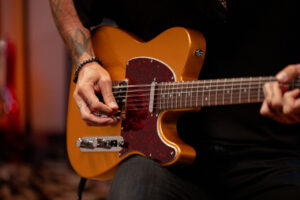
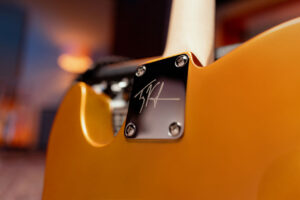
The Squier Troy Van Leeuwen Paranormal Telecaster XII takes its inspiration from Van Leeuwen’s Fender Custom Shop Masterbuilt 12-string Jazzmaster crafted by senior master builder Paul Waller. “I asked the Custom Shop to build me a double-neck guitar but it was going to take a long time to get it finished. So in the meantime, Paul Waller made this beautiful 12-string Telecaster as like an interim solution, so I’d have something to play in the meantime.” That guitar became much more than a temporary stopgap until the double-neck was completed: it quickly earned its place as an idea worth pursuing on its own. In light of popular Squier signature models like the J. Mascis Jazzmaster, it seemed like the perfect idea.
I asked Van Leeuwen whether designing a signature model for Squier rather than Fender meant having to compromise on his original vision. “Not at all,” he said. “I didn’t have to limit my ideas in any way. We were able to put this together from the ground up and I’m really happy with it.”
The Squier pairs a Nyatoh body with a maple neck, a laurel fingerboard and two Fender Designed Alnico single-coil pickups. Its 25.5-inch scale and familiar Telecaster shape keep it connected to the platform’s roots, while the custom Telecaster XII headstock and distinctive Copper Age finish make it unmistakably Troy’s guitar, and yet accessible to everyone. “The pickups sound great,” Van Leeuwen says. “They’re not too hot because that’s not what this guitar is about. And the bridge intonates perfectly which is especially important for a 12-string!”
As for amplification, Van Leeuwen didn’t describe needing a separate, radically different setup to make the instrument work. His existing rig is already designed to accommodate that sort of versatility, so he can simply plug in and play. That’s an important distinction: the guitar becomes another colour in an established palette, rather than an excuse to rebuild the whole rig around it.
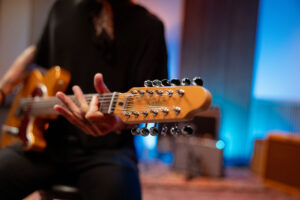
And that, ultimately, is what makes the Paranormal Telecaster XII feel like a Van Leeuwen instrument. It has the visual confidence, the unusual character and the practical thinking you’d expect from a guitarist who values both presentation and function. Most importantly, it takes a distinctive Custom Shop idea and makes it available to players who might never otherwise have considered a 12-string Telecaster. “I can’t wait to hear what people play on this guitar,” Van Leeuwen says. “It’s always interesting seeing my guitars go out into the world and tell their own stories.”
Learn more about QOTSA’s upcoming Australian tour here
Learn more about the Squier Paranormal Telecaster XII here
Gear Rundown: Drive-By Truckers
Drive-By Truckers are having quite the renaissance at the moment. Thirty years into their career as alternative country and (sort of) southern rock’s premier cult heroes, the band are experiencing a new wave of fandom as fresh acts such as MJ Lenderman and Wednesday publicly pay tribute to them as being a primary influence. Having also served as a launch pad for Jason Isbell’s esteemed solo career after his stint with the band back in the 2000s, Alabama’s masters of songcraft recently reunited with their friend and ex-bandmate for a one-off show at this year’s Shoalsfest. So, to celebrate, let’s dive into the gear that fuels this band of genre-bending road warriors.
Read more interviews, columns and features here.
The Baxendale factor
Before the gear itself, a quick word on the man whose name keeps turning up. Scott Baxendale built his first guitars in 1974 at Mossman Guitars in Winfield, Kansas. He spent time in Nashville restoring vintage instruments in the late ’70s, then bought Mossman in 1985 and moved it to Texas, where he built around 250 guitars before opening the Colfax Guitar Shop in Denver. That’s where he began teaching lutherie, and where his now-famous Harmony and Kay conversions took shape: old budget-brand guitars stripped down and rebuilt on the inside like pre-war Martins.
The Truckers came into his orbit through their guitar tech, and they took to his work straight away. Baxendale ended up joining them on the road as a tech for an acoustic tour, fell for Athens, and relocated there in 2010 to open Baxendale Guitars. The band has returned the favour, thanking him in their liner notes and even writing a song about him. As you’re about to see, a lot of the strangest instruments in this rig carry his stamp.
Mike Cooley
Keith Richards and Townes Van Zandt rolled into one, Mike Cooley serves as the band’s dark horse. Having written some of their most rowdy rockers as well as some of their most heart wrenching ballads, ‘The Stroker Ace’ doesn’t speak much, but when he does it carries weight.
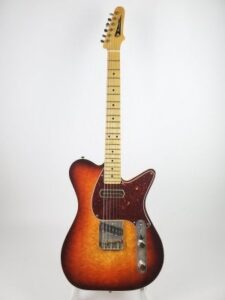
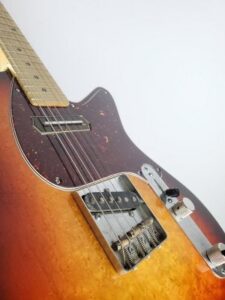
Cooley’s guitar collection is a lesson in embracing the unloved ugly ducklings of the guitar world. His stock Epiphone Flying V has taken some damage along the way and been glued back together, while his rare and perhaps best forgotten Gibson Corvus I is, in his words, a “bad idea from the ’80s” that he’s kept rocking with a retrofitted P-90. Two Baxendale builds round things out. His longstanding main guitar is a warped, Keef-inspired T-style nicknamed the ‘Cooleycaster‘ that carries a Seymour Duncan Hot Rails in the bridge and a Seymour Duncan Seth Lover SH-55 in the neck, and his main acoustic is a custom Baxendale adorned with unique artwork by the band’s late great collaborator Wes Freed. Cooley also has a second Cooleycaster that features Lollar pickups, specifically a Charlie Christian in the neck and their alnico Hot Tele in the bridge.
The amp rig is simple and direct. A single-channel Sommatone Roaring 40 head feeds a matching Sommatone 2×12 open-back cab loaded with Eminence Red Coat speakers, with an unidentified Sound City head riding along as insurance.
Also nice and simple is his pedalboard. A Dunlop JD-4S Rotovibe and Dunlop Cry Baby Wah lead off, with dirt courtesy of a Boss SD-1 Super Overdrive and a Greer Amps Pork ’N’ Beans boost. The signal then hits a Boss RE-20 Space Echo, a TC Electronic PolyTune and a Morley ABY Switcher, which lets him jump between his acoustic and electric rigs. A Sommatone Boost footswitch sits close by for extra gain, and a Voodoo Lab Pedal Power 2 Plus tucked under the Pedaltrain board runs the lot.
Patterson Hood
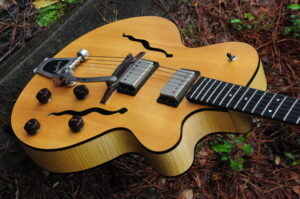
DBT’s most prolific songwriter and enthusiastic spokesman Patterson Hood’s guitars are a mix of the vintage and the handmade. The son of David Hood, bassist and member of Muscle Shoals’ legendary Swampers studio band, Patterson’s Alabama music roots run deep. The showpiece of Hood’s rig is a semi-hollow Baxendale fitted with a Bigsby and a pair of Seymour Duncan Antiquity humbuckers. Its snake-shaped f-holes were drawn by Wes Freed, the artist behind all of the band’s artwork. There are also two Gibson SGs, one tuned down a whole step to accommodate the bulk of the band’s material being in D standard.
Then there’s the Baxendale Mandocello, which ties neatly back to that Kay conversion story. It starts life as an old Kay acoustic, with Baxendale modifying the braces, cutting a new bridge and nut and swapping in mandolin tuners. It’s tuned F–C–F–C, a unique oddball addition to the band’s rig.
Hood’s amp choices are classic Americana: a 1972 Fender Deluxe Reverb alongside a reissue ‘63 Fender Tube Reverb, with the two sometimes running together because he likes reverb on top of reverb for the band’s spacier jams. A Fender Vibro-King stays close as an auxiliary amp.
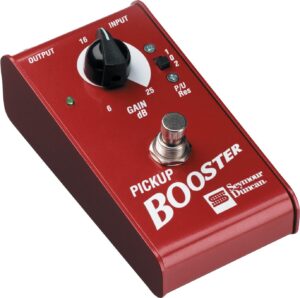
The pedalboard breaks a golden rule by placing delays before the drive. After a TC Electronic PolyTune, the signal runs through a Boss RE-20 Space Echo and Boss DD-3 Digital Delay, then into a Seymour Duncan Pickup Booster, Boss SD-1 Super Overdrive, Boss GE-7 Equalizer and Electro-Harmonix Small Stone Analog Phase Shifter. A Morley ABY Switcher splits the signal to both amps, and a Voodoo Lab Pedal Power 2 Plus keeps everything fed.
Jay Gonzalez
Multi-instrumentalist and secret weapon Jay Gonzalez follows the same philosophy as his bandmates, favouring the odd and the old. His main guitar is a 1968 Gibson SG Special with its original P-90s and Vibrola tailpiece, backed by a vintage Gibson SG-100 with a single P-90 and a Bigsby.
His amp is an Ace of Clubs combo built by fellow Athens maker Steve Hunter, with one British-flavoured channel, one American-flavoured channel, and reverb.
On his board, a TC Electronic PolyTune leads into an MXR Micro Amp, a DOD FX52 Classic Fuzz modified by Steve Hunter and a Xotic EP Booster. Things then get trippy with a TC Electronic Flashback delay, finishing with a Boss RT-20 Rotary Ensemble.
And that’s a wrap! Three players, three very different boards, and a band that proves the most interesting tones rarely come off the shelf.
Learn more about Drive-By Truckers here
Seymour Duncan is distributed locally by Australis
Back in the room: SAE Melbourne revives its audio expo as M.a.A.T.E!
Audio and music production can be a very isolated process. You might spend a week with a band, but the following days, weeks and months are often spent quietly editing, mixing and adjusting on your own. SAE in Melbourne are looking to bring the community together in a huge new Australian event, aptly called M.a.A.T.E!
The Music and Audio Technology Expo brings together professionals, students, distributors and more for a day at SAE’s Melbourne campus. Along with unveiling SAE’s new 9.1.4 Dolby Atmos system, mastering engineers Joe Carra and Nicholas Di Lorenzo are presenting, alongside keynote speaker Larry Crane, editor of Tape Op and owner and engineer at Jackpot! Recording Studio in Oregon.
Catch up on all the latest interviews and features here.
We spoke to Gareth Parton, Senior Lecturer at SAE and a music producer and audio engineer, about the event.
It builds on the Melbourne Audio Trade Show (MATS), which ran under SAE from 2016 to 2018. “Those events brought together manufacturers, distributors, engineers, producers, educators and students, creating a rare opportunity for the Australian audio community to connect face-to-face,” Parton says. The relaunch gets a new name, and he’s happy to take credit. “Also, I thought the re-launch should have a new name… and this is the most Aussie acronym I could come up with!”
As for why now, Parton points to demand. “We felt the timing was right to bring the event back because there’s a real appetite for a space where the industry can come together. Our goal is to connect manufacturers, professionals, educators, students and emerging creators, and provide opportunities to learn, network and share ideas. Ultimately, we want M.a.A.T.E! to strengthen the audio community and help inspire the next generation of audio professionals.” The timing suits SAE too, which is celebrating its 50th year. The Melbourne campus has had some impressive renovations and upgrades, including the new Dolby Atmos theatre and an SSL Duality, which joins existing API, Audient and Avid S6 consoles.
What Parton remembers most about the earlier events is the atmosphere. “People weren’t just coming to see new equipment; they were coming to talk shop, learn from each other and connect with others who shared the same passion for audio.” That has shaped this year’s program. “We’ve built a program that combines technology, education, discussion and hands-on experiences, giving attendees plenty of opportunities to connect with both industry leaders and each other.”
The exhibitor lineup covers a lot of ground. CMI Music & Audio will demonstrate products from Korg, Arturia, Native Instruments, Universal Audio, Moog, Ableton and Sonarworks throughout the day, while Ableton shows off the new features in Live. “AVID will showcase the latest Pro Tools updates and SAE’s brand new 9.1.4 Dolby ATMOS system in the theatrette,” Parton says. Amber Technology, Link Audio, Group Technologies, Factory Sound, Studio Connections, Roland and Sky Music round out a floor spanning recording, broadcast, live sound and instruments. Pacific Ears will host a presentation on safe listening and hearing protection, the Music Producers and Engineers Guild will present on the guild, and Panorama Audio Labs will promote a new plug-in.
“Attendees can expect product demonstrations, hands-on technology showcases, expert presentations and practical discussions covering recording, music production, live sound, monitoring, acoustics, software, hardware and emerging technologies. Whether you’re interested in studio recording, electronic music production or live event technology, there will be something relevant to explore,” Parton says.
Heading up the program is keynote speaker Larry Crane, who will be joining via Zoom. “Larry has been one of the most respected voices in recording for decades,” Parton says. “Through his work as a producer and engineer (Elliott Smith, Sleater-Kinney, The Go-Betweens, Stephen Malkmus), at his Portland studio Jackpot! and through Tape Op magazine, he’s had conversations with some of the most influential people in audio while remaining deeply connected to the realities of making records. Larry’s perspective is unique because he’s not only worked at a high level, but he’s also spent years helping others learn, develop and think critically about the creative process.”
Beyond the keynote, Parton has two sessions circled. “Mastering is often one of the least understood stages of the production process, and we’re bringing together experienced mastering engineers (Nick Di Lorenzo and Joe Carra) to discuss critical listening, workflow, emerging technologies and the future of mastering.” The other is more hands-on. “The Live Synth Jam should also be a highlight. It’s a chance to see synthesis and electronic music creation in a more creative and collaborative environment, showcasing both instruments and performance techniques.” He also recommends spending time with exhibitors. “Some of the best insights often come from informal conversations and hands-on demonstrations with the people who design, distribute and support these technologies.”
The expo isn’t aimed at one corner of the industry. “Someone attending their first audio event can learn from an experienced engineer, while established professionals can discover new technologies or reconnect with colleagues,” Parton says. “We want M.a.A.T.E! to be accessible to anyone with an interest in music and audio technology, regardless of where they are in their journey.”
Registration is free, and his advice for the day is simple. “The biggest recommendation is to come for the full day! Bring questions, introduce yourself to people and take advantage of the networking opportunities.” The price tag is deliberate, too. “The event is free because we want it to be as accessible as possible.” There’s a reward for those who stay the distance. “There will also be some exclusive deals and door prizes on the day… so stick around ‘til the end!”
Looking ahead, Parton hopes M.a.A.T.E! becomes a fixture. “My hope is that M.a.A.T.E! becomes a regular meeting point for Australia’s music and audio community.” He’s clear on what success looks like. “If attendees leave feeling inspired, having learned something new, discovered a new technology, made a valuable connection or simply felt more connected to the wider audio community, then we’ll consider the event a success.”
For more information, head here
Sony’s ECM-AX10 brings Eclipsa Audio spatial recording to the smartphone
Sony has launched the ECM-AX10, a compact microphone that lets creators record spatial audio on their phones. Sony says it’s the first smartphone mic anywhere to earn Eclipsa Audio certification, the format used for immersive sound on YouTube.
Catch up on all the latest news here.
Eclipsa Audio is an open-source spatial audio format developed by Google and Samsung, built on the Immersive Audio Model and Formats (IAMF) specification created with other contributors through the Alliance for Open Media and released under a royalty-free licence. Because the underlying specification is open, files can be made with freely available tools rather than proprietary software. YouTube has accepted Eclipsa Audio uploads since January 2025, and Samsung’s 2025 TV and soundbar range was among the first hardware to support playback. Google and Samsung also set up a certification and brand licensing program to give manufacturers and buyers some assurance of quality, which is the program the ECM-AX10 now passes through.
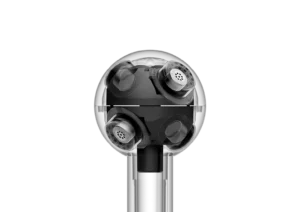
Inside the ECM-AX10 is a purpose-built spherical module holding four omnidirectional capsules, which pick up sound from all around the phone. Sony’s spatial audio processing then turns that signal into a recording with a convincing sense of where sounds sit and how far away they are, aimed at making everyday video feel more immersive. The mic weighs roughly 24g and plugs straight into a phone’s USB-C port, so there are no cables or extra power sources to manage.
Three recording modes cover different delivery needs. Ambisonics is the route to publishing in Eclipsa Audio on YouTube, and it works with Sony’s Spatial Audio Video Tool app. Binaural mode draws on the same proprietary technology behind Sony’s 360 Reality Audio, producing a three-dimensional mix tuned for headphones, which is useful when a platform doesn’t support Eclipsa Audio. Stereo is the conventional option for videos that will be played over headphones or speakers.
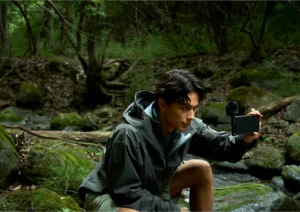
Sony’s Spatial Audio Video Tool app ties the process together on the phone itself, letting creators shoot, review, trim, and export spatial audio content without moving to a computer. The ECM-AX10 isn’t locked to that app, though, and works with general recording and video apps as well as Sony’s own.
The microphone was developed and tuned by engineers at Sony PCL.
For more information, head here
Make Noise launches 208hp 4 Zone CV Bus Case and CV Big Bus
Make Noise has announced the 208hp 7U 4 Zone CV Bus Case and the CV Big Bus, a new Eurorack case and a redesigned control voltage distribution system, released on 12/10/2026.
The case is built from powder coated metal for mechanical durability, with a sleek matte black finish chosen to match the company’s Black & Gold modules. The mounting rails have been updated to black anodised tapped strips, replacing the sliding nut design of earlier versions. The lid is removable and can be closed with the system fully patched, and the bus boards now include 31 shrouded headers for connecting modules.
Catch up on all the latest news here.
At the centre of the case is the Make Noise 4 Zone Power system, which Make Noise describes as a new approach to housing the growing universe of Eurorack modules. It works like several independent power supplies in a single case, so noisy modules can be isolated from noise-sensitive ones. Each zone has its own isolated +12V and -12V supplies and a dedicated ground return path. Total available power is +12V at four amps, -12V at 2.4 amps, and +5V at one amp, shared across the four zones.
The CV Big Bus is an evolution of the original CV Bus, which was designed in 2013 for Alessandro Cortini’s personal Make Noise system. To cope with the higher modulation density of the New Universal Synthesizer System, it doubles the channel count from four to eight. The channels are distributed horizontally across the centre of the system, so control signals appear beneath their potential destinations and cable mess is kept down. Illuminated numerical indicators show channel number, level, rate, and polarity at a glance, with colour coding to make complex patches easier to follow. Typically, the bus would carry the most important signals in a patch, such as clock, modulation, sequence, and audio, but any signal the system creates can be shared.
A high-quality stereo line driver is built into the Big Bus, converting modular signal levels to line level. It has mini-jack inputs for left (or mono) and right, a single master volume control, and a stereo line output pair, with the left output doubling as a headphone output. The outputs are AC coupled and include a limiting circuit with visual indication, designed to protect ears and PA systems when patching gets experimental.
The CV Big Bus can be bought as a standalone replacement for any CV Bus, and all Make Noise cases and ReSynthesizers will now ship with it installed. It’s compatible with the Make Noise 7U Case and the 4 Zone case, though Make Noise can’t confirm compatibility with cases from other manufacturers.
For more information, head here
KIT Plugins releases BB Chamber D, based on Blackbird Studio’s reverb chamber
Nashville developer KIT Plugins has released BB Chamber D, a reverb plug-in that recreates the reverb chamber inside Blackbird Studio’s Studio D, one of the most coveted acoustic spaces in Nashville.
Developed in collaboration with Blackbird Studio, the plug-in aims to capture the lush depth and musical decay of the chamber, which has shaped the sound of countless recordings. It’s built on KIT’s proprietary ADPT:AI technology, a modelling engine developed specifically for reverb and room emulation.
Catch up on all the latest news here.
“Every great recording space has a personality,” said Jim Collett, newly appointed president of KIT Plugins. “Studio D’s chamber has an unmistakable sense of depth and emotion that you feel the moment you hear it. With ADPT:AI technology, we weren’t trying to build another reverb — we wanted to preserve the soul of one of the most inspiring rooms in modern recording history while giving creators the freedom to explore it in entirely new ways.”
Blackbird Studio was opened in the Berry Hill neighbourhood of Nashville in 2002 by sound engineer John McBride and his wife, country star Martina McBride. The idea began with a plan to build a vocal booth in the couple’s garage, and grew into a purchase of the existing Creative Recording Studios, which was rebuilt and renamed after the Beatles song, a nod to McBride’s favourite band. The facility has since grown into one of the largest recording complexes in Nashville, with Studio A built around a vintage Neve 8078 console once owned by Donald Fagen. Its client list includes Taylor Swift, Dolly Parton, Beck, and Bruce Springsteen, and in 2013 McBride also launched the Blackbird Academy to train aspiring recording engineers.
Where the physical chamber is fixed, the plug-in lets users reshape the space with adjustable Size and Width controls, producing anything from tight rooms to extended, lush decays. Three microphone options are modelled on mics commonly used in the chamber: the C24 for a balanced, natural sound, the R88 for warmth and smoothness, and the 414 for a brighter, more detailed result. Virtual cushions can be added to alter decay time and tonal character, mirroring the dampening techniques engineers use in Studio D.
Source placement is also flexible. Audio can be routed through Hi-Fi, PA, or Direct source modes and positioned inside the chamber or fed from Studio D’s live room, recreating real-world tracking and reamping techniques.
Further shaping tools include pre-delay, pre and post high-pass and low-pass filters, and a saturation stage based on KIT’s A5 emulation of the Studio D console. A four-band EQ inspired by that console, a compressor, and a ducker, which keeps the dry signal forward while the reverb moves out of the way, round out the signal path. A preset manager covers factory, collaborator, and user presets.
BB Chamber D is available in VST3, AU, and AAX formats for macOS 10.14 or above (Intel and M-Series) and Windows 7 or above, with support for all major DAWs.
For more information, head here
Baby Audio releases HyperWarp, a granular time warping plugin
Baby Audio has released HyperWarp, a granular time warping effect that breaks audio down into microsampled snapshots and reassembles it into rhythmic glitches, tape-stop style bends, and textural ear candy.
HyperWarp is based on the acclaimed granular engine from Baby Audio’s Grainferno and comes from the same lead developer. Rather than exposing every setting of that engine, it offers a curated version built around a graph input system, eight core parameters, and seven distinct effect profiles.
Catch up on all the latest news here.
The graph panel sits at the heart of the plug-in. It plots time against time, with the length of the processing window on the horizontal axis and the distance warped backwards on the vertical. Downward slopes slow the audio, upward slopes speed it up, curves create tape stop and record scratch effects, and straight stairsteps jump the signal backwards in time to repeat earlier beats. Steeper lines make grains play in reverse, while a line matching the dotted stop angle freezes playback and generates grains from a single point, an oscillator-like effect that suits vocals and sound design. A step drawing mode, two randomisers, and dozens of preset shapes are included for quick results.
The Warp panel adds four granular controls. Resolution sets how often grains are generated, Pitch shifts them independently of playback speed, Scatter adds randomness to playback position, and Feedback returns earlier grains to the engine for delay-like cascades. These remain active even when the graph is flat.
Each of the seven profiles reconfigures the engine behind four macro controls. They include Clean Warp for transparent tonal glitching, Degrade Warp for grain-level sample reduction distortion, Harmo-nicer for sparkling octave and fifth layers, and Fauxcoder for resonant, vocoder-like textures. A band split control restricts processing to a chosen frequency range, with the dry signal filling in the rest, alongside a standard wet/dry mix.
A free trial of HyperWarp is available to download here.
My Rig: C.O.F.F.I.N
Thanks for taking the time Ben! With Out In Oslo out and the band about to head out on your biggest headline run yet, can you speak a bit to your sonic influences for this record?
I think like most it’s the culmination of all the things you pick up on and get excited by from that first time you experience some emotional reaction to music. And this record probably shows we’ve had a few more runs around the sun and broadened our intake of music. All the classics like AC/DC, [Black] Sabbath, Mötorhead, Stones, Stooges etc. but also a bit more traditional folk and blues as well as country influences getting through.
Can you give us a rundown of your current rig, and has anything changed heading into this touring cycle compared to previous C.O.F.F.I.N runs?
For the record I borrowed Bryce’s kit from Amyl And The Sniffers. A Ludwig Classic similar to what I’ve been hiring when touring internationally.
I run a pretty standard meat and potatoes rock set up: one rack tom, a floor, 2 crashes, hats, and a ride. Probably the most distinct feature of my set up is having a hi-hat mounted tambourine. Touring Aus I’ve usually just used whatever the house kit is or call on the generosity of a support to sort me.
Catch up on all the latest interviews and features here.
What does your setup look like these days? Has the more expansive, dynamic sound of Out In Oslo pushed you toward anything new, or are you sticking with what’s worked for you in the past?
It’s kinda funny because of the nature of touring I never really use my own kit which is a maple DW Collector’s Series I got for cheap in LA after it was used for demos in a store on Sunset Strip. I definitely need to get new cymbals, I’m currently borrowing our manager Jake’s, all mine are pretty smashed up.
With the documentary 10,000 Miles From Oslo charting more than two decades of the band, has looking back at your gear history over the years changed how you think about your current setup at all?
I mean it’s really nice to have decent gear with the band playing bigger shows now, you feel way better while playing, but I’m glad I had such a random mix of stuff I had to play on over the years. [It] makes you very versatile. I also used to like heaps more stuff on the kit when I was younger. More toms, more cymbals etc.
Classic kid attitude that ‘more was better’.
Between headline shows, festival slots, and now international touring, does your rig change much depending on the size or type of show, or do you try to keep things consistent wherever you’re playing?
Pretty much keep it the same for everything now. We got our first custom logo bass drum head the other day which is pretty cool, haha.
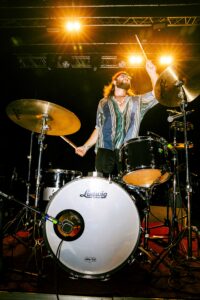
Photo by Dougal Gorman
Most importantly: amps. What are you running live, and does that change at all for a headline show versus something like the King Gizzard-curated block party?
Abijah: For the most part I’ll run a Mesa Boogie Dual Rectifier into a Marshall cab loaded with [Celestion] greenbacks. That’s the standard setup for touring and headline shows but for something like party or festival shows where the backline is provided, it’s usually a [Marshall] JCM 800 or 900 but sometimes you never know what you’re gonna be hit with and can kinda get away with anything really. That’s where the ol’ distortion and boost pedals earn their keep.
Aaron: Usually I try to run a JCM whenever I can but have definitely played through absolute dog shit plenty of times! Just like Abijah said, always have a lil overdrive pedal ready in case it’s one of those occasions.
Kosty: Where I can, I’ll run the Ampeg SVT Classic head into an 810 cab which is very lightweight and not heavy at all to lug around. I’ll run a little bit of overdrive from my pedal into the rig and it gives it hella crunch. That paired with a 70’s lawsuit-era Greco ‘Rick’, it’s VERY loud. For smaller venues, I’ll still run the same set up-will just have to turn it down a tiny bit.
Do you find yourself reaching for the same gear for both live and recording, or does the studio bring out a different side of your tone?
We were lucky this time around to be doing most of the instruments at Sundowner Studios in Melbourne which has a bunch of cool gear in it. So we’d often switch stuff up and play around for different tracks. “Try this guitar on this one, get that amp out for this, switch this rack tom out with a bigger one for this tune…”
In your own words — what makes the ultimate C.O.F.F.I.N sound? Has that definition shifted at all across six albums?
Heavy gear played very loud. Finally got to play as loud as we wanted on this last record.
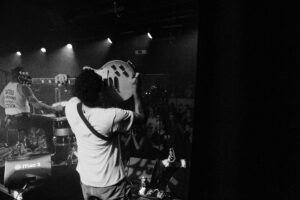
Photo by Dougal Gorman
Can you tell us a bit about your first instrument, and what led you to the gear you’re currently playing?
My first kit was a chunky 80s yellowing Pearl Export that my mum got me second hand from the iconic but now gone Billy Hyde’s in Sydney. I suppose I slowly started to copy the drum set up from most of my favourite rock bands like The Stooges, The Band, [The Rolling] Stones, AC/DC etc.
What’s the one piece of gear you/the band can’t live without on this upcoming tour?
My hi-hat mounted tambourine!
Learn more about C.O.F.F.I.N’s upcoming tour here