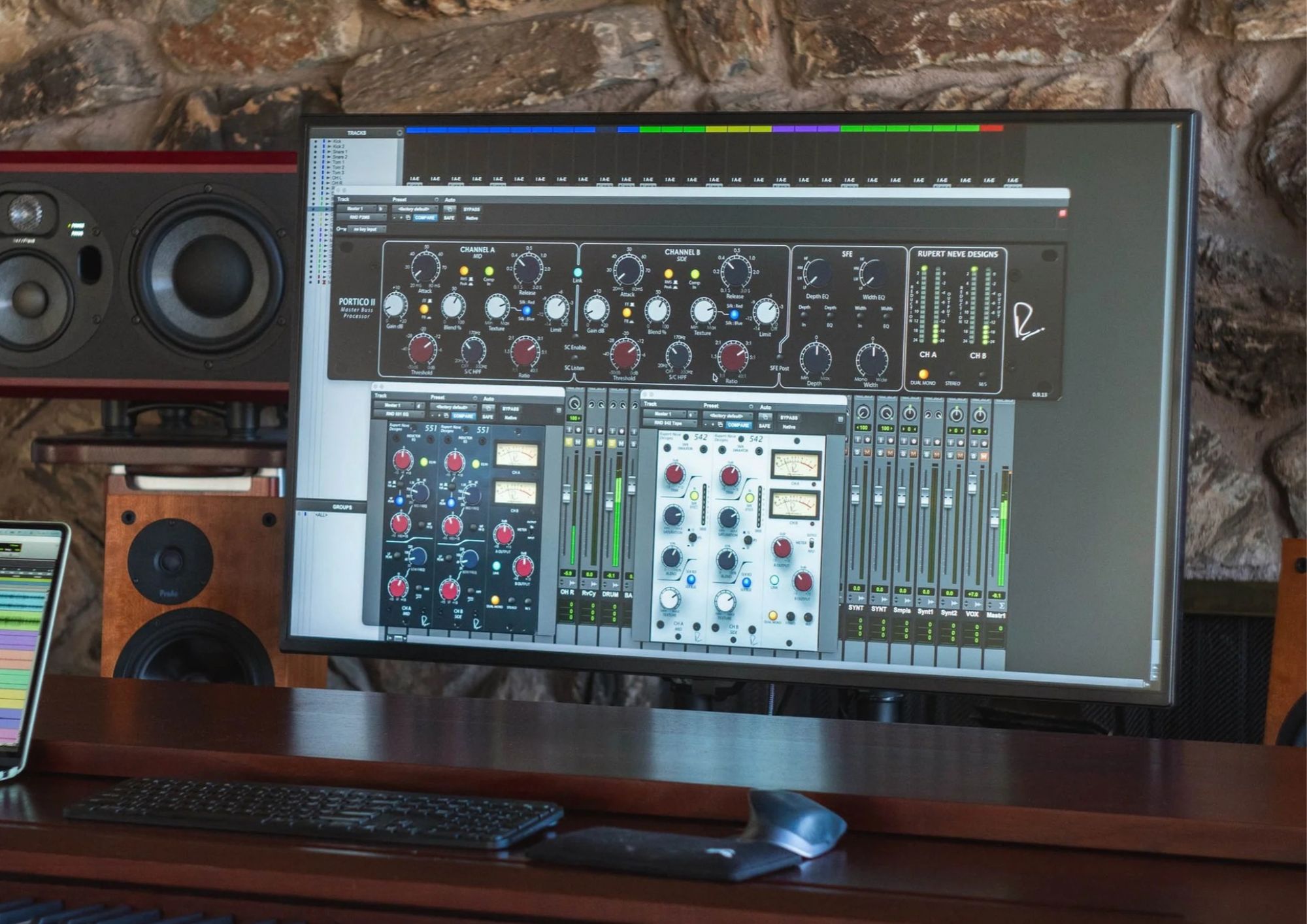
The Portico II, 551 Inductor EQ, and 542 Tape Emulator mark the brand's debut in plugin form.
Rupert Neve Designs has stepped into software for the first time, releasing three plugins modeled on its own hardware units: the Portico II Master Buss Processor, the 551 Inductor EQ, and the 542 Tape Emulator. Built in partnership with McDSP, the trio marks the first time Rupert Neve Designs has developed and shipped plugins under its own name.
The Portico II Master Buss Processor targets dynamics control and stereo imaging, giving engineers a software counterpart to the brand’s hardware bus processor. The 551 Inductor EQ carries over the company’s three-band 500-Series EQ circuit, a design that traces back to the Shelford Channel and pulls from earlier vintage EQ work by Rupert Neve himself.
Read all the latest product & music industry news here.
The 542 Tape Emulator, meanwhile, is built to reproduce RND’s tape saturation circuitry, and adds a soft clipper alongside the brand’s Silk Red and Blue harmonic saturation controls.
All three plugins run in AAX, AU, and VST3 formats, with native support for both Intel and Apple Silicon systems. Compatibility extends across major DAWs, including Pro Tools, Logic Pro, Cubase, Ableton Live, FL Studio, LUNA, Reaper, and Studio One.
Rupert Neve Designs was founded by audio engineer Rupert Neve, whose circuit designs have shaped professional recording for decades and influenced generations of consoles, preamps, and outboard processors used in studios worldwide. The company built its reputation on the Portico and Shelford hardware ranges, favored by engineers for their harmonic character and hands-on control over tone. Bringing that circuitry into plugin form allows the brand to extend its analog legacy to producers working entirely in the box, without requiring the rack space or budget that outboard gear demands.
The move into plugins also follows a broader trend among hardware manufacturers translating analog circuit designs into software, giving studios and home producers access to signature tonal characteristics without needing physical rack space. For Rupert Neve Designs, the release signals a shift toward meeting engineers where much of modern production now happens: inside the DAW.
For more info, visit Rupert Neve Designs here.