The complete guitar and bass rig packs the same Neural Capture technology and processing power as the flagship Quad Cortex, into a smaller, more compact unit.
Mini but mighty definitely applies here.
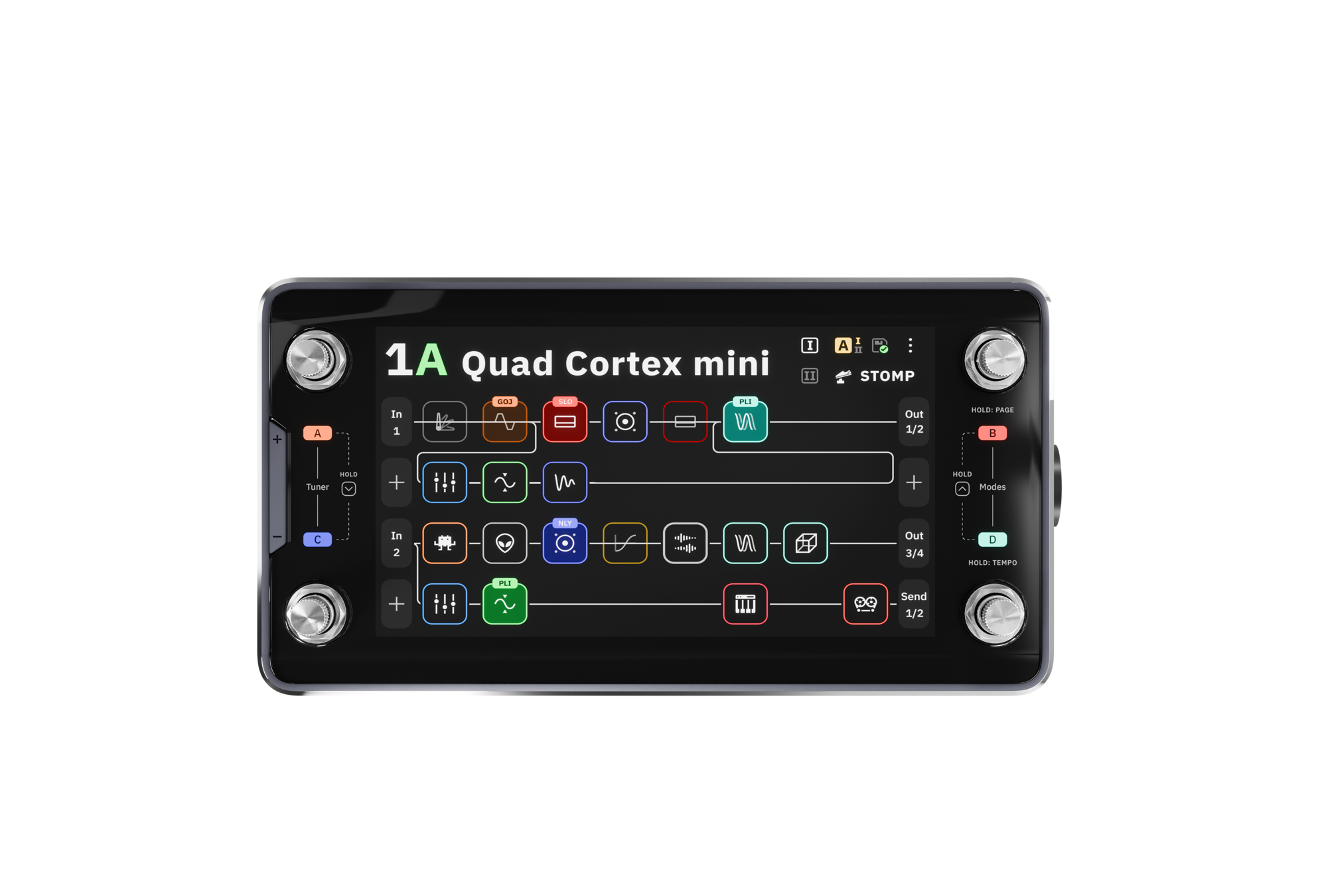
Neural DSP has announced Quad Cortex mini, bringing the company’s flagship digital modelling platform to a significantly smaller design without sacrificing the processing power or features that made the original a studio and stage favourite. Measuring just 22.8 x 11.8 x 6.5 cm and weighing 1.5 kg, the mini version maintains the same audio quality, Neural Capture technology, and 7″ touchscreen interface while fitting naturally into pedalboards, compact racks, and desktop studios.
Catch up on all the latest news here.
Unfamiliar with the Quad Cortex? Here’s the gist. It’s an all-in-one digital guitar and bass rig that replaces physical amps, cabinets, and pedals with high-quality digital models. The Neural Capture technology is the standout feature, creating digital replicas of your actual gear by analysing your real amps and drive pedals, and producing what Neural DSP calls ultra-accurate clones. You can also tap into thousands of community-created Captures for instant access to different tones.
The critical detail, according to Douglas Castro, CEO and co-founder of Neural DSP, was avoiding the usual compromises that you get with compact hardware. The Quad Cortex mini maintains the same machine-learning-based modelling and processing architecture as its larger counterpart, creating what Neural DSP describes as ultra-accurate digital replicas of amps, cabinets, drive pedals, fuzzes, and compressors.
Take a look at the Quad Cortex mini below:
Control happens through the 7″ touchscreen paired with four stainless steel rotary footswitches, so you’ll get tactile control where you need it. Both Neural Capture V1 and V2 are supported for capturing your own gear, while the onboard library spans 90+ amps, 100+ effects, 1000+ IRs, and 2000+ Captures. Cortex Cloud adds free access to thousands of community Captures. There’s no shortage of tonal inspiration.
The Focus system lets you dive into parameters quickly using the aforementioned rotary footswitches, while the Pages system extends footswitch control without adding more hardware. Multiple operational modes—Preset, Scene, Stomp, and Hybrid—adapt to different playing styles, and Gig View streamlines everything for stage use. A 16-channel USB-C audio interface (8 in, 8 out) turns the unit into a capable recording hub.
Connectivity covers the essentials, and then some: instrument/microphone combo input with phantom power, balanced XLR outputs, stereo send/return via TRS, MIDI over both TRS and USB-C, plus a headphone output for silent practice sessions. Neural DSP has sensibly included a locking power connector too—we’re sure players who’ve dealt with accidental unplugs will appreciate that.
Perhaps the smartest aspect is full ecosystem integration. Presets and complete system backups transfer seamlessly between Quad Cortex mini and the full-sized version. This makes the mini an ideal backup rig. On the other hand, you can maintain identical sounds across multiple units without rebuilding patches from memory.
CorOS 4.0.0 launches alongside the hardware, bringing Nordic Concert Hall (a spacious hall reverb), Blossom (a swelling reverb that builds after the initial note), Studio Plate 70 (vintage plate reverb), and Phase Doctor (for aligning signals in stereo and multi-amp configurations). The update works across both Quad Cortex models from day one.
Learn more about the Quad Cortex mini here. For local enquiries, visit Australis Music Group.