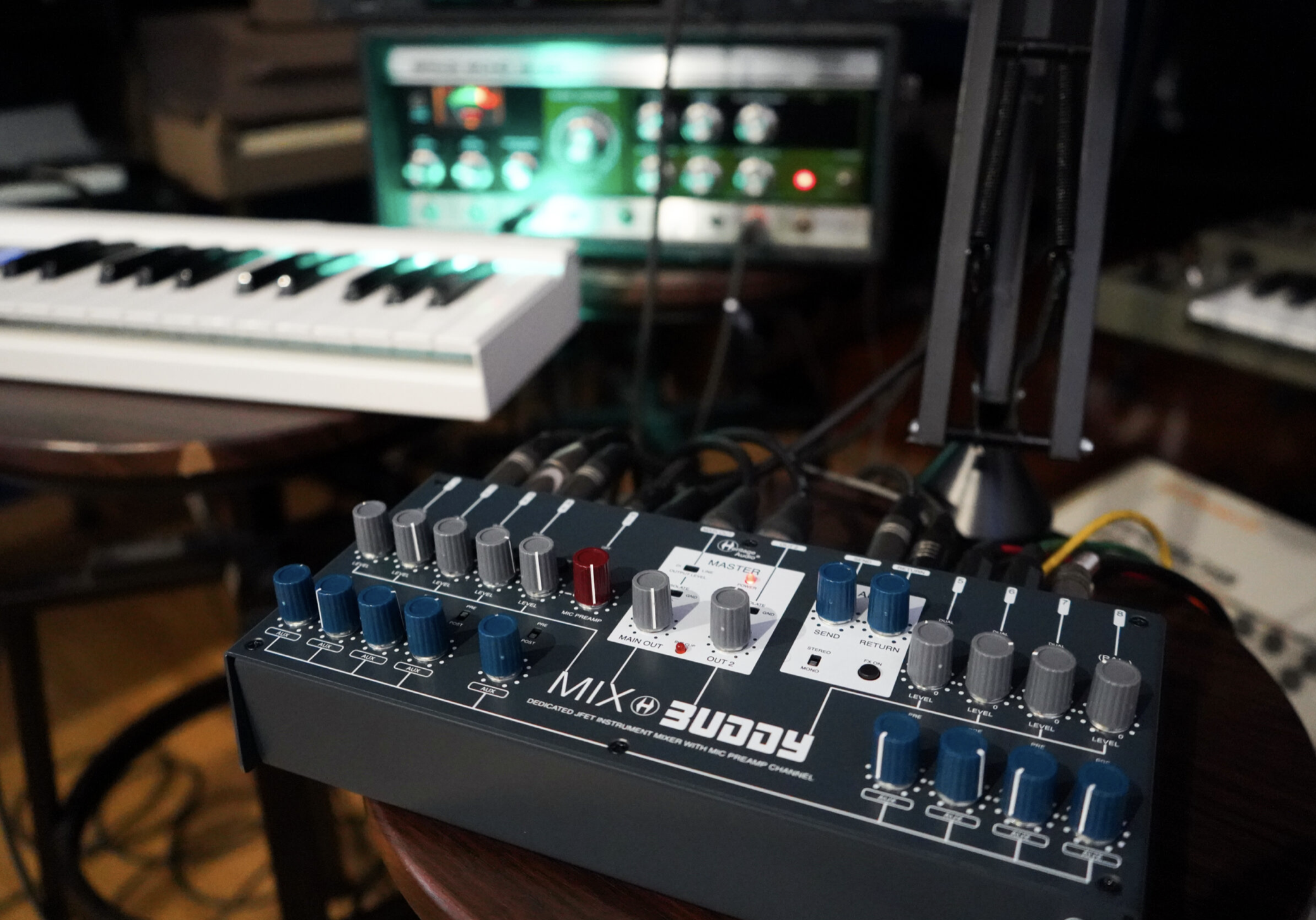
The Mix Buddy packs 19 inputs across two JFET topologies, a mic preamp and Heritage Audio's 73 DI transformer output into a desktop mixer purpose-built for instruments.
Heritage Audio has launched the Mix Buddy, a 19-input desktop instrument mixer built around JFET circuitry throughout, with a dedicated mic preamp and two independent master outputs.
Catch up on all the latest news here.
Eight hi-gain inputs (four stereo pairs) use Toshiba 2SK JFET 12dB gain buffers, voiced for organic instruments and lower-level sources – for example, passive basses, vintage synths, Rhodes – where the slight colouration adds character. Six unity channels (three stereo pairs) use the same JFET topology at unity gain, staying out of the way of higher-output sources like drum machines, active basses and modern synths. Both channel types include a THRU output, volume control, mute and a pre/post fader AUX send.
Mic preamp duties fall to a JFET input stage with up to 70dB of gain, phantom power and AUX loop routing, so vocals can run through a pedal chain without external gear. A balanced stereo line input handles interfaces and computers and supports daisy-chaining multiple Mix Buddy units, while a stereo FX return doubles as an additional input pair.
The main output runs through Heritage Audio’s 73 DI transformer circuit, the same one used in their standalone DI boxes, with a switchable line or mic level output for going direct to a console or front of house. Main Out 2 is transformerless, for a clean, uncoloured mix path. A headphone amplifier with its own volume control on the front panel gives a third independent listening path, and a global FX on/off switch handles instant wet/dry comparison.
The Mix Buddy sits on the desk rather than in a rack. For studios juggling passive instruments, drum machines, mics and modern synths through a single mixer, the input channel diversity alone makes it worth a look.
Learn more at Heritage Audio. For local enquiries, head here.