The single-oscillator analogue desktop synth keeps Yamaha's original panel labelling and adds paraphonic modes, a ring modulator and a step sequencer.
Behringer’s long-rumoured CS Mini now has its own product page, taking a voice inspired by Yamaha’s CS synths and fitting it into one of the company’s palm-sized desktop units.
Yamaha launched the CS-80 in 1977, and it’s become one of the most sought-after polysynths ever made, thanks largely to Vangelis and his Blade Runner soundtrack. Original units now sell for eye-watering sums. Behringer first floated the idea of a mini version on social media in 2022, and after a prototype, a mention in its Synthtribe software and a sighting at a trade show in China, the CS Mini has finally surfaced with a demo video.
Catch up on all the latest news here.
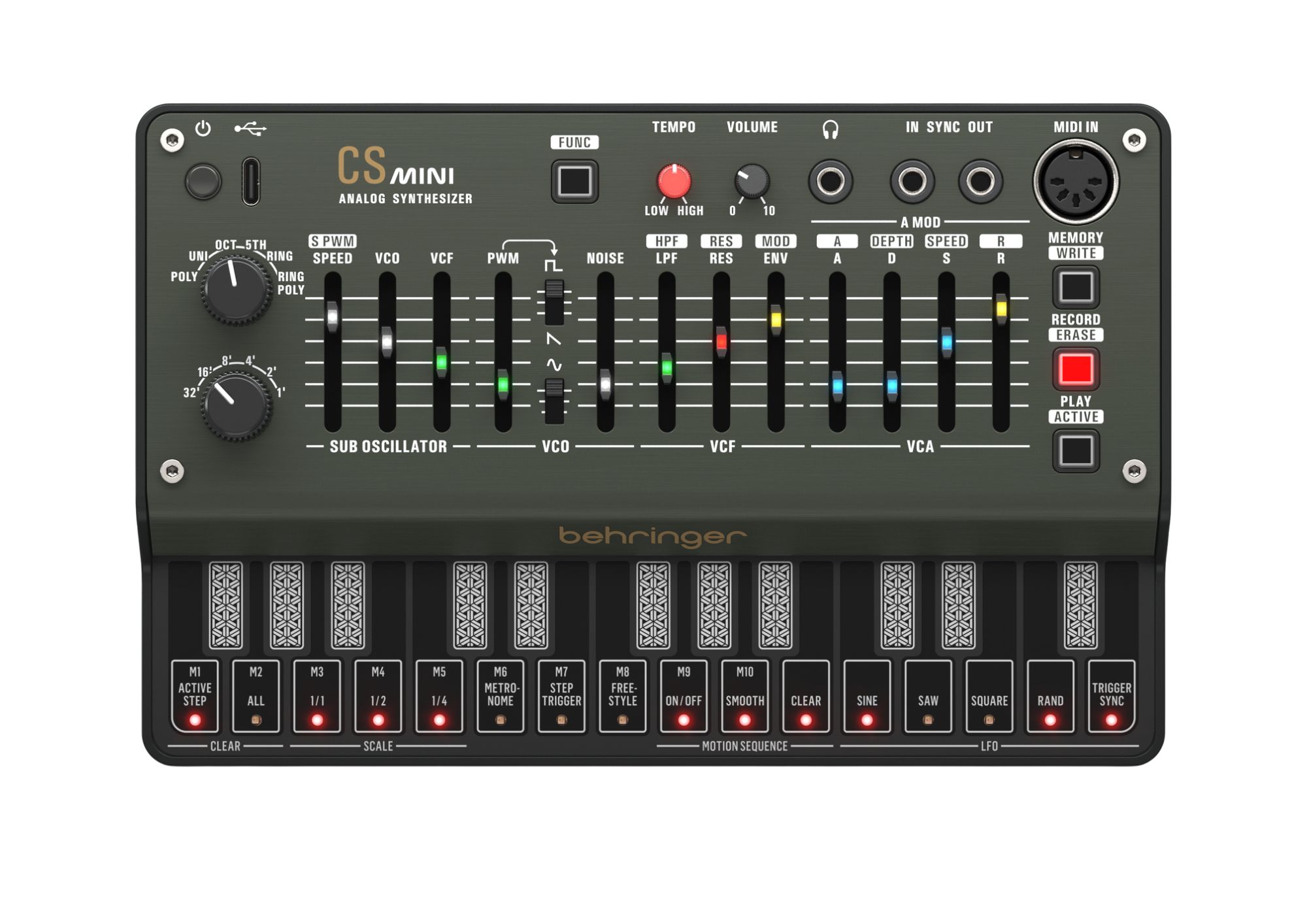
It’s built around a single analogue oscillator with sawtooth, sine and pulse waves that can all be selected at once, along with noise and an octave range running from 32′ down to 1′. The pulse wave gets PWM from the internal LFO. Behringer has also kept Yamaha’s original panel labelling, so the control marked “sub-oscillator” is actually an LFO rather than a true sub.
The filter switches between low-pass and high-pass, each with its own cutoff and resonance, and there’s an ADSR amp envelope plus a multi-mode LFO with sine, saw, square and random shapes for vibrato, wah and rhythmic movement. A ring modulator with attack, release, depth and speed controls nods to one of the CS-80’s signature effects. The voice modes cover paraphonic, unison, octave and fifth settings, plus two ring mod modes.
Notes can be played on 27 touch keys or over MIDI, and a built-in step sequencer records parameter changes as well as notes. Connections include USB-C for power and MIDI, a headphone/line output, sync in and out and a 5-pin MIDI input, and the unit can run from a computer, a phone charger or a power bank. Because it’s fully analogue, there are no presets, but full MIDI CC control means third-party patch editors can fill that gap.
For more information, head here