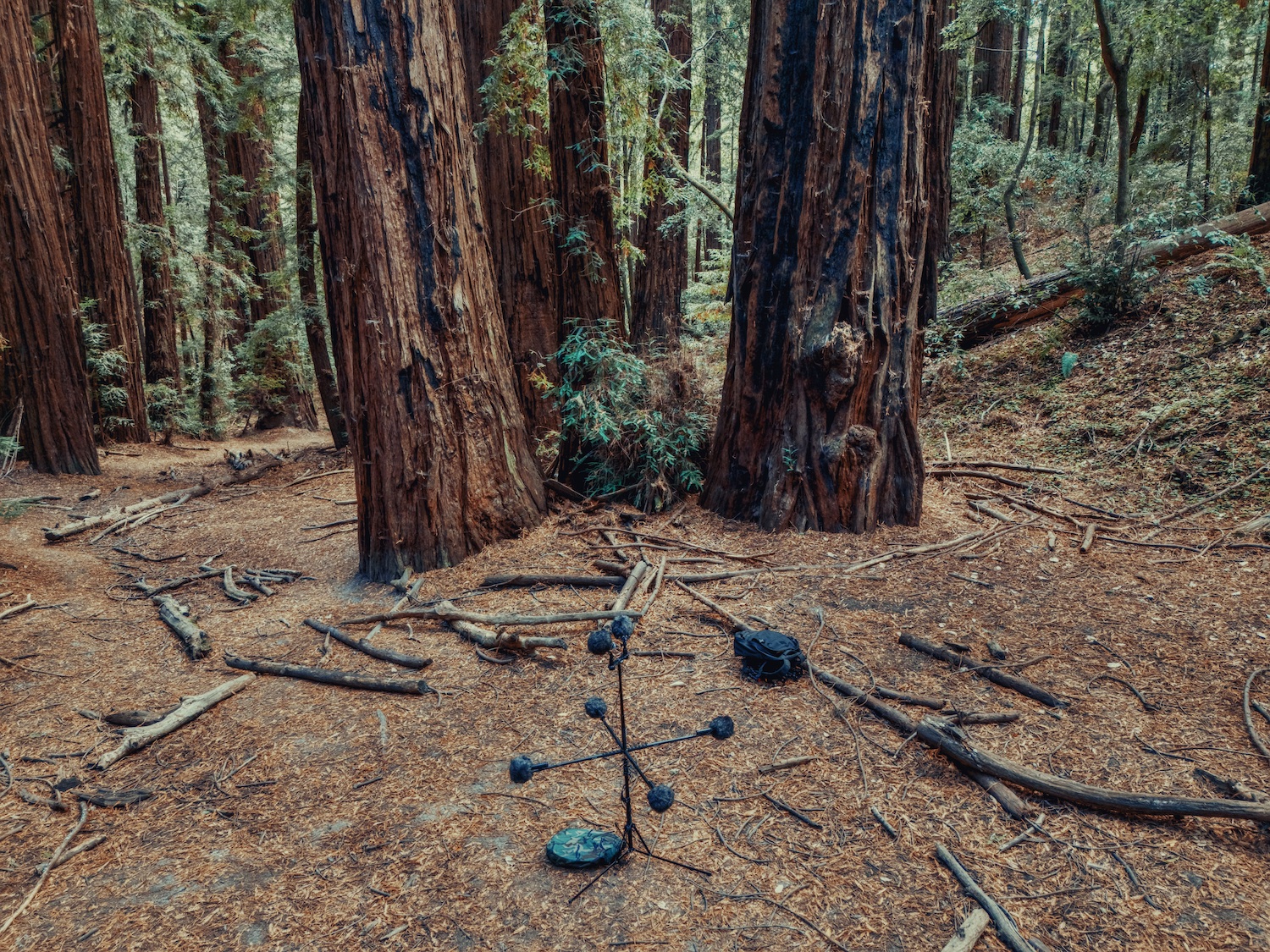
Nature sound recordist Thomas Rex Beverly climbed 70 metres into ancient trees to document their acoustic layers using Sennheiser's flagship condenser mics.
Using the Sennheiser MKH RF Series, Thomas Rex Beverly recently completed one of field recording’s most ambitious projects: capturing the complete sonic profile of California’s ancient redwood forests, from the forest floor to 70 metres up in the canopy. A highly protected area, Beverly states, “More people have climbed Mount Everest than have climbed an old-growth redwood tree.”
Catch up on all the latest features here.
After obtaining permission, Beverly headed to the heart of California’s Santa Cruz Mountains, in a secluded redwood grove. The trees in this conservation area are undisturbed by logging, with some believed to be as old as 1000 years. “It was about ensuring there was minimal noise pollution and that we could access the trees without causing harm,” Beverly explains, adding, “The location was perfect for this kind of deep sonic exploration.”
Beverly primarily used Sennheiser MKH 8000 Series microphones for their clarity, wide frequency response, and ability to capture nuanced, ambient sounds even in the most challenging environments. His setup included the MKH 8020, MKH 8030, and MKH 8040 in various configurations to capture the redwood grove’s diverse acoustics. The MKH 8020 proved particularly effective for capturing the most subtle sounds of the redwoods thanks to its low self-noise and high sensitivity.
“I had a double ORTF setup of Sennheiser MKH 8040s,” Beverly explains. “I was testing directional setups using the MKH 8040 and MKH 8030, pointing the microphones upward to capture the sounds of the tree canopy while recording from the forest floor.” Beverly also deployed an MS stereo configuration combining the MKH 8030 and 8040.
Given the immense height of the redwood trees, capturing sound across multiple vertical layers was essential. “The difference in sound between the base of the forest and 60-80 metres up is huge,” Beverly explains. “On many trees, the branches don’t even start until about 50 metres high, so recording from the forest floor and then from the canopy gives a totally different sonic perspective.”
The objective was to record simultaneously at the base of the tree, then at approximately 30 metres, 60 metres, and 70 metres up. “The mics were all recording in parallel so that when syncing them up, you could hear the same sound from different heights in the tree,” Beverly notes. “For example, when a big wind gust came in, you could hear that at 30, 60 and 70 metres. It gives listeners a deeper look into the micro-ecosystems of the tree.”
During a ten-day period in March 2024, Beverly positioned multiple microphones throughout the grove to capture a range of environmental sounds. His setup included spaced omnidirectional microphones, the double ORTF configuration, and experimenting with the Sennheiser AMBEO VR ambisonics microphone to capture spatial audio across the trees’ vertical landscape.

Having fostered a lifelong fascination with old trees, Beverly’s connection to redwood trees runs deep. “I’ve always been drawn to the stories trees tell through sound,” he says. “Redwoods, in particular, offer a unique perspective on nature. This project was about capturing not just the sound of the forest, but the essence of the trees themselves.”
By using contact microphones carefully positioned on the bark, Beverly could record the unique ‘crackling’ sound of water being drawn up through the xylem of the redwood trees–the tissue responsible for transporting water and nutrients within the tree. Beverly shares, “You get this crackling, almost whispering sound as water moves up through the bark. That’s something the MKH 8020s—great for capturing ambient sounds—couldn’t pick up, so the contact mics really helped create that dimension.”
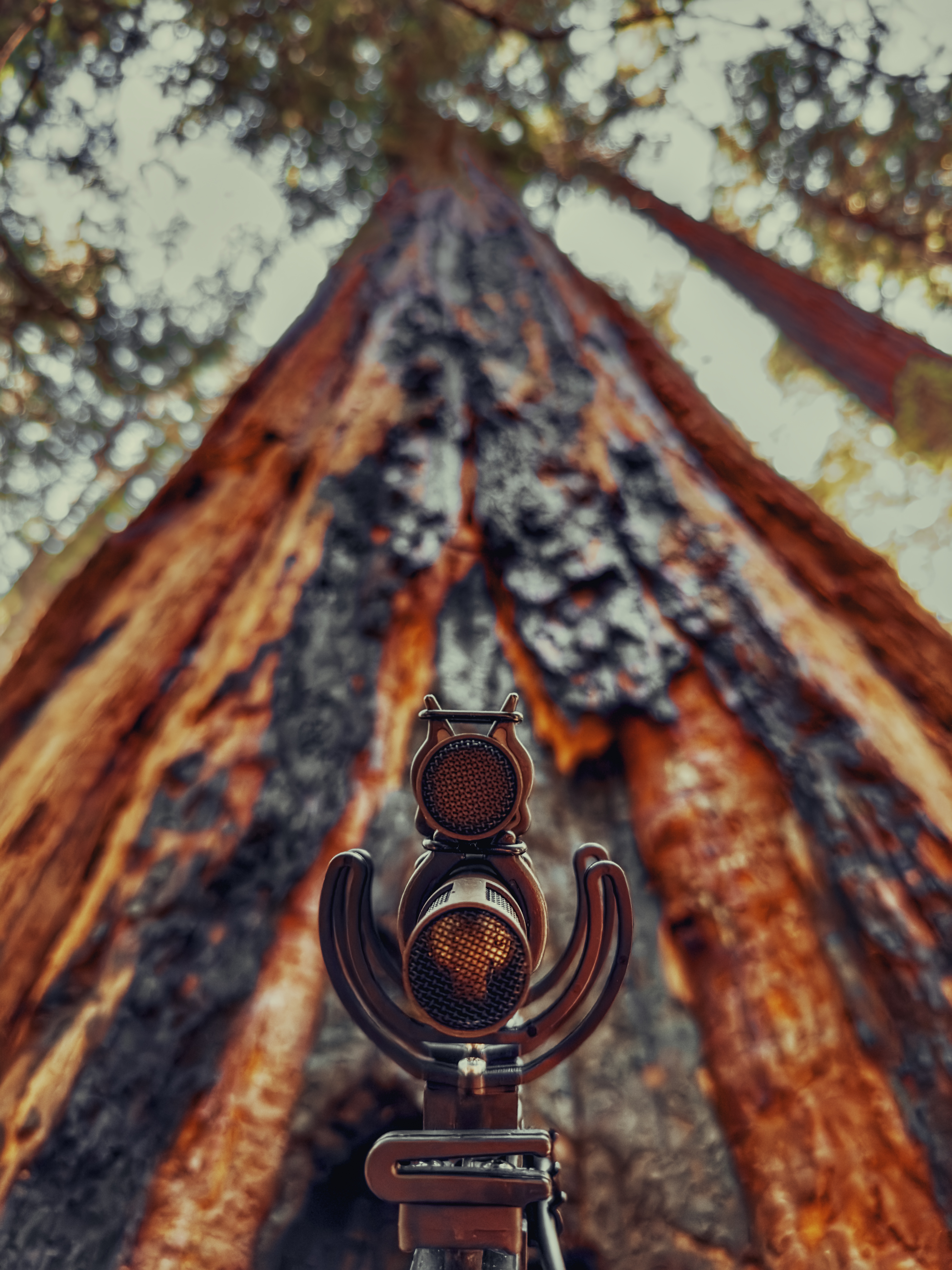
Something like the call of a raven or owl could lead to discoveries: “When the raven made a loud enough call, it vibrated the tree, and I could hear it through the contact mic,” he explains. “It was a unique way of experiencing how wildlife calls can vibrate the tree itself.”
The ability to juxtapose ambient sounds captured by the MKH 8040 microphones with the internal sounds via contact mics gave Beverly a deeper sonic insight into these ancient, living organisms. “It’s a whole new perspective, and it’s conceptually and sonically fascinating to go from the environment outside the tree to the internal life of the tree itself,” he adds.
Following a half-year break to protect rare bird breeding in the redwoods, the pinnacle of the project came when Beverly and two climbing guides set up rigs at varying heights in one tree to record the subtle sounds of the canopy. This required a multi-day process involving tree-climbing gear, crossbows to shoot ropes over branches, and meticulous planning to ensure minimal disruption to the tree’s health.
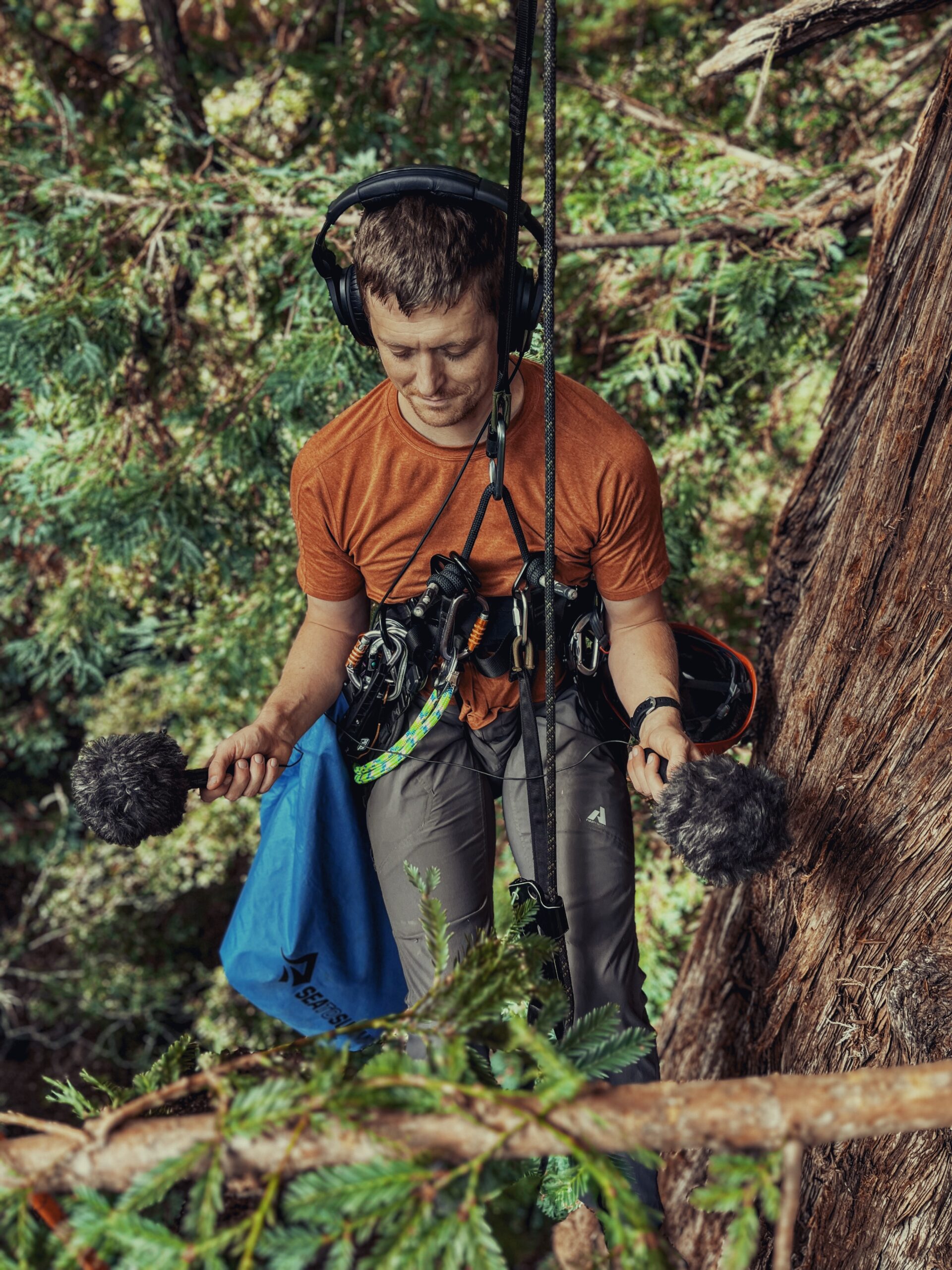
“We started by shooting a fishing line over the top of the branch, which took most of the day. After that, we gradually pulled thicker ropes through and finally set up a climbing rope,” Beverly explains. The process took about three days of careful work.
Beverly placed microphones at multiple heights within the tree to capture sound events from different vertical perspectives. “By having two rigs on the forest floor and three rigs in the tree itself, I could switch between different perspectives if something significant happened, like a branch falling or an animal call,” he explains.
Recording not just at the top of the tree, but also at different points in the lower canopy and at the base, revealed stark differences in sound between layers. “The wind sounds very different depending on where you are in the tree,” Beverly points out. “The needles in the lower canopy are much bigger because there’s not as much light, and they’re trying to get moisture, while at the top of the tree, the needles are much smaller.”
This vertical perspective allowed Beverly to capture subtle shifts in wind, animal sounds, and even the creaks of branches at different heights. “The quietness of the redwood groves is remarkable,” he notes. “There are few animal species here, so when something does happen—a branch breaking, an animal call—it really jumps out. One night, there was a windstorm, and I managed to capture the sound of a giant redwood tree falling. It sounded like an explosion in the distance.”
One of the most innovative aspects of Beverly’s project was his use of 3D microphone arrays. He built a 4.0.2 setup, utilising four MKH 8020 omnidirectional mics in a square formation at the base of the tree, with two MKH 8040s positioned above them. This arrangement was designed to capture the vertical element of the forest’s soundscape, adding depth and dimension to the recordings.
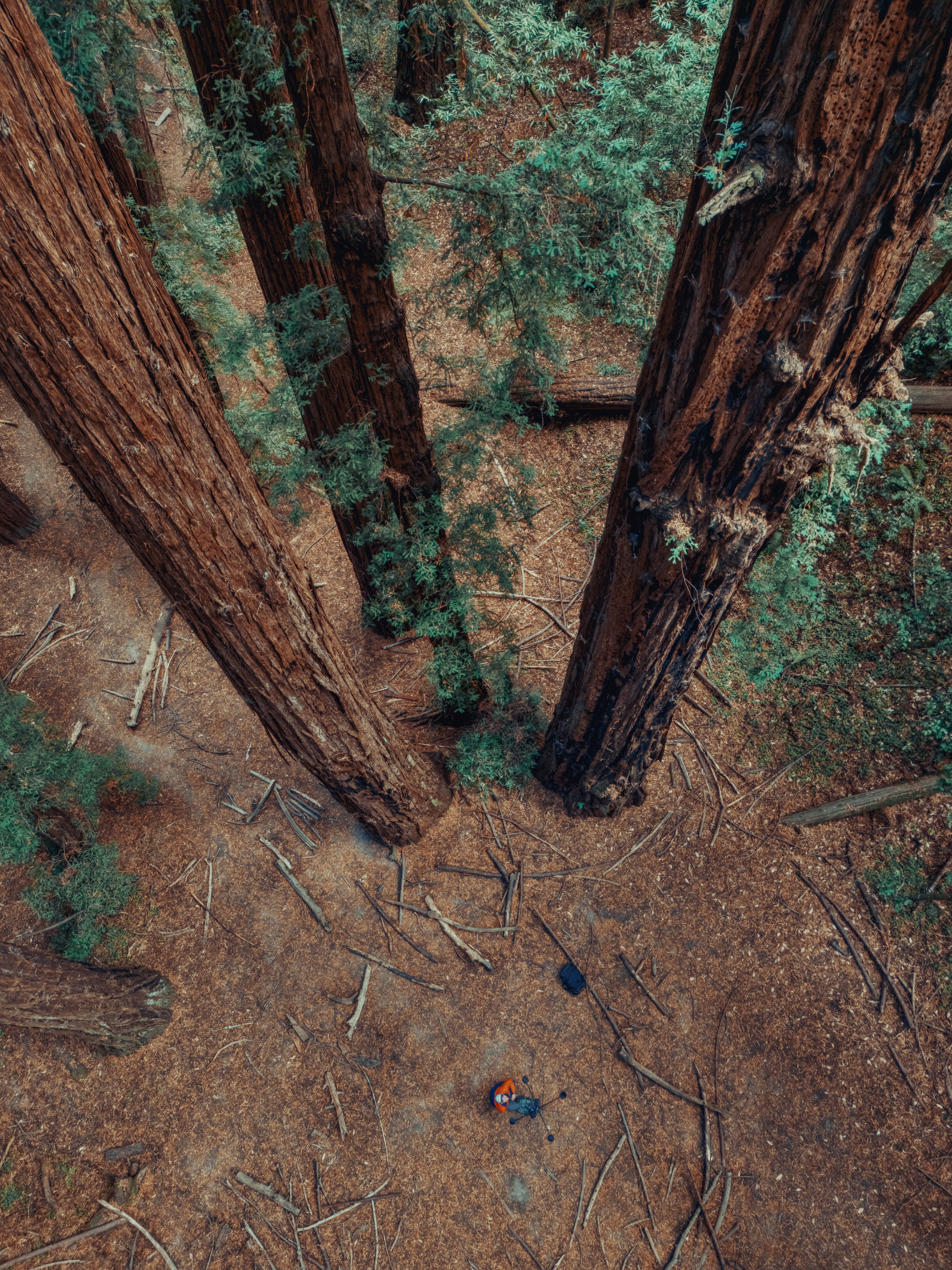
“I was really keen to build 3D mic setups with the MKH 8000 Series mics,” Beverly explains. “The 8020s and 8040s in this array were ideal for capturing the massive vertical component of this environment.”
Beverly set up a similar array at the top of the tree to record sounds from the canopy and integrate them into a 3D mix. “The challenge was managing all the equipment, including ropes and microphones, at great heights,” he says. “But it was an amazing experience. It’s very different from recording in multiple ecosystems miles apart; this was about capturing the nuances of one tree.
“Being in a harness for hours, dealing with batteries and SD cards, while trying to attach everything to the branches—it was tricky,” he adds. “But the reward of being able to capture sounds from the tree’s canopy and juxtapose that with the sounds from the forest floor made it all worth it.”
Beverly even spent the night in a “tree boat” (a hammock suspended nearly 70 metres high), recording with his MKH 8020s. “One of the most surreal moments was when I had calmed down in the hammock and started recording. There was barely anything happening, just the faintest wind gusts moving through the canopy,” he recalls. “But that sense of space, being that high up, with distant owl calls and the wind swirling around you—it was incredible. Seeing the stars from the canopy, a lovely sunrise in the morning, and hearing the whole forest wake up with the dawn chorus, it’s quite surreal.”
Despite the physical challenges, Beverly found the experience deeply rewarding. “It’s one of the trickiest setups I’ve ever done, but also one of the most unique,” he says. “No one has ever really tried to capture the sounds of a redwood tree canopy.”
Beverly’s ambitious project demonstrates the power of high-quality microphones in capturing the delicate sounds of the natural world. This pioneering effort not only sheds light on the rich and complex sound world of the redwood trees but also underscores the importance of preserving and protecting ancient areas.
Check out the Sennheiser MKH RF Series here. For local enquiries, head here.