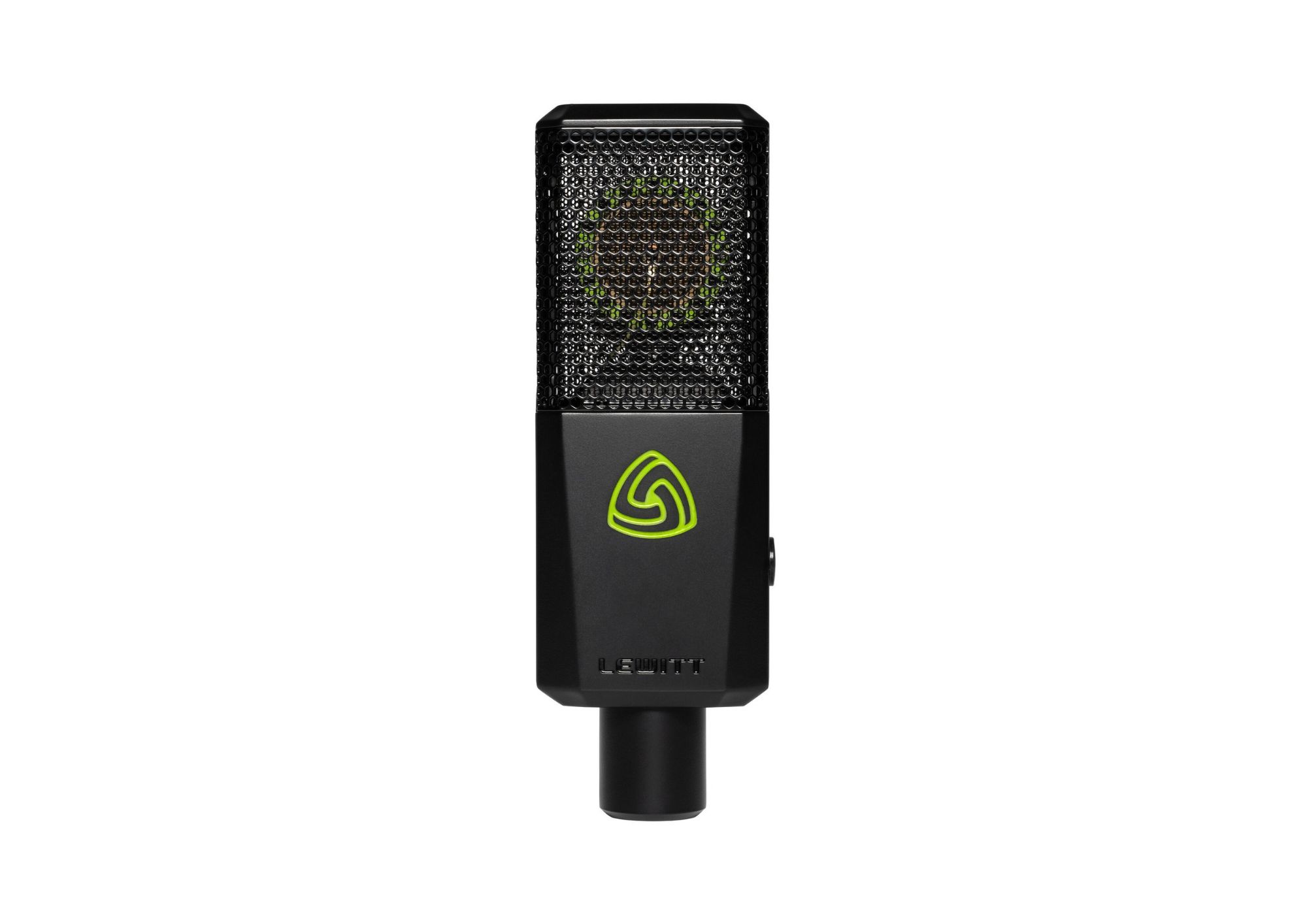
A dual-output condenser that turns a single mic into a stereo pair.
Choose the wrong polar pattern at tracking and you usually live with it. Set a drum room mic to cardioid, realise in the mix it needed more of the room, and the only fix is a re-record. The LCT 640 TS takes that decision out of the tracking session.
The mic uses LEWITT’s one-inch dual-diaphragm capsule, with three-micron, gold-sputtered Mylar diaphragms front and rear. In Multi-Pattern Mode it behaves like a conventional large-diaphragm condenser. You select one of five patterns from the front panel: omni, wide cardioid, cardioid, supercardioid and figure-8.
Catch up on all the latest features here.
Dual Output Mode sets it apart from most studio condensers. Hold the centre button for two seconds and the mic sends each diaphragm to its own output: the front to the standard XLR and the rear to a mini-XLR on the side of the body. Each output needs its own phantom power. Record both to separate channels and LEWITT’s free Polarizer plugin turns them back into a single mic, with a slider that sets the pattern inside your DAW. You can compare omni against figure-8 on a vocal while the singer’s on a break, or leave the call until mixdown.
The same mode also lets one LCT 640 TS record in stereo on its own. With the side of the mic pointed at the source, the front and rear diaphragms face left and right, and recording both outputs to a stereo track gives you two signals from a single capsule, which LEWITT pitches as Mid-Side recording without a second mic. Because both signals come from the same point, they stay in phase, so there’s no time spent nudging mics around to fix phase problems, and the stereo width is set afterwards in the mix by how far apart you pan the two tracks. That’s handy for acoustic guitar, piano or a room sound when there’s no time or space to rig a pair. If you’d rather use a conventional pair, LEWITT calibrates every LCT 640 TS to the same sensitivity at 1 kHz with its Perfect Match process, so any two of them work as a matched stereo pair straight out of the box.
Everything else on the mic is electronic. Separate buttons control the pad and the low cut:
- Pad: 6, 12 or 18 dB, which engages automatically if the mic overloads.
- Low cut: 40 Hz or 80 Hz at 12 dB/octave, or 160 Hz at 6 dB/octave for reining in proximity effect on close vocals.
You can lock the controls so a bumped button doesn’t undo your settings mid-session. The LEWITT logo doubles as a status light: white in normal use, red on overload and green in Dual Output Mode.
Tonally, the LCT 640 TS is clean and detailed, with a lift in the upper presence region and little change in character between patterns. Self-noise of 10 dB(A) makes it a good fit for quiet sources like spoken word and fingerpicked guitar. At the other end, a 134 dB max SPL (more than 150 dB with the full pad) has guitar cabs and kick drums covered.
Based in Vienna, LEWITT was founded by Roman Perschon, who worked at AKG before starting his own company. The brand has since grown from studio condensers into interfaces, plugins and the Elgato Wave range it co-developed. The LCT 640 TS has also earned recognition beyond the brand: in 2019 it gained certification from the METAlliance, the group of veteran engineers and producers that includes Al Schmitt and Chuck Ainlay. More recently, LEWITT took Sound On Sound’s Best Microphone award three years running with the LCT 1040, Pure Tube and RAY.
At a glance
- One-inch dual-diaphragm true condenser capsule
- Five polar patterns: omni, wide cardioid, cardioid, supercardioid and figure-8
- Dual Output Mode with free Polarizer plugin (AU, AAX, VST)
- Single-mic stereo recording in Dual Output Mode
- Pad: 0, 6, 12 or 18 dB, with automatic engagement on overload
- Low cut: 40 Hz, 80 Hz or 160 Hz
- Self-noise: 10 dB(A)
- Max SPL: 134 dB (0.5% THD, no pad)
- Sensitivity: 31.4 mV/Pa
- Dynamic range: 124 dB(A)
- Frequency range: 20 Hz–20 kHz
For local enquiries on LEWITT, head here.