Moog Music has been synonymous with serious synthesis for decades, ever since the very first commercial synthesizer bore the Moog name. The Muse might just be the most complete instrument they've ever created.
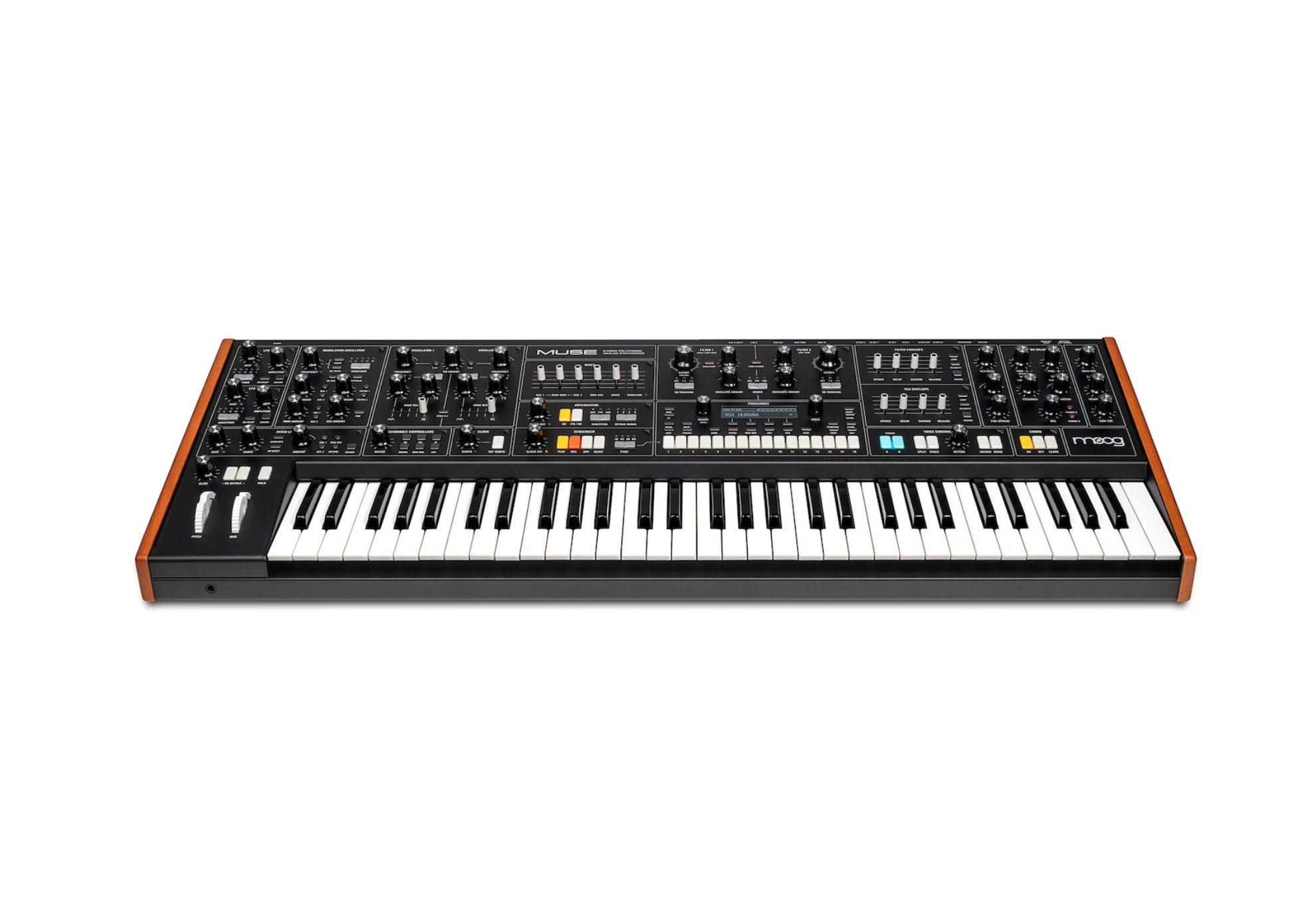
Dubbed by Moog Music as the ultimate live performance synth, the Muse is an eight-voice analog bi-timbral polyphonic synthesizer – built for, and by, modern musicians, producers and sound designers. It’s the culmination of over five years of dreaming, design, and passion, and Moog’s dedication has paid off.
Rather than starting the Muse from scratch, Moog went back through their own catalogue and cherry-picked from the very best of it. Oscillators were shaped from the Minimoog Voyager, brought together by a saturating mixer, dual transistor ladder filters, and stereo discrete VCAs – all inspired by Moog Modular circuits. Each of the eight analog voices runs dual VCOs, a modulation VCO, dual VCFs and a stereo VCA, and Moog’s recognisable character runs through all of it.
Catch up on all the latest features and interviews here.
Expressive and expansive, the Muse is designed for players and sound explorers alike – you could get lost in it for hours on end. The sonic possibilities are basically limitless on this synth, with 16 banks of 16 patches – 256 presets right out of the box. For those used to trawling through plugins, the voice count might seem modest on paper – the depth, however, is anything but. You’ll come across lush pads, plucks, leads, and subterranean basses, all bendable to your will through modulation controls, a dedicated macro control, customisable envelopes and flexible LFOs.
The Muse has earned its stage credentials, starting with its 61-key Fatar keyboard, which offers both velocity and aftertouch for an expressive playing surface that responds to touch and dynamics. A Left-Hand Controller, programmable MACRO knob, and “More” menus for every module add even more control while performing. The front panel gives direct access to every parameter of its synthesis engine, which is exactly how it should be on a live instrument.
On the Muse, the arpeggiator is a lot more flexible than usual and becomes more of a compositional tool than a simple playback function. It works by taking the notes held on the keyboard, playing them one at a time in a repeating, rhythmic pattern, with the rate determined by the Clock Tempo and Clock Div settings. Direction controls shape how the pattern moves, and via the Programmer, you can go even deeper – programming a custom rhythm across buttons 1–16, setting gate lengths, and engaging probability controls.
Chord memory lets you save a chord shape and trigger it with a single key press, and with per-key functionality, you can assign a different chord to each key across the entire keyboard. This means complex harmony becomes far simpler, and will free up your other hand for the Left-Hand Controller or MACRO knob while performing. This is also a game changer for singers and multi-instrumentalists, who are often multitasking live.
The polyphonic sequencer does a lot more than play back a fixed pattern, and there are two ways to get into it. Step Record is exactly what it sounds like – the sequencer stops, and you enter notes one at a time, which is handy when you want to build something precise without the pressure of playing it live. Live Record flips that around. The sequencer runs and captures whatever you play in real time, which feels a lot more natural while you’re working things out. Either way, you’ve got 256 independent 64-step sequences to work with, each of which can optionally reference a specific patch, so there’s plenty of room to move.
Parameter recording, generative and probabilistic functions, and per-note editing mean you can set something and keep tweaking it in real time, adding movement and dynamics rather than just looping the same thing over and over. For anyone running a hybrid setup, it goes well beyond the Muse itself. The sequencer can drive external gear polyphonically via MIDI, run two independent monophonic sequences simultaneously via CV, and sync with just about anything else in your studio via MIDI or CV.
On the modulation side, you’ll get two LFOs for general use, each with adjustable waveform shapes, plus a third dedicated purely to pitch, so vibrato and pitch expression have their own lane and don’t eat into your other modulation options. Two loopable ADSR envelopes handle the dynamics side of things, and while they come pre-wired to the filter and volume out of the box, they can be assigned to just about anything on the panel.
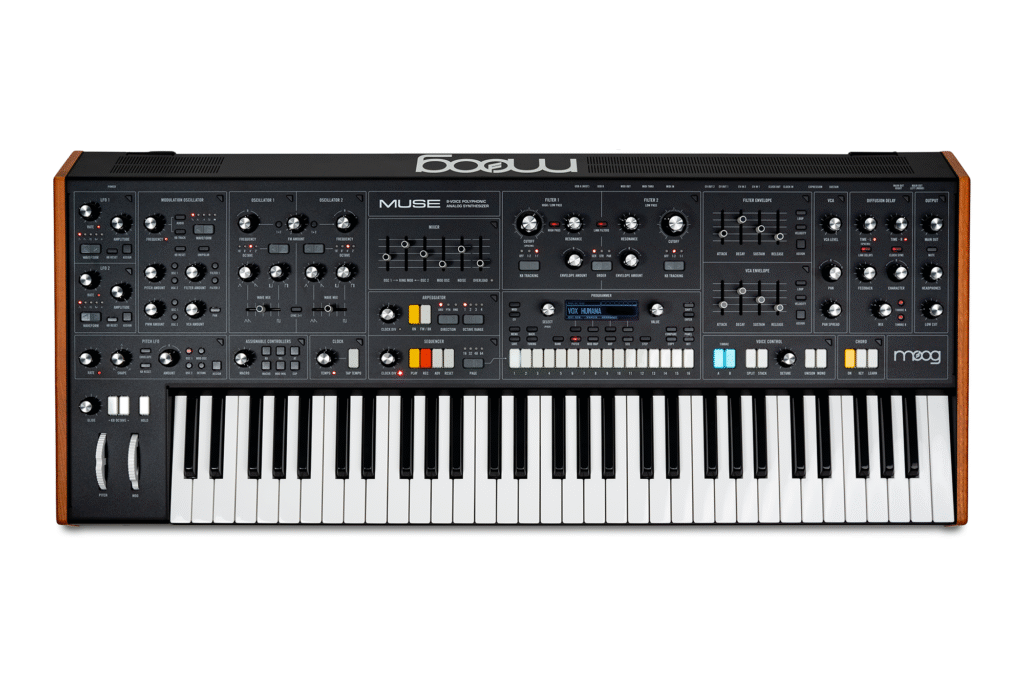
Pulling all of that modulation together is the Mod Map, a dedicated system where all modulation settings are created and stored. You can set up routings quickly using the Assign buttons directly on the modulation sources, or go deeper through the Mod Map button in the Programmer if you want more precise control. You’ll get a 16-slot modulation matrix per timbre per patch, meaning you can route almost any source to almost any destination and dial in exactly how much and in which direction. It’s deep, but the knob-per-function layout and “More” menus for every module keep everything accessible rather than overwhelming, especially while performing.
The onboard Diffusion Delay is worth noting. Inspired by vintage digital rack delays, it goes well beyond a basic echo. You’ll get everything from diffuse reverb-like trails and filtered echoes to multi-tap stereo ping-ponging. It syncs to global tempo and can be bypassed per timbre independently, so both layers of your patch aren’t locked to the same effect.
Every patch on the Muse contains two independent timbres, and what you do with them is pretty much up to you. Stack them for thick, layered bi-timbral sounds, split them across the keyboard to run two entirely different patches at once, or use the voice control section to decide exactly how many of the eight voices each timbre gets. For anyone who’s ever hauled two keyboards to a gig to pull that off, the Muse makes a pretty strong case for leaving one of them at home.
Moog’s Muse means there’s no compromise when it comes to analog sound and a performance-ready synth – it’s made for both. It’s deep enough for serious sound designers and immediate enough for the stage, which is a balance that can be pretty hard to pull off. From everything on offer here, it’s difficult to argue with the result.
The Moog Muse is now available at a special limited‑time price through authorised Moog dealers in Australia. Find your Moog music Australia dealer here.