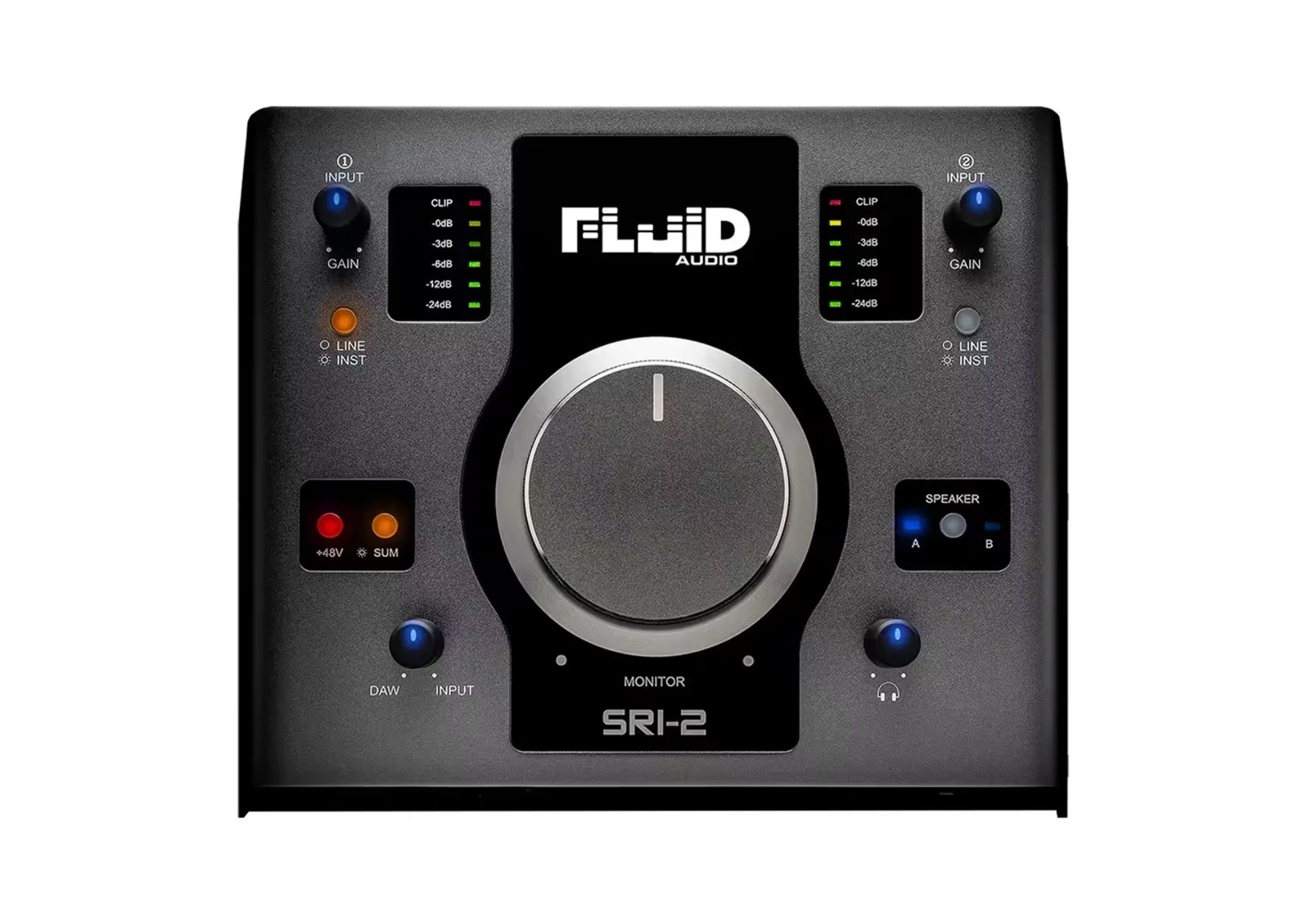
Fluid Audio’s wedge-shaped desktop interface pairs two Class A preamps with outputs for two sets of monitors, so a mix can be checked on a second pair with one press of a button.
Most home studios run into the same problem sooner or later. The interface is sorted, the monitors are set up and the mix sounds great in the room, right up until it’s played in the car and the vocal disappears under a wall of bass. Fluid Audio has spent years on the speaker side of that problem with monitors like the FX8 and C5, and the SRI-2 tackles it from the interface end. Alongside two mic preamps and 24-bit/192 kHz conversion, the wedge-shaped desktop unit can drive two pairs of monitors and switch between them from the front panel.
Catch up on all the latest features and reviews here.
Checking a mix on a second, different-sounding pair of speakers is one of the simplest ways to catch those problems before a track leaves the studio. It’s usually a job for a separate monitor controller wired in next to the interface, but the SRI-2 builds the switching in and saves another box and its tangle of cables on the desk.
Preamps and inputs
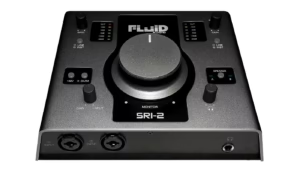
Recording duties go to two Class A preamps on combo XLR/quarter-inch inputs, each with up to 46 dB of gain and +48V phantom power for condenser mics. A button on each channel flips between mic, line and instrument level, and in instrument mode the input switches to a 1 MΩ Hi-Z load with up to 52 dB of gain, enough for low-output pickups. A passive guitar run into a standard line input tends to come through duller and quieter than it should, and the higher impedance keeps its top end and level intact. LED meters on each channel show where the levels are before they reach the DAW.
The line inputs accept signals up to +25 dBu, with gain running from -11 to +29 dB. Because that range dips below zero, a synth or outboard compressor that comes in hotter than expected can be pulled back at the interface, without anyone having to get up and chase the level at the source.
Conversion and sample rates
Fluid Audio quotes 104 dB of dynamic range on the mic inputs and a frequency response within 0.1 dB across 20 Hz–20 kHz, a flat response that keeps the preamps from tilting the sound one way or the other. Sample rates run from 44.1 kHz up to 192 kHz, taking in 48, 88.2, 96 and 176.4 kHz along the way, so a session for a video project can stay at 48 kHz while a high-resolution recording goes higher.
Direct monitoring
For tracking, a direct monitoring knob blends the incoming signal with playback from the DAW. Monitoring through software adds a small delay, and it’s most noticeable on vocals, where a singer hearing themselves a fraction late can be enough to throw a take. Hearing the input directly gets around that. By default, input 1 sits on the left and input 2 on the right, so a SUM button folds the two into mono. That’s handy when singing and playing at once, putting voice and guitar together in the centre instead of one on each side.
Switching between two pairs of monitors
Plenty of interfaces this size stop at a single pair of monitor outputs, but the SRI-2 has four balanced TRS outputs for two pairs of speakers, with a front-panel button to flip between them. A mix can go from the main monitors to a smaller pair, or to a set of cheap computer speakers standing in for what most listeners will hear, with one press instead of a reach around the back of the desk to swap cables. Master volume runs through a solid aluminium knob with a rubber grip, and Fluid Audio quotes 102 dB of dynamic range and 0.0014% THD+N on the main outputs.
The headphone output has its own level control and delivers 75 mW per side into 32 ohms, with an output impedance under 10 ohms. A low output impedance generally suits low-impedance headphones, which covers most of the closed-back models people reach for when tracking.
Build, power and compatibility
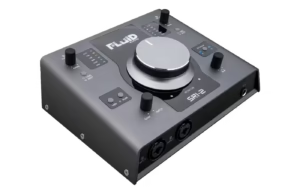
The anodised aluminium chassis keeps it solid, and the angled wedge shape tilts the controls up towards whoever’s sitting at the desk. The SRI-2 runs entirely on USB 2.0 bus power, phantom power included, so a laptop is enough to run a two-mic setup away from the studio. It’s class compliant on Mac and Windows, with a full Windows driver available from Fluid Audio for DAW use. An iPad works too, through Apple’s Camera Connection Kit and a separate power supply into the SRI-2’s micro USB input. Paired with Cubasis, that’s a lighter rig than a laptop for capturing ideas in a rehearsal room.
In the box
Cubase LE for desktop and Cubasis LE for iPad are both included, along with a USB cable, so there’s enough to start recording straight away. When Performer Magazine reviewed the SRI-2, it listed no cons at all and recommended it to budget-conscious home studio owners, singling out its practical features and sturdy build.
Who it’s for
For a songwriter tracking vocals and guitar at home, two inputs and direct monitoring will cover most sessions, and a podcaster can run two condenser mics straight from a laptop with phantom power coming over USB. The monitor switching is the part that keeps earning its place once the recording’s done. Anyone who adds a second pair of speakers down the track has a quick way to hear how a mix holds up away from the main monitors, which is the kind of check that stops it falling apart in the car.
For local enquiries, head here