From James Jamerson's Motown pocket to Thundercat's genre-defying six-string virtuosity, these are some of the most iconic bass players who pushed the instrument far beyond its supporting role and changed the way we hear music.
For much of rock and roll’s early history, the bass was a background instrument – something that was felt more than heard, holding down the low end while the guitarists got all the glory. Then a handful of players came along and fundamentally changed the conversation, turning the bass into a rhythmic, melodic voice and a compositional tool.
Here are some of the most influential and iconic bass players.
Read more gear features, artist interviews and columns here.
James Jamerson
Few players have had as much influence on the electric bass as James Jamerson. The Motown session legend played on more hits than almost any musician in history, often uncredited. He brought an improvisational fluency to the electric bass that nobody had heard before, drawing heavily on his upright bass background to create melodic, syncopated lines that sat deep in the pocket while constantly moving within it. His work on tracks like Marvin Gaye’s ‘What’s Going On’ and The Four Tops’ ‘Bernadette’ remains some of the most studied bass playing ever committed to tape. Jamerson played a 1962 Fender Precision Bass he nicknamed “The Funk Machine” – a battered, string-heavy instrument that became inseparable from his sound.
Jaco Pastorius
Few instruments have a “before and after” moment as clearly defined as the electric bass. Jaco Pastorius is that moment. The Florida-born prodigy arrived on the scene with Weather Report in the mid-1970s, playing a fretless bass with the melodic authority of a horn player and the harmonic sophistication of a jazz pianist. His self-titled 1976 debut album, opening with ‘Donna Lee’, a Charlie Parker bebop head played in full on a fretless bass, announced in no uncertain terms that the rules had changed. Pastorius famously removed the frets from a cheap Japanese Fender Jazz Bass, filled the slots with wood putty and lacquered the fingerboard, creating the instrument he’d play for much of his career.
Paul McCartney
It’s easy to overlook just how inventive Paul McCartney’s bass playing was, largely because it sounds so natural within the context of Beatles recordings. But listen closely and the melodic lines are undeniable – particularly from Revolver onwards, where McCartney began treating the bass as a lead instrument, weaving counter-melodies around Lennon and Harrison’s guitar parts rather than simply anchoring the chord progression. Songs like ‘Something’, ‘Come Together’ and ‘Rain’ feature bass lines that are as compositionally significant as any other element in the arrangement. McCartney played a Höfner 500/1 violin bass in the band’s early years before switching to a Rickenbacker 4001S, both of which became iconic in their own right.
John Entwistle
In a band featuring Keith Moon on drums and Pete Townshend on guitar, it would have been understandable for the bass player to stay at the back and let the legends take the stage. John Entwistle was a legend himself. Dubbed “The Ox,” Entwistle developed an aggressive picking style and a bright, trebly tone that cut through The Who’s controlled chaos rather than sitting beneath it, essentially playing lead bass in a band that had no conventional lead guitarist. His isolated bass tracks, particularly on ‘My Generation’, remain to be a jaw-dropping listen. Entwistle favoured heavily modified Fender Precision and Jazz basses throughout his career, and was one of the first bass players to use Marshall stacks.
Larry Graham
Slap bass didn’t begin with Larry Graham, but it effectively starts there for most listeners. The Sly & the Family Stone bassist developed his thumping and plucking technique out of necessity – early gigs with his mother’s duo had no drummer, so Graham began percussively slapping the low strings with his thumb to compensate. The result was an entirely new approach to the instrument that would go on to define funk bass for decades and directly influence players from Marcus Miller to Flea. Graham’s work on ‘Thank You (Falettinme Be Mice Elf Agin)’ and ‘Everyday People’ is foundational listening for any bass player, and his later group Graham Central Station pushed the technique even further.
Peter Hook
While most bass players hold down the low end, Peter Hook built his entire style around melody. The Joy Division and New Order co-founder developed a playing approach that was unlike anything else in post-punk – running his bass high up the neck, often in the upper register where guitars would normally sit, while the guitars dropped back into a more textural role. The result was a sound that was instantly identifiable and deeply influential on generations of alternative and indie players who followed. Hook’s melodic, lead-driven lines on Joy Division tracks like ‘Shadowplay’ and ‘Transmission’ gave the band much of its emotional weight, and his work with New Order, particularly on ‘Blue Monday’ and ‘Bizarre Love Triangle’ – translated that approach seamlessly into electronic music. He has long been associated with his distinctive Yamaha BB series basses, typically played with the strap set low and his right hand positioned near the neck for that characteristic warm, resonant attack.
Flea
There’s a strong argument that Flea is the reason an entire generation of teenagers picked up a bass guitar in the ’90s. The Red Hot Chili Peppers’ explosive bassist brought a physicality and showmanship to the instrument that was impossible to ignore – all flying fingers, slap technique and shirtless energy – while simultaneously being a genuinely sophisticated player capable of locking into a groove as deep as anyone. His melodic bass intro to ‘Under the Bridge’ alone has been learned by more beginners than almost any other bass line of its era. Flea has played a range of instruments over the years, most notably a series of Music Man StingRays and his signature Flea Jazz Bass by Fender.
Charles Mingus
As a double bassist, composer and bandleader, Charles Mingus occupies a singular space in music history. His bass playing was ferociously physical and harmonically complex, but it’s his compositional voice that truly set him apart. Mingus approached the bass as the centre of the ensemble rather than its foundation, building entire musical worlds around its low register. Albums like The Black Saint and the Sinner Lady and Mingus Ah Um remain high watermarks of jazz composition and performance, and his influence on how musicians think about bass in an ensemble context is difficult to overstate.
Bootsy Collins
James Brown had impeccable taste in musicians. When he hired a teenage William “Bootsy” Collins in 1970, he got arguably the most instinctively funky bassist who ever lived. Collins’ playing with Brown’s band, captured on live recordings from the early 1970s, is a masterclass in rhythmic precision and feel, all locked-in grooves and percussive attack. His later work with Parliament-Funkadelic took that foundation into entirely new territory, combining deep funk with psychedelic excess in a way nobody had attempted before. Collins became as well known for his star-shaped basses – custom instruments by luthier Joe Strain – as he was for his playing, creating one of the most recognisable visual identities in music.
Kim Deal
Alternative rock’s relationship with the bass changed significantly when Kim Deal started playing one. The Pixies co-founder brought a directness and melodic simplicity to her bass lines that perfectly counterbalanced Black Francis’s abrasive guitar work, and her instinct for the right note in the right place was as important to the Pixies’ sound as any other element. Deal was largely self-taught and never particularly interested in technical flash, which turned out to be exactly what made her playing so good and so effective. Her subsequent work with The Breeders, particularly on Last Splash, confirmed her as one of the most distinctive bass voices in alternative music. She’s long been associated with a Fender Bass VI, a six-string bass that she often played more like a baritone guitar.
Thundercat
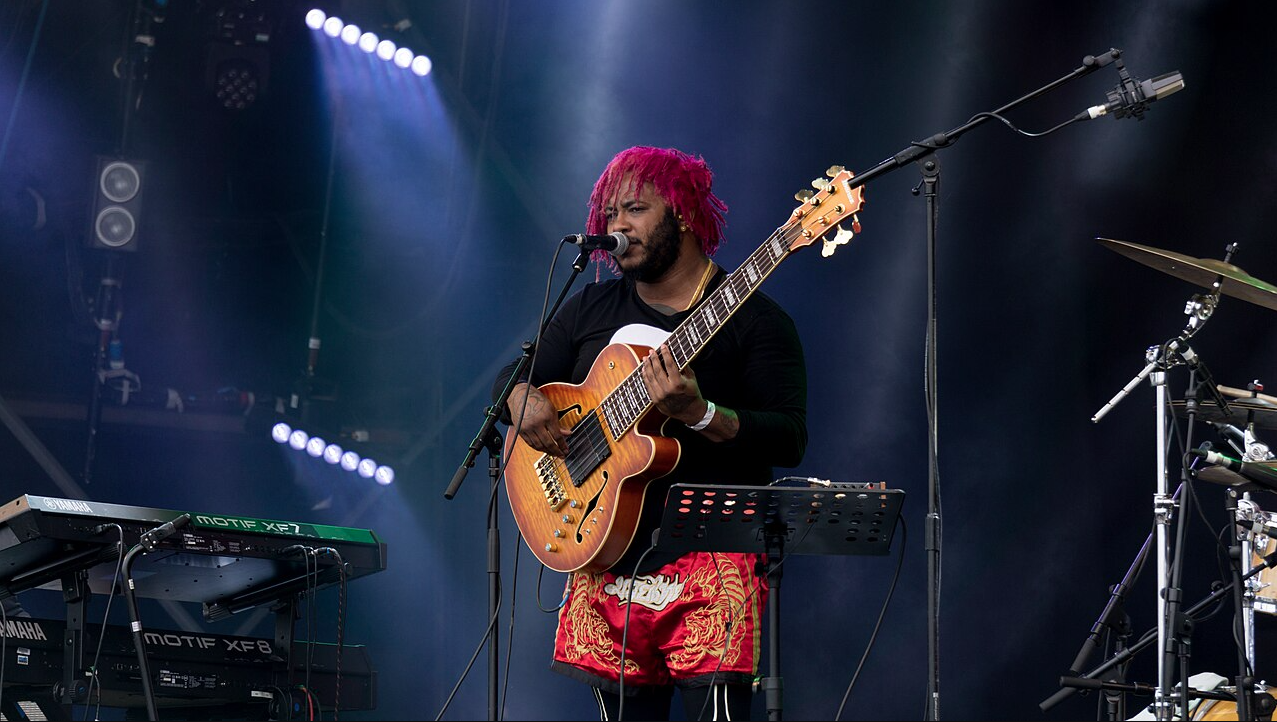
If James Jamerson opened the door and Jaco Pastorius blew it off its hinges, Thundercat rebuilt the whole house. The Los Angeles bassist, born Stephen Bruner, has spent the past decade dismantling virtually every assumption about what a bass player’s role should be, combining jazz harmony, funk rhythm, R&B melody and outright absurdist humour into a playing style that has no obvious precedent. His work as a collaborator and session player for Kendrick Lamar, Flying Lotus and Kamasi Washington has been as influential as his solo albums, and his bass playing on Lamar’s To Pimp a Butterfly is some of the most technically and emotionally complex work the instrument has produced in recent memory. Thundercat plays a custom Ibanez signature model, the THB600 – a 6-string bass built to handle the full harmonic range his playing demands.