From Duane Eddy's session work to Victoria De Angelis's signature Longhorn, Danelectro's masonite-bodied guitars have turned up in the hands of artists across alternative rock, pop and country.
Nathan Daniel founded Danelectro in Red Bank, New Jersey back in 1947. For the first few years, the company didn’t even put its own name on anything, but built amplifiers for Sears and Montgomery Ward instead. These amps were sold under Silvertone and Airline, badges that those department stores used for their own gear. When Danelectro moved into guitars, they applied the same kind of logic – to build something good enough, fast enough, and cheap enough to move through a catalogue rather than a music store.
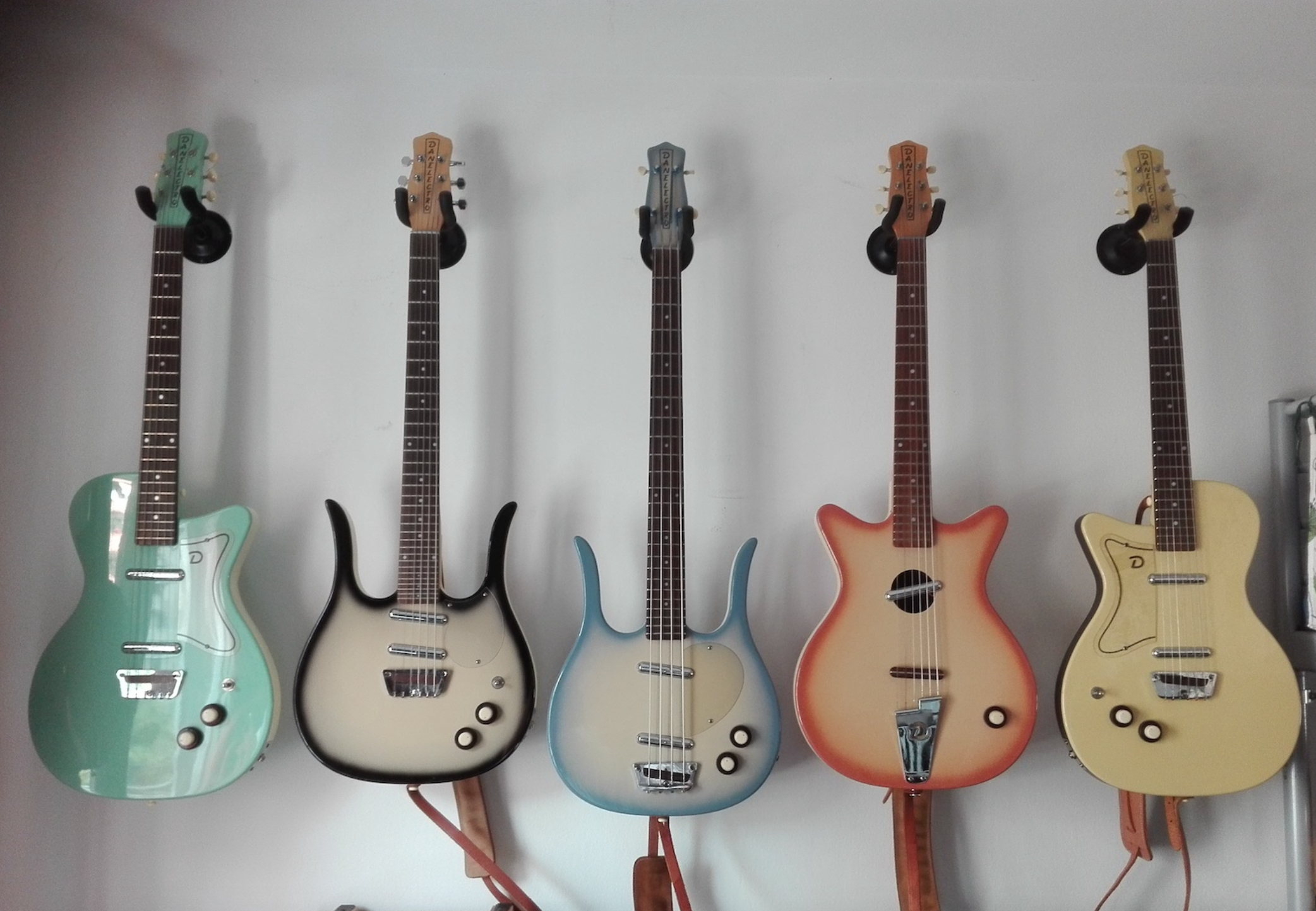
That meant using masonite instead of solid wood. Masonite is a dense hardboard, originally made for things like flooring and furniture backing. Daniel used this because it was quick to work with and far cheaper than carving a body from mahogany or alder. The same instruments went out under two names, distinguished mostly by their covering: Silvertone in maroon vinyl for Sears, Danelectro in light tweed for everyone else. The pickups got the same budget treatment, housed in actual lipstick tube casings because they were cheap, available, and roughly the right shape.
By 1956, Danelectro built a six-string bass – at this time, an odd instrument, and one that never broke through commercially. It did, however, find a permanent home in Nashville and LA session work for “tic-tac” bass parts. A 1966 sale to MCA was supposed to take the company further upmarket, but the new owner’s push to sell through small guitar stores rather than department stores backfired, and Danelectro folded in 1969. The brand sat dormant until the late ’90s, when new ownership relaunched it with reissues of the old Silvertone and Danelectro designs, alongside a new line of effects pedals that’s kept the company going ever since.
Across Danelectro’s history, what has remained is the tone of the guitars. Masonite doesn’t resonate like solid timber, so Danelectros tend to sound thinner and brighter than a typical guitar, with less natural sustain. Plenty of serious players have leaned into that sound – here’s some of the most notable.
Catch up on all the latest features here.
Notable guitarists who use a Danelectro
Duane Eddy
Eddy built a key part of his sound around a Danelectro baritone, using heavy tremolo and reverb to turn its low-tuned twang into something massive. Tracks like “Because They’re Young” and several others across his catalogue ran on that guitar, and it was used almost exclusively on his 1960 album The Twang’s the Thang – one of the earliest records to show what a low-tuned guitar could actually do.
Jimmy Page
Page picked up a Danelectro 3021 Shorthorn for around £30 in early 1966 and used it through his session career and into Led Zeppelin’s biggest moments. Tuned to DADGAD, it’s the guitar behind “White Summer/Black Mountain Side,” “In My Time of Dying” and “Kashmir” – songs that became permanent fixtures of his live set with the band.
Eddie Van Halen
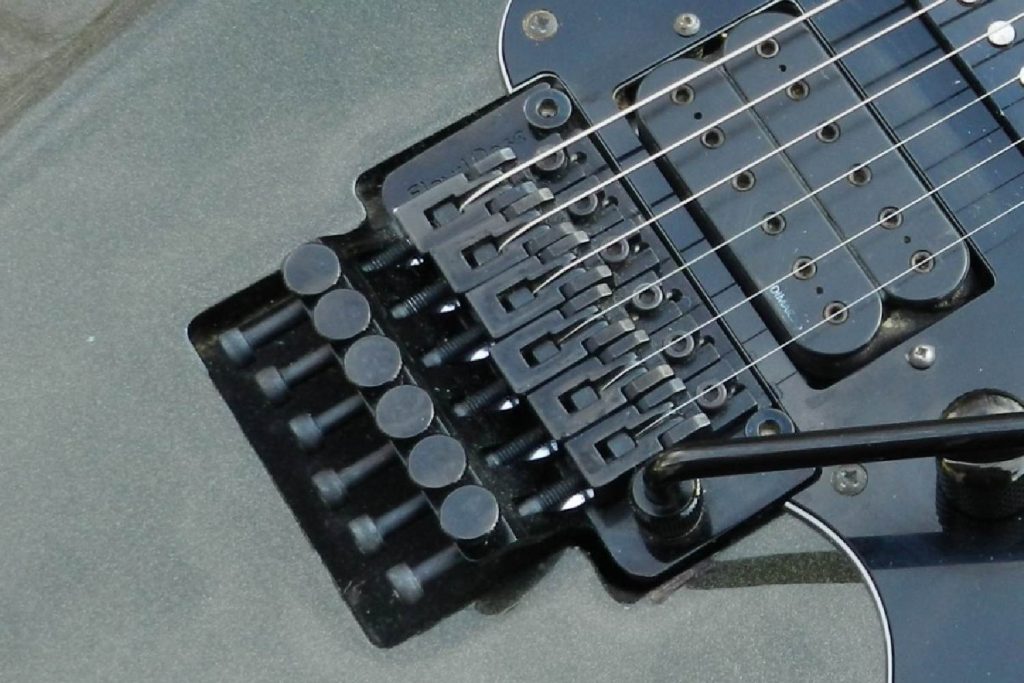
Van Halen’s connection to Danelectro is an unusual one. He bought a body from Charvel and fitted it with a neck from an old Danelectro, along with a Gibson PAF pickup and a Floyd Rose tremolo. That guitar served as a backup during Van Halen’s early touring years before it was later carved into an elaborate dragon-and-snake design known among fans as the Dragonsnake.
Tom Petty
Petty played a Danelectro Longhorn Bass in the Traveling Wilburys’ “End of the Line” video, and also used Danelectro instruments during the recording of Wildflowers. The Longhorn’s distinctive double-cutaway body made it one of the more visually recognisable instruments in the clip.
Peter Buck
R.E.M.’s Peter Buck has long used Danelectro 12-strings – a key part of the jangly, layered guitar work that became one of the band’s defining traits.
Joe Perry
Perry has reached for Danelectro guitars across his career with Aerosmith, on recordings and live. At the band’s Las Vegas residency he brought out a Danelectro 59 12-string for “Seasons of Life,” and also recorded a track with a Danelectro guitar similar to the one associated with Jimmy Page.
Beck
Beck built a chunk of his catalogue around vintage Silvertone and Danelectro instruments, including the Dano Pro, which suits his genre-hopping, slightly lo-fi approach to recording. He’s used Jerry Jones copies of Danelectro models in live settings as far back as Lollapalooza in 1995.
Mark Oliver Everett (Eels)
Eels frontman E has used a handful of different Danelectro models over the years, including a variety of Pro 56 models and a black Danelectro baritone, giving the band’s recordings a warmer, darker low end.
Dan Auerbach
The Black Keys frontman has built a recording rig around off-brand guitars, with Danelectro sitting alongside Harmonys, Supros and Silvertones. On El Camino he used a ’60s Danelectro alongside his ’53 Les Paul and ’58 Stratocaster.
Syd Barrett
Pink Floyd’s original frontman used a Danelectro 3021 as a spare guitar in the band’s early days, most notably during the UFO Club performances in 1966. It can be seen alongside his mirrored Fender Esquire in footage of “Interstellar Overdrive,” where its brighter, thinner character added a different texture to the band’s psychedelic sound.
Ronnie Wood
Wood switches to a Danelectro baby sitar for “Paint It Black” and “Jumpin’ Jack Flash” with the Rolling Stones – the Danelectro original for indoor shows, and a Jerry Jones reissue for outdoor performances where weather is a concern.
Mark Knopfler
Knopfler has used Danelectro guitars across several albums and tours. He used a 1963 Danelectro DC-1 for slide on “Miss You Blue” and “Corned Beef City” from 2012’s Privateering, and a Danelectro Silvertone 1452 extensively on 2004’s Shangri-La – appearing on “Boom Like That,” “Stand Up Guy” and “Don’t Crash the Ambulance.” On the 2019 Down the Road Wherever tour, he kept a Danelectro 59 DC tuned to open C for slide work.
James Hetfield
Hetfield’s Danelectro moment came at Metallica’s 2024 All Within My Hands benefit concert, where he slung a Danelectro ’58 Longhorn Baritone over his shoulder for a blues arrangement of “Fuel” – playing it in the key of B rather than the original’s key of E, giving the song a heavier, more swampy feel.
Phoebe Bridgers
Bridgers picked up a black metalflake Danelectro ’56 Baritone during the recording of her 2017 debut album Stranger in the Alps, after producer Tony Berg had one in his studio. She bought it that same day. The instrument appears throughout the album and opens her 2020 follow-up Punisher with its first note. She has described it as her main writing tool, saying the lower tuning makes everything “darker and less Americana.”
Victoria De Angelis (Måneskin)
De Angelis discovered the Danelectro Longhorn Bass through a used instrument listing, bought it cheaply on a whim, and took it to rehearsals. It became her main instrument and she is now synonymous with the model, with her own signature Longhorn editions available. In a 2022 Guitar World interview she explained the appeal: the short scale, the unique tone, and the fact that not many bass players use one.
Alana Haim
Haim played a Danelectro at the 2021 Grammy Awards and has also been seen with a vintage Danelectro-built Silvertone U-1 – confirmed in a video interview with Reverb. The U-1 is a classic ’50s design, built by Danelectro for Sears under the Silvertone name.