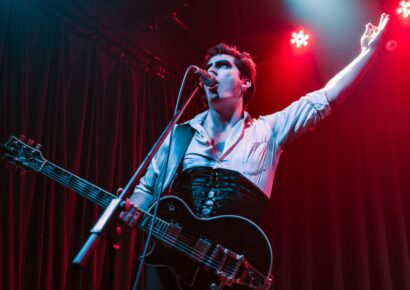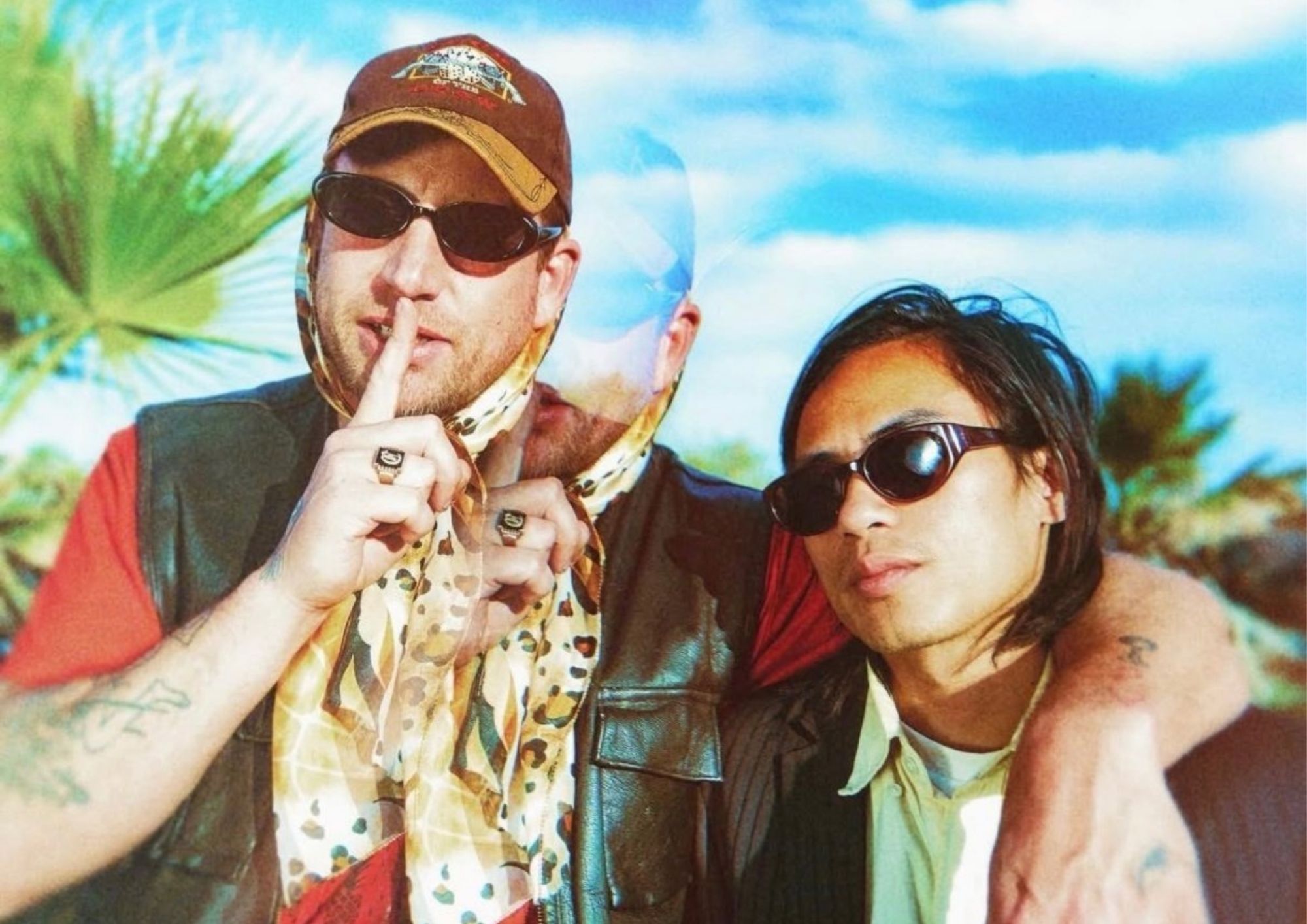
No pedals, no problem. Ahead of their Australian shows in December, we take a look at the gear behind swiftly rising New Orleans duo Twisted Teens.
Caspian Hollywell and RJ Santos were neighbours in New Orleans’ Holy Cross neighbourhood long before they were bandmates, and it was only after Caspian got into the habit of chatting to RJ while he smoked out the front each morning that the pair recorded a couple of songs together and decided to start a touring band. Since putting out their self-titled debut in 2024, they’ve followed it with Blame the Clown and Florida Water Blues this year alone, signed to Sub Pop and lined up a US run supporting Kurt Vile, with their first album for the label, The Holy Cross Tigers, due out in November.
Twisted Teens make country inflected punk music in the loosest sense, with garage rock, power pop, Cajun and old-time music all finding their way into songs that are often pieced together from drum machines and layers of overdubs in a home studio. On stage, though, the pair strip everything back to a straight-ahead rock and roll band, and neither of them uses effects pedals.
Caspian doesn’t even own a tuner, preferring to tune by ear and plug straight into the amp, and has stated, “There’s not a single effect pedal on our stage.” With nothing standing between their instruments and their amps, what they plug in shapes almost everything you hear at a Twisted Teens show.
Read up on all the latest features and columns here.
Caspian Hollywell
Caspian plays a candy apple red Fender Telecaster with a maple fretboard, and since a Tele bridge pickup run into an amp that’s working hard doesn’t need much help to snarl, it’s a natural fit for a player who reckons the best guitar tone has just a little break-up to it rather than being completely clean or fully distorted.
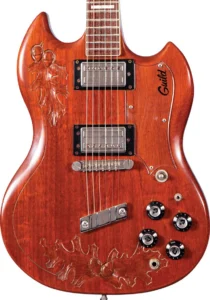
Alongside the Tele is a Guild S-100, a model name Guild first used in 1963 on the Polara before giving it, in 1970, to a new solidbody that borrowed heavily from the Gibson SG, with slightly offset horns, a mahogany body and neck and a pair of humbuckers. Soundgarden’s Kim Thayil made it a grunge icon in the early ’90s, and Guild has revived it several times since. Caspian’s particular S-100 looks to be most likely a 1974 S-100NB, identifiable due to it unique carved top.
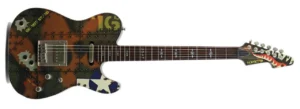
Caspian’s most eye-catching guitar by some distance is his Schecter Flying Tiger. Schecter built its Aviation Collection in small runs between 2003 and 2008 as a tribute to WWII warplanes, and the Flying Tiger takes its look from the Curtiss-Wright P-40 Warhawk, right down to the shark mouth painted across the headstock. Beneath the camo there’s a black-bound mahogany PT body, Schecter’s take on the Tele, along with a maple neck, a rosewood fretboard with stars-and-bars inlays and a Duncan Designed humbucker and single coil, with the humbucker coil-tappable via a push/pull tone knob. Early runs had a USAF logo at the 12th fret, which was historically off the mark given those planes flew under the US Army Air Forces during the war, and while Schecter corrected it in late 2004, Caspian’s still wears the original mistake.
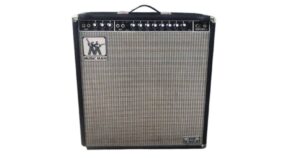
A Music Man 410 Sixty Five combo takes care of Caspian’s amp duties alongside a range of Fender combos, which isn’t as big a jump as it might sound, given Music Man was started in the early ’70s by former Fender men Forrest White and Tom Walker with Leo Fender as a silent partner. The Sixty Five was the company’s first product when it arrived in 1974, a hybrid design pairing a solid-state preamp with two EL34-type power valves for 65 watts, and the 410 version pushes that through four 10-inch speakers in a layout that isn’t far off a Fender Super Reverb.
RJ Santos
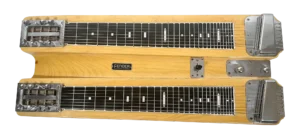
RJ, who’s credited on the band’s first record as Razor Ramone, plays a 1953 Fender Dual Eight Professional in blonde. It’s a console steel rather than a pedal steel, a distinction plenty of reviewers have missed, so much so that RJ has said he’s planning a sign for the next tour that reads “THIS IS NOT A PEDAL STEEL”. Without pedals or knee levers to retune strings on the fly, every chord change comes down to where he places the bar and the angle he holds it at.
Fender launched the Dual Professional in 1946, when Hawaiian and western swing music were hugely popular, and gave it two eight-string necks side by side so a player always has two tunings ready to go. RJ keeps the bottom neck in C6, or sometimes A6, and moves up to the top neck’s open G whenever a song needs big open chords. By the time his was built in 1953, the early rectangular pickups had been replaced by a single trapezoid pickup on each neck, a hot, thick-sounding design that steel players still rate for its western swing bite, although Fender introduced the Stringmaster that same year and it had taken over within a couple of years.
His steel generally runs through a Roland JC-40, a 40-watt, 2×10 stereo combo that scales down Roland’s famously clean JC-120 Jazz Chorus and has its Dimensional Space Chorus, vibrato, distortion and reverb built in. All that clean headroom makes plenty of sense for an instrument Caspian describes as having almost no pick attack or high harmonics, since it leaves room in the mix for his guitar parts to get as spiky as they like, and RJ has also been spotted playing through a few different Fender combos.
The future of rock and roll looks bright with these guys around.
Check out their upcoming Australian dates here