A quarter-tone double-neck, a six-track looper and a foot-controlled ring modulator drive the rig behind one of the strangest and most viral bands in recent memory.
Angine de Poitrine are not a normal band. The Quebec duo play in papier-mâché heads and black-and-white polka-dot suits, write instrumental tunes built on quarter tones and somehow make all of it groove. Klek de Poitrine plays drums. Khn de Poitrine plays guitar and bass at the same time, on the same instrument, through two separate rigs.
Read up on all the latest features and columns here.
Their KEXP performance of “Fabienk” racked up millions of views and sent a lot of guitarists straight to the pause button to work out what Khn’s hands were doing. Since then the duo have released their second album, Vol. II, and toured North America, the UK and Ireland. In March they’ll make their Australian debut, with headline shows at Melbourne’s Forum and Sydney’s Enmore Theatre and slots at Golden Plains and WOMADelaide, so plenty of local fans are about to see the rig up close.
Microtonal Double-Neck
Like a lot of good ideas, this one started with a power tool. Klek built the band’s first microtonal guitar himself, and in his words, “I added more frets on a guitar with a saw.”
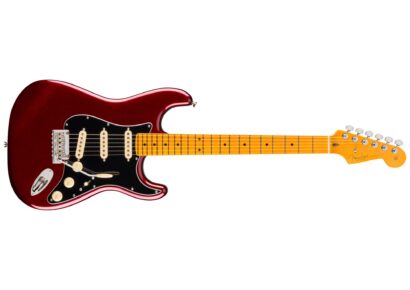
The double-neck Khn plays now is a little more refined. Quebec luthier Raphaël Le Breton built it by hand at Lutherie Le Breton in Alma, pairing a Stratocaster-style guitar on top with a Precision Bass-style bass underneath, both with maple bodies and necks and ebony fretboards. The guitar half has three single coils and a fixed bridge, while the bass runs a P-style split coil.
Then there are the frets. Le Breton added an extra one halfway between each standard fret, up to the 15th on the guitar and the 12th on the bass, which gives Khn 24 notes per octave instead of the usual 12. Higher up the neck the spacing goes back to normal, since quarter tones up there would leave barely enough room for a fingertip. For Khn, the extra notes aren’t a party trick. “The goal is to use these notes like any others,” he’s said. “Not as decoration but as the language itself.”
Each half is wired as its own instrument with its own output jack, so the guitar and bass run as two completely separate signals from the moment he plays a note.
Viral fame also means touring the world, and touring the world means you need a spare. Khn’s backup comes from Godin, which fretted both necks to the same quarter-tone layout and worked on the chambering and weight distribution to ease the load on his shoulders. It’s finished in matching polka dots, right down to the dice knobs. Naturally.
Pedals
With one pair of hands covering two instruments, the Boss RC-600 Loop Station is what makes the whole act possible. Khn splits its six tracks down the middle, three for guitar and three for bass, so he can lay down a bassline, leave it running and play guitar over the top, or stack two guitar parts as he does on “Utzp”. On the band’s 2024 tour a Boss RC-500 did the job, with a Boss DB-90 metronome keeping time beside it.
The sound that tends to stop people mid-scroll is the ring modulator. Khn runs a white Warm Audio RingerBringer, based on the Moogerfooger MF-102, and plays it with his feet through a bank of M-Audio EX-P expression pedals labelled for the mix, frequency and rate controls. A Yamaha FC7 volume pedal has since taken over on mix duty. If the intro riff of “Fabienk” made you check your speakers, that’s the RingerBringer.
The rest of the guitar side is surprisingly familiar. An MXR Bass Octave Deluxe adds a sub-octave, which you can hear doubling the guitar on “Yor Zarad”, and a ProCo RAT 2 provides the main distortion. A Mad Professor Supreme covers overdrive and heavier gain, sometimes stacked on top of the RAT, and there’s a Fender Engager Boost on the board as well. Delay comes from a Boss DD-8 with its mode knob pulled off entirely. Set and forget, presumably.
Then there’s the mystery box. Francis Malo of Quebec builder Infect FX made Khn a one-off pedal in 2025, and rumours have placed it anywhere between an overdrive and a ring mod. Malo has since described it as an overdrive, and it turns up on solos and the crunchiest overdubbed layers. A Boss TU-3 keeps both necks in tune, and a Radial BigShot ABY handles switching.
Amps
After all that, the amps are pleasantly straightforward. The guitar neck feeds a Roland JC-120 Jazz Chorus, a clean solid-state platform that leaves the pedals to do the talking. The bass neck goes into a Hartke HA2500 head, which Khn keeps on the floor rather than on top of the cab, and out through an Acoustic B410 MkII 4×10.
You can catch Angine de Poitrine at Golden Plains
Check out the rest of their Australian dates here