The Grammy-winning producer paired the AEA R88 ribbon mic with AEA's RPQ3 preamp across drums, acoustics, vocals and re-amped drum loops on Hilary Duff's album luck… or something.
Hilary Duff’s luck… or something is out now, produced by her husband, Grammy-winning Matthew Koma. The producer and songwriter, whose credits include Zedd, Shania Twain, and P!nk, set out to revisit the bright, organic pop of Duff’s early-2000s catalogue with a modern touch. Drummer Griffin Goldsmith’s performances shaped much of the record’s energy, alongside a stereo ribbon mic that appeared on nearly every source – the AEA R88.
Catch up on all the latest news here.
The R88 is a hand-built stereo ribbon microphone made in Pasadena, California, by AEA – a company founded in 1964 that began as a record label and mobile recording studio before moving into ribbon repair and full-scale manufacturing. Their 1998 R44C, an evolution of the iconic RCA 44BX, helped reintroduce ribbons to a generation of engineers raised on condensers, and the R88 sits within that same lineage of classic ribbon design rebuilt for modern studios.
What makes the R88 distinct is its Blumlein configuration – two figure-8 ribbon elements stacked at 90 degrees inside a single body. Each element rejects sound from its sides, picks up from front and rear, and the two combined deliver a wide, naturally phase-coherent stereo image without needing two matched mics, careful placement geometry, or a stereo bar. Point the mic at a source, and you’ve got an instant stereo capture with realistic depth and minimal phase issues.
The ribbons themselves are thin, low-mass strips of aluminium suspended in a magnetic field. They respond to air movement rather than sound pressure, which gives ribbon mics their characteristic warm, smooth top end and natural transient response. The R88 in particular is known for its detailed midrange and ability to capture room ambience without harshness.
It’s a passive design, meaning it doesn’t need phantom power, but it does need a preamp with serious gain and a clean noise floor to push the signal to usable levels. That’s where AEA’s matching preamp comes in.

Photo credit: Brynn Osborn
Koma pairs the R88 with AEA’s RPQ3 preamp and EQ as his consistent signal chain.
“I can’t imagine using the R88 without the RPQ3,” he says. “It has a way of gaining the mic without adding any intrusive noise. And the EQ has a ton of character. I love it on acoustics. That chain is pure magic.”
The RPQ3 is designed specifically to handle passive ribbon mics, with high gain, low noise, and high-impedance loading that lets ribbons respond naturally without compromising their low-end response. Its built-in EQ section is voiced to complement ribbon character, handling proximity effect on the low end and adding clarity on the top without introducing harshness.
“I use it on absolutely everything,” Koma says. “As a room mic for drums, on acoustics, piano, organ, and even background vocals. I love how it captures a room. It gives everything such dimension, air, and width.”
The mic’s Blumlein pattern makes it well suited to room work – it captures sound from front and back equally, picking up the natural reflections of a space rather than just the direct sound of the source. On drums, this translates to a sense of the room’s character sitting underneath the close mics. On piano or organ, the stereo image holds without artificial widening. On background vocals, multiple singers around the mic can be captured in a single take with their natural positioning preserved.
For re-amping, Koma ran drum loops back through a Fender Princeton – a low-wattage tube amp known for breaking up at modest volumes – with the R88 positioned about three metres back to capture the room.
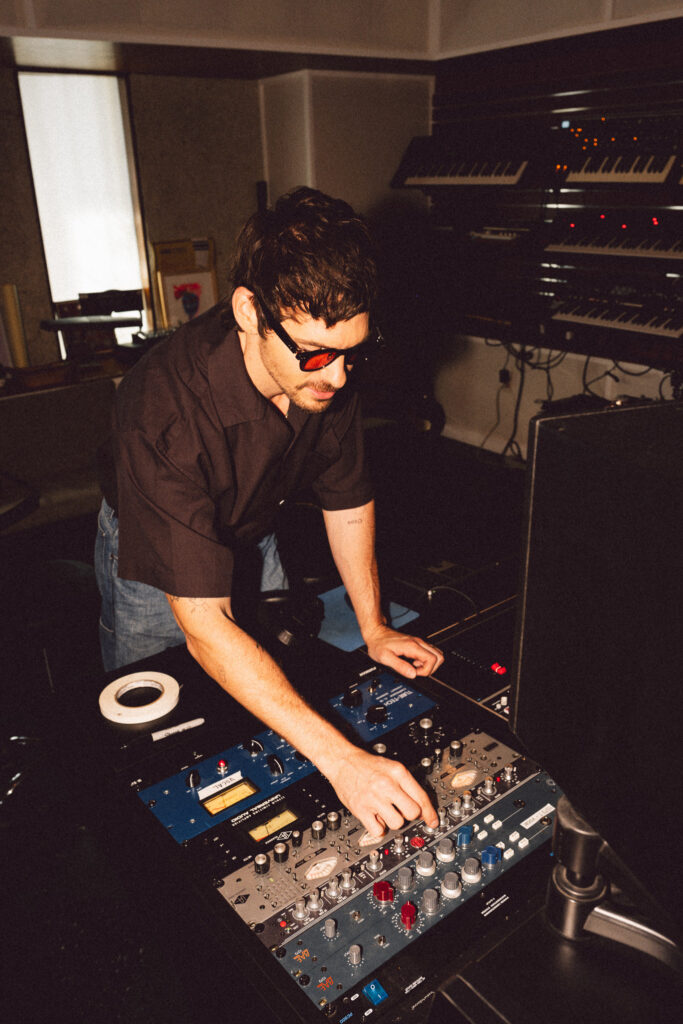
Photo credit: Brynn Osborn
“That kinda became this weird glue we used on every tune to give some air to stuff that felt a little more digital out of the box,” he explains.
The distance from the source matters with a ribbon mic. Sitting back from the amp lets the room’s acoustics shape the captured signal, blending the Princeton’s tube saturation with the natural decay of the space. The R88’s Blumlein pattern means you’re picking up the amp’s direct sound, the room’s reflections behind the mic, and the side rejection helps keep unwanted noise out of the take.
The R88 has appeared on Koma’s work beyond luck… or something, including his band Winnetka Bowling League and sessions with Good Charlotte and The Runarounds.
“It’s my ‘always up’ mic, so anytime we’re starting an idea and want an organic element to feel slightly more colourful, it’s the go-to,” Koma says. “The R88 is the one. If I could only have one mic to record with, it would be that – hands down.”
Check out the AEA R88 here.