We take a closer look at the gear and methods behind one of alternative music's most distinctive producers of the last two decades, from Vampire Weekend to Clairo to Haim and beyond.
Rostam Batmanglij has spent the better part of 20 years building his production approach, which is now so distinct that it’s easily recognisable. Warm, harmonically adventurous and textured, Rostam started in a Columbia University dorm room and ended up on some of the most critically acclaimed records of the 2000s, 2010s and beyond.
Catch up on all the latest features and interviews here.
The Vampire Weekend years
Rostam produced the first three Vampire Weekend albums solo: the self-titled debut (2008), Contra (2010) and Modern Vampires of the City (2013), which was co-produced with Ariel Rechtshaid.
For the debut, the band played live in full. Contra was half live, with he and Ezra Koenig’s first real foray into using Pro Tools as a compositional tool. Modern Vampires of the City, despite its organic sound, was created entirely electronically.
Vampire Weekend (2008)
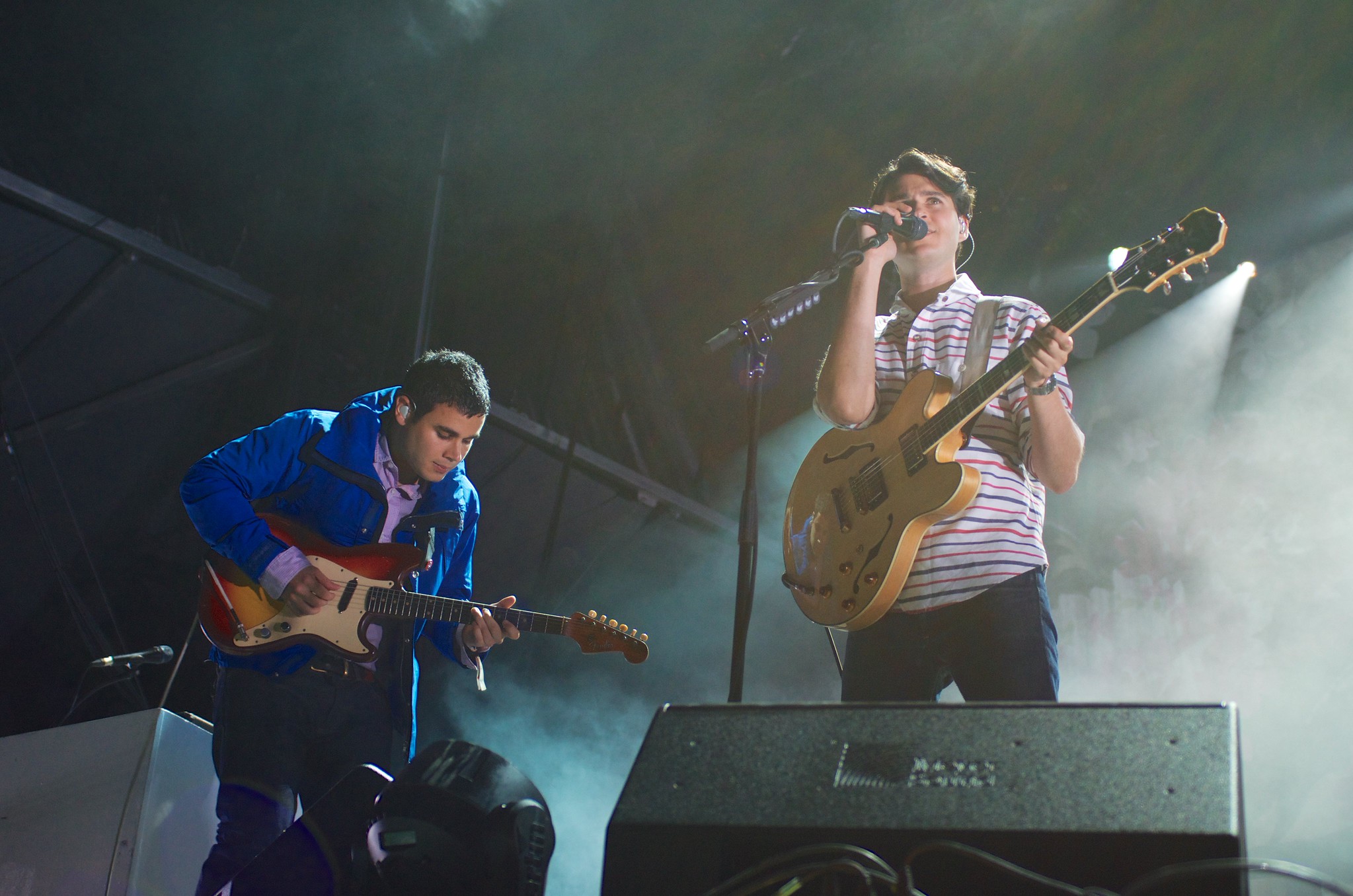
For their self-titled debut, Fender Deluxe amps were the main guitar amplification. Live, Rostam ran an M-Audio Keystation 49e MIDI controller alongside a Casio Tone Bank CA-100, with a Yamaha VSS-30 PortaSound sampling keyboard appearing in a Studio Q session from the same period.
Contra (2010)
Contra was tracked to Pro Tools HD, with engineer Tito bringing API preamps and Empirical Labs Distressors to the snare tracks. Guitar tones were drawn on a Fender Mustang and a Harmony Silvertone Newport H42, routed through a Roland RE-201 Space Echo. Fender Deluxe amps carried over from the debut.
Modern Vampires of the City (2013)
Rostam and co-producer Rechtshaid mirrored MacBook Pros with identical software and plugins for remote collaboration between Brooklyn and LA, with Universal Audio central to the whole setup: UA Apollo, UAD-2 Satellite FireWire and UAD-2 QUAD PCIe DSP cards.
For guitar, Rostam plugged a Gibson Les Paul direct into Pro Tools through an Avid SansAmp plugin, combining it with the UAD ATR-102 Mastering Tape Recorder and AltiVerb reverb to get what a more “scrappy” sound. The UAD Fairchild 670 compressor went on lead vocals for Don’t Lie and Obvious Bicycle.
A Boss VT-1 Voice Transformer was used to alter the formant on Ezra Koenig’s vocals on Diane Young. Live, Rostam upgraded to dual M-Audio Keystation 61es controllers, with a Casio CA-110 visible at the 2012 Pitchfork festival.
Clairo – Immunity
Rostam co-produced Clairo’s Immunity in 2019, working primarily at Truth Studios and Echo Park Back House Studios in Los Angeles. The Mix with the Masters breakdown he did with Clairo confirmed Waves CLA-76 compression on vocal stems. His own synth contributions came via a John Bowen Solaris. The UA Apollo handled interfacing throughout, consistent with how he’d worked since Modern Vampires.
Discovery – LP (2009)
Started in 2005 before either Vampire Weekend or Ra Ra Riot had broken through, shelved while both bands found success, then completed and released on XL Recordings in 2009. Built entirely on synthesisers, 808 bass, drum programming and processed vocals, both Rostam and Miles worked on synth and drum programming, with guest vocals from Vampire Weekend’s Ezra Koenig and Angel Deradoorian of Dirty Projectors.
Hamilton Leithauser and Rostam – I Had a Dream That You Were Mine (2016)
Recorded largely with Leithauser, formerly of The Walkmen, in the period after Rostam left Vampire Weekend, I Had a Dream That You Were Mine is a more intimate record. Rostam played acoustic guitar, harmonica, piano and harpsichord across the record, with his production approach pulling toward a warmer, more analogue feel than the UAD-heavy Modern Vampires sessions.
HAIM
Women in Music Pt. III (2020)
One of the higher-profile collaborations of Rostam’s post-Vampire Weekend career, and Grammy-nominated for Album of the Year. His Steinway upright piano features on Los Angeles, and he’s spoken about his role being partly about surfacing Danielle Haim’s personality as a guitarist.
I Quit (2025)
Rostam returned to produce HAIM’s fourth studio album, continuing the working relationship established on Women in Music Pt. III.
Vagabon – Sorry I Haven’t Called (2023)
Rostam produced Vagabon’s third album, maintaining the kind of understated, detail-oriented approach that runs through most of his collaborative work.
Georgia – Euphoric (2023)
Rostam co-produced Georgia’s third album, a record the London singer-drummer-producer has described as the best thing she’s made. Georgia spoke about the collaboration in terms of mutual trust and a genuine back-and-forth.
Rostam’s solo records
On Half-Light, released in 2017, the centrepiece instrument was an upright piano he’d bought in England – the same model that used to sit in the lounge at Abbey Road.
By Changephobia (2021), he’d fallen for a Steinway upright, which he used on From the Back of a Cab and credited on HAIM’s Los Angeles. His songwriting process typically starts in Ableton before migrating to Pro Tools for the production stage, with Reason used for specific tasks – he built the synth bass on Bike Dream in Reason and used a Korg Trident synthesiser on the same track. The Sonnox Oxford SuprEsser features in his mixing chain for controlling harsh frequencies.
His studio also houses a Fender Silverface Champ from the 1970s, confirmed in an Instagram Q&A, alongside an Epiphone Sheraton II played live during the Vampire Weekend era, and a Gibson ES-335 used live on his solo material. Film and theatre work fed back into his production palette too. Rostam became interested in super high-quality samples, sourcing strings and drums that eventually led to choir patches.