A few things might come to mind when someone asks what a Fender amp sounds like. Some will say a super clean sound with a mid-scooped nature, others will mention ragged overdrive that sags when dug into or a big, open sound that guitarists can’t hide behind. The ’62 Super Amp delivers all of these tropes and more. Often overlooked by players who want the sounds of ’50s Tweed and mid-’60s Black Panel era amps, Fender’s reissue of the ’62 Super amp bridges the gap perfectly, offering the woolly overdriven sounds of its Tweed predecessor and the mid-scooped cleans of its Black Panel successor.
Upon hearing that Fender had decided to reissue a version of the Brown Panel Super as part of their American Vintage line, I was excited and curious, as it’s one of the few Fender amps in their current lineup to have harmonic tremolo. Only built for around five years (1959 – 1964), Brown Panel Supers were considered professional players’ amps during that time, and can be seen being used by guitarists such as Tommy Tedesco (The Wrecking Crew), Steve Cropper (Booker T. & the M.G.’s), and, most notably, heard on the ZZ Top album Tres Hombres.
Catch up on all the latest features and reviews here.
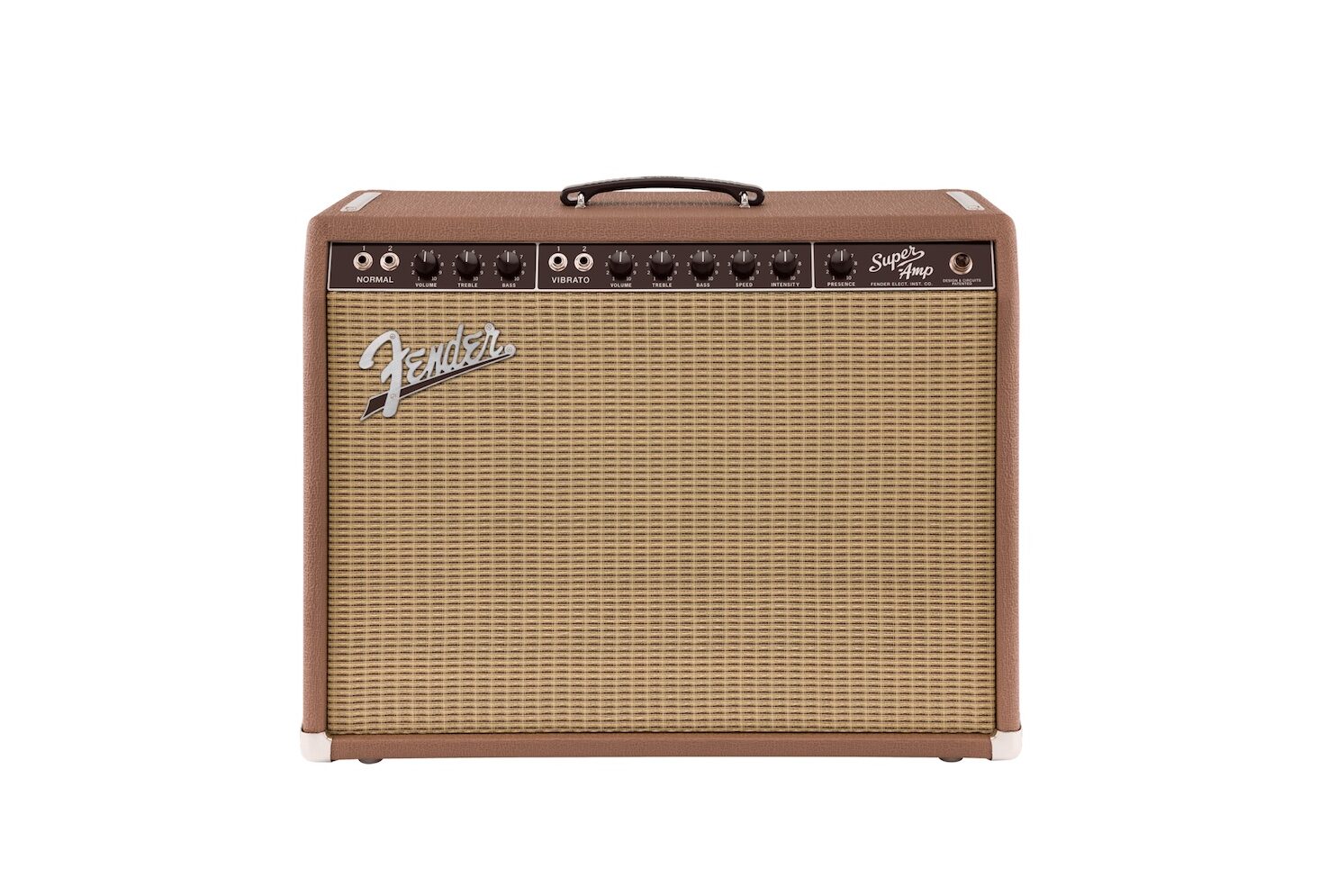
This amp has the correct vintage vibes. At first glance, one could easily mistake it for an original with its period-correct construction of a solid pine cabinet, which has a half-opened back, brown Nubtex covering and aged wheat grill cloth. Fender has lovingly recreated the ’62 Super alongside some necessary modern appointments, such as a modern IEC power outlet and safety standards. Featuring two 6L6 output tubes, six 12AX7 preamp tubes and a 5AR4 rectifier tube, as well as the 6G4-A circuit variation, which improves biasing and adds a higher-rated transformer. On the back panel, there’s a jack to operate the tremolo function, primary and secondary speaker outputs and on/off and standby switches.
Celestion has custom-designed a pair of 10″ speakers with an impedance rating of 4 ohms. After doing some research, an original Brown Panel Super would have come loaded with Jensens or Oxfords, depending on the year. I am unsure how accurate Celestion’s design is, having never had the chance to play an original Super from this era. However, this is one of the greatest-sounding amps I have played through. For its simple volume, treble, bass and presence controls, the ’62 Super boasts one of the most responsive and surgical tone stacks of any amp. For a pair of 10″ speakers, it is incredible how much bass and treble response there is. Turning it up will harken back to the woolly rasp of the Tweed era. For an amp that is rated at 40 watts, it is surprisingly comfortable to play at volume, and its pine body provides loads of resonance for sustained feedback.
The Normal channel provides everything one needs from an amp of this nature. There’s plenty of clean headroom for recording, putting your favourite pedals in front of it and being heard in a band context. But where this channel shines is on ten and using the guitar’s volume to control dynamics – everything from pristine clean to moderately overdriven can be achieved through this method. For a tone stack that only has treble and bass, there is quite a range of tone-shaping possibilities.
What makes the ’62 Super so special and exciting is its Vibrato channel, which features phase-shifting harmonic tremolo. Unlike a traditional tremolo, which modulates the amplitude of a signal, a harmonic tremolo splits the signal into low and high frequencies and modulates them out of phase, creating a unique sound that varies in amplitude and phase. While it’s easier to find a harmonic tremolo via a pedal these days, none of them can compare to Fender’s original design. This tremolo brings a complex musicality of chords and single note lines with a sound that is thick and syrupy, reminiscent of Pop Staples and early psychedelic bands. It’s important to note that the ’62 Super’s vibrato channel does not feature a spring reverb, unlike the later Black and Silver Panel Supers.
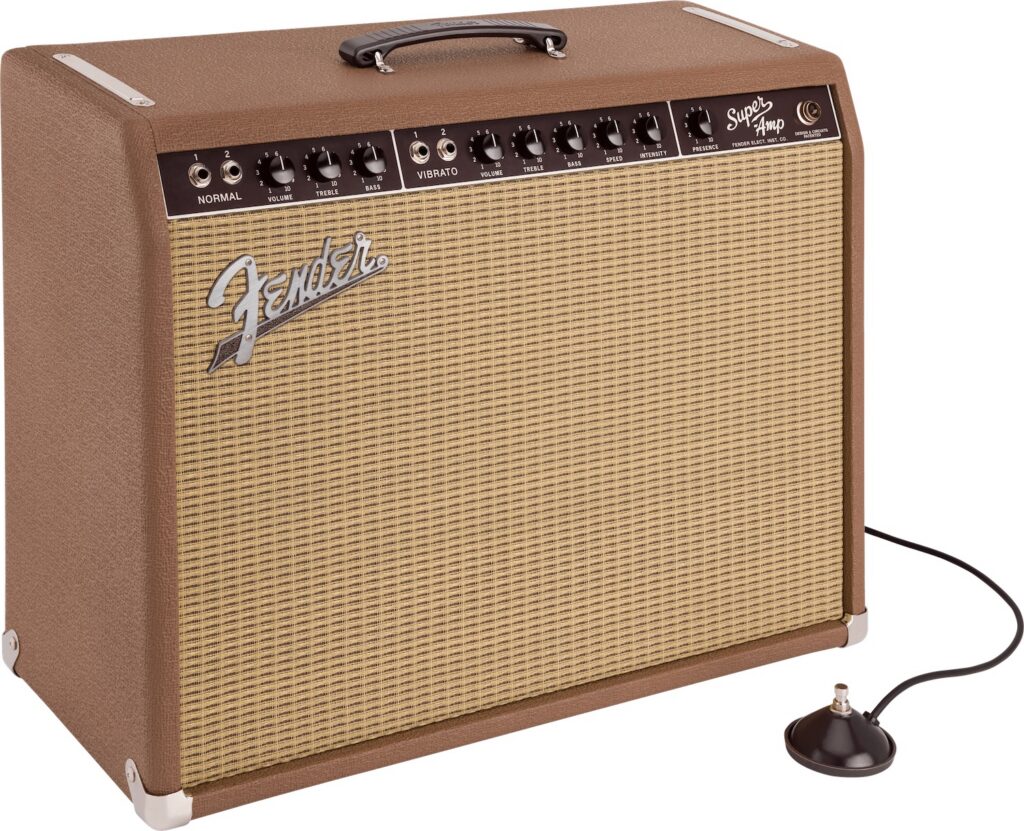
The tremolo can be cancelled/engaged via the provided footswitch. The footswitch has a satisfying click and is made from brown-coloured plastic, and has a reasonable amount of cord. While historically accurate, the hardwired footswitch will work best for players without extensive pedalboards, and its smooth base may benefit from some grip tape on polished floors.
Both Normal and Vibrato channels feature two inputs, with each of the second inputs providing 6db less gain for instruments with higher output, as well as a global presence knob, which subtly opens the highs up.
With the feature set and price point of the ’62 Super, this amp isn’t necessarily aimed at beginners or players who want sounds and modern features like an effects loop or cab sim output from their amps. It’s aimed at Fender amp enthusiasts, people chasing real specific tones or seasoned musicians who just want to plug straight into an amp that has great clean and slightly overdriven sounds, as well as the best harmonic tremolo circuit. Having written all that, anyone thinking of buying one of these should, as it’s hard to come by an amp as glorious as this.
Head to Fender for more.