Two digital engines, six voices of analogue filtering and 49 full-size keys make Arturia’s latest Freak its most playable yet.
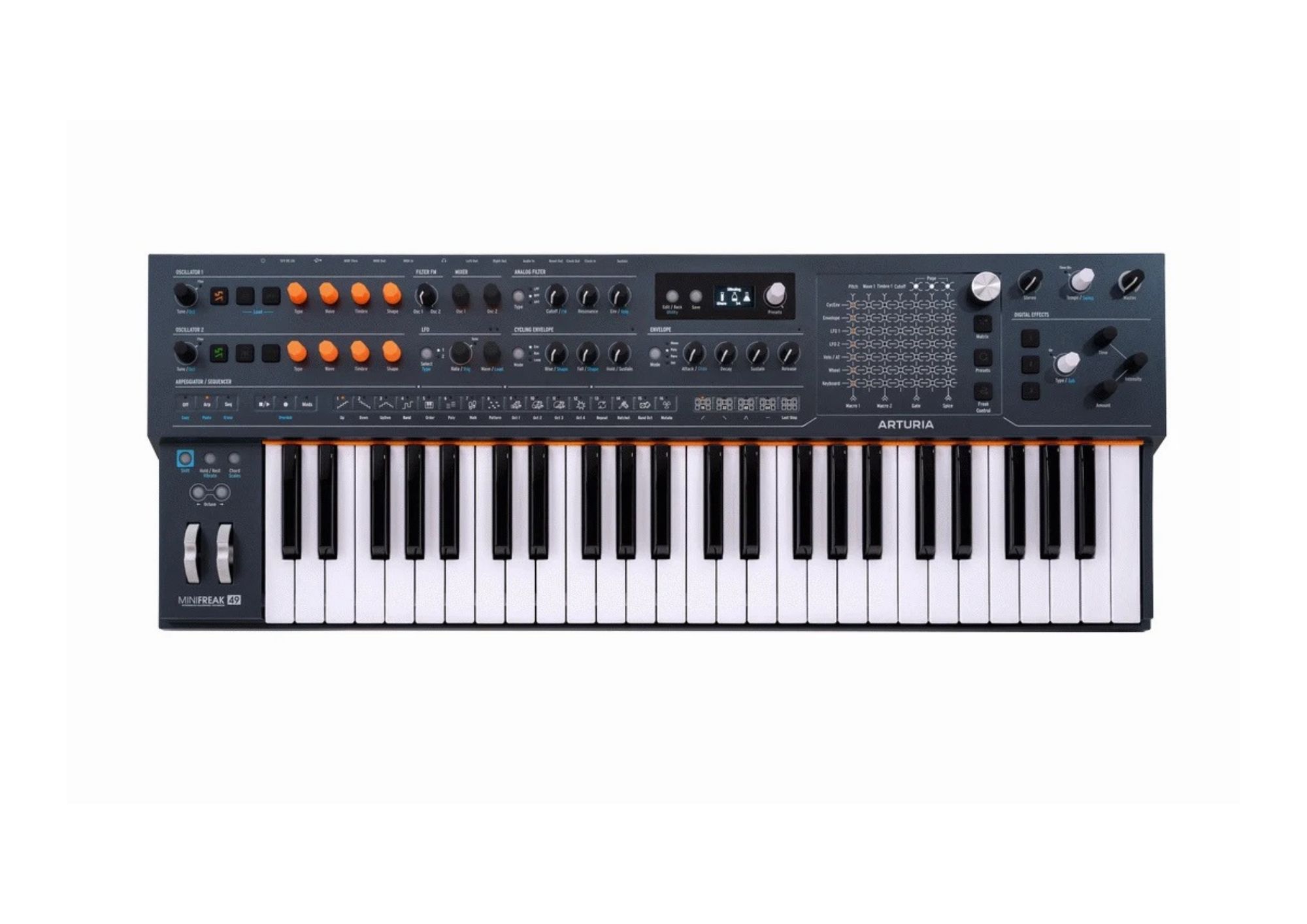
The MiniFreak 49 is the latest hardware synth in Arturia’s Freak series, and the biggest one yet. It’s a six-voice hybrid synthesiser with two fully customisable digital engines, analogue filters on every voice and an XYZ touch matrix, alongside aluminium pitch and modulation wheels for expression. Synths have become far more accessible over the past few years as builders have refined classic designs and used new technology to bring costs down, and if you’re one of the many synth-curious players that’s created, there’s a good chance Arturia is already on your radar.
Arturia describe the MiniFreak 49 as an “algorithmic synthesiser”, but that description doesn’t do it justice. It’s the culmination of the Freak series and expands on it, covering everything from classic dark basses and textural pads to synth strings and otherworldly effects. Like many synths, it pays to know some synth terminology to make sense of the top panel and the sound design options, but if you’re completely new to synths, Arturia have included 350 factory presets to get you started, along with 162 user slots for your own patches.
Catch up on all the latest reviews here.
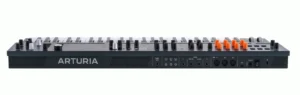
The MiniFreak 49 offers more than 30 oscillator modes across its two engines, with algorithms from Arturia, Mutable Instruments and Noise Engineering. Users can choose and blend sine, sawtooth, square and triangle waveforms, as well as ring and frequency modulation, filters, phase shifting, a sampler and a bit crusher to shape the sound. It can be a little overwhelming at first if you don’t read up on what each mode does, but once you’re familiar with them, creating sounds is a real pleasure. You can craft almost any classic synth sound, from 80s synth-pop bass, lush pads, orchestral strings, faux brass and percussive drum sounds to completely destroyed industrial leads and alien spacecraft noises.
On top of the two engines, you can further shape the sound with the attack, decay, sustain and release of the envelope section, as well as change how the envelope cycles. The analogue filter offers low-pass, high-pass and band-pass modes, and it can get pretty gnarly at extreme settings. Filter FM is a bipolar control that applies audio-rate modulation from engine one or engine two directly to the analogue filter cutoff. There are also two LFOs per voice, each with a customisable shape, and vibrato can be brought in using the mod wheel.
It has all your connection needs covered, with stereo outputs, an audio input (mono TS), DIN MIDI in, out and thru, USB-C, clock in and out and reset out for syncing analogue gear and Eurorack, plus a sustain pedal input. The 12V power supply comes with universal adaptor fittings, so you can take it to most countries without worrying about how to power it.
There is the option to run it in mono, but the sounds lose the width that comes from Voice Panning, the new feature that places each voice individually in the stereo field. Even with Voice Panning turned down to zero, mono doesn’t give you the full depth and spectrum of a patch, because everything has been designed to be heard in stereo. Make sure whatever you’re plugging into has enough inputs.
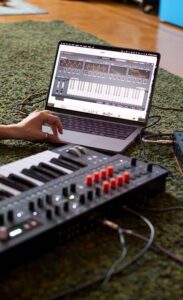
The effects section has three slots, each with 13 algorithms to choose from, and the slots can run as inserts or sends. The types include chorus, flanger, phaser, reverb, delay, distortion, bit crusher, EQ, multiband compression and a vocoder, all with their own sub-types. Adjusting the stereo controls changes how the effects are spread across the stereo field, and with a wide reverb or chorus on a pad, the sound seems to wrap around the room rather than coming from two speakers.
The XYZ touch matrix nods to classic pin matrix synths, but instead of using pins to route and change sounds, Arturia have built a pressure-sensitive surface with LED feedback. It lets you assign modulation to specific parameters, create macros and link them to the mod wheel and keyboard. If that all feels like too much, the matrix can also be used to browse presets, or simply as a light show that responds to the sound being generated.
The 49 full-size, semi-weighted keys feel nice to play and respond to both velocity and mono aftertouch, a big step up from the original MiniFreak’s 37 slim keys. You can transpose up or down three octaves with the octave buttons, and the buttons get brighter or dimmer depending on the octave you’ve selected. While this technically isn’t a drone synth, the Hold button will sustain a sound indefinitely. Chord mode lets you play diatonic chords from any of the modes by pressing only the root note. There’s a fully featured arpeggiator with up, down, up/down, random, order, poly, walk and pattern modes, which you can push further with repeat, ratchet, random octave and mutate, as well as by changing the octave range. There’s also a 64-step sequencer that’s simple and satisfying to program, and both the arpeggiator and the sequencer can run from the internal clock or follow an external one.
The MiniFreak 49 can be set to monophonic, polyphonic, paraphonic or unison modes. Paraphonic mode expands the number of voices to 12, while unison restricts them.
For players just starting to explore synths and seasoned sound designers alike, the MiniFreak 49 is a worthy instrument to explore with and be inspired by. With two engines, six voices of analogue filtering and a deep modulation matrix in a reasonably sized package, Arturia have packed a lot of synth into one keyboard, and everything has been designed to be easy to change, access and understand. You can lose days scrolling through the presets or tweaking its seemingly endless parameters.
For local enquiries, head here