AlphaTheta DDJ-FLX2 | Jands | RRP $399
There’s something fascinating about watching someone take control of a room using little more than two decks, a laptop and an instinct for the perfect moment. As a guitarist, I’ve always been drawn to the physicality of playing an instrument, but I’m not a snob. I love watching DJs twist a few knobs and instantly change the emotional temperature of a crowd. For many musicians, though, the barrier to entry has always been steep: the gear was expensive, the software confusing, and the culture could feel like a closed shop if you weren’t already in it.
Catch up on all the latest features and reviews here.
The AlphaTheta DDJ-FLX2 cuts through that wall like a hot knife through a USB cable. This compact, lightweight controller feels like a deliberate statement about what modern DJing should be: accessible, intuitive, affordable, and genuinely fun. And maybe, most importantly, it shows that DJing, curating, blending, warping and flowing music is something anyone can participate in. You don’t need a booth, a residency, or a nightclub’s worth of gear. You just need a laptop, a few favourite tracks, and a willingness to press play.
Out of the box, the FLX2 feels less like “DJ gear” and more like an invitation.
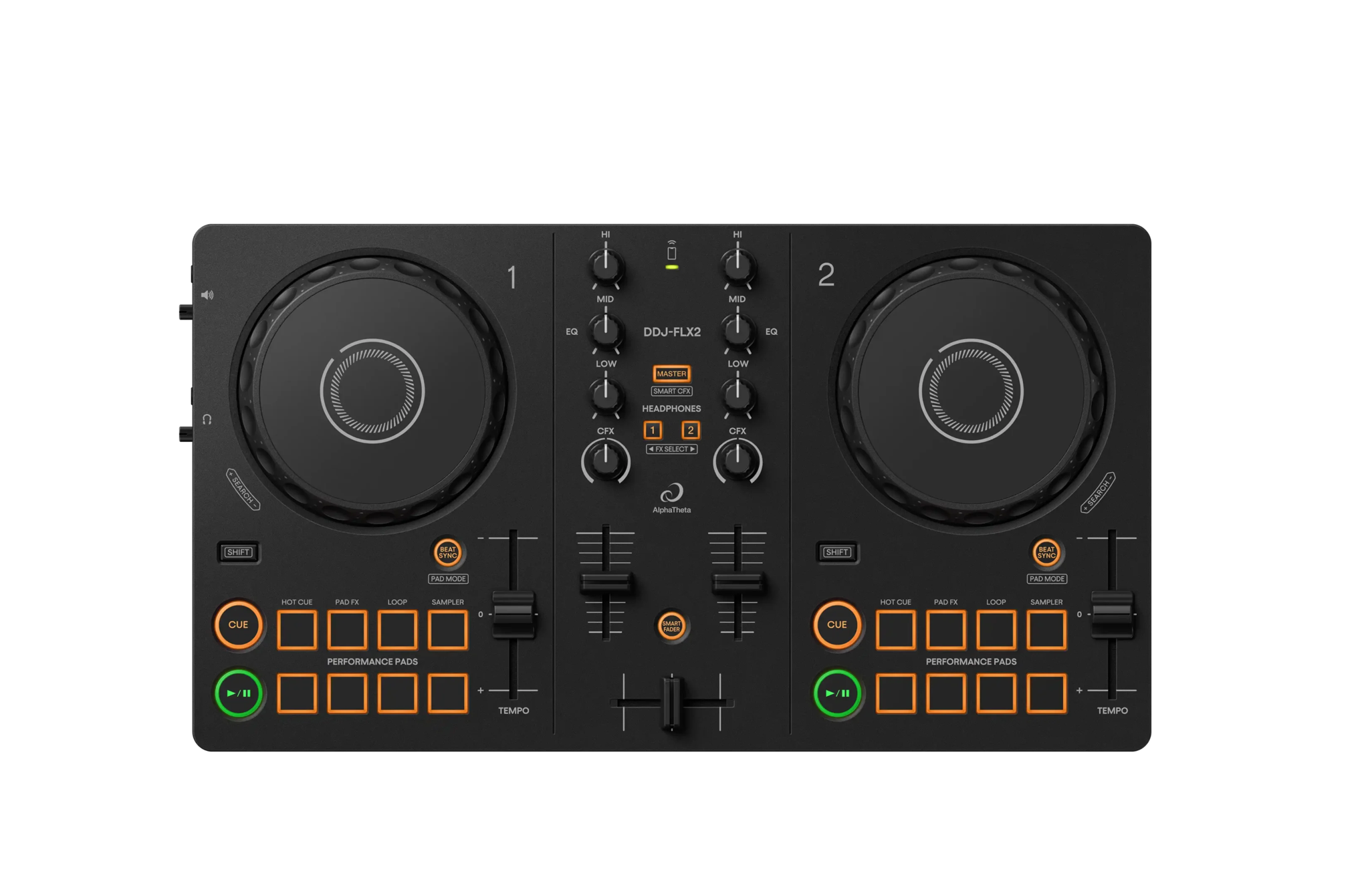
It’s remarkably light, powered over USB-C, and small enough to slide under your arm on the way to a rehearsal room or house party. The layout is clean and grows naturally from the lineage of Pioneer/AlphaTheta controllers, with the essentials right where your hands want to go: a pair of jog wheels, eight performance pads per deck, a simple mixer section with EQs, and a crossfader begging to be messed with. What struck me first was how un-intimidating it is. There’s no barrage of buttons, no cryptic workflow to decode, no sense that you need to pass some unspoken test before you’re “allowed” to touch it. You could hand this thing to a complete beginner and they’d be making a sound within minutes. And not just sound—music with movement, transitions with shape, mixes with intention.
The big headline features, Smart Fader and Smart CFX, are emblematic of AlphaTheta’s push to democratise DJing. If you’re new to mixing, the transition between songs can feel like a high-wire act—BPMs to match, levels to balance, EQs to finesse, all while anticipating where the energy of a set needs to go. Smart Fader essentially says, “relax, I’ll handle some of that for you.” When you move the crossfader, the FLX2 automatically adjusts tempo, volume and low-end content to keep things smooth. It’s like training wheels for transitions—and that’s not an insult. Even guitarists use tuners.
The Smart CFX knob applies a curated effect as you twist it, morphing the track with filters, echoes, delays and sweeps in a way that feels performative rather than technical. It’s simple, but it adds a sense of theatricality to transitions that might otherwise feel static for beginners.
Are these features designed for seasoned club veterans? Probably not. But they’re perfect for the other 95% of people who just want to make music flow without being punished for not owning 15 years of DJ muscle-memory. And that’s the whole point.
The real magic trick is how seamlessly the FLX2 connects with music you already listen to. Depending on your software platform (Serato, rekordbox, djay and others) you can pull tracks directly from services like Apple Music, TIDAL, Beatport or SoundCloud. That means you don’t need a meticulously curated 500GB MP3 library to get started.
You can literally explore DJing using the songs you streamed on the train this morning. It feels a little like my early days of guitar, when I’d grab whatever you could find—a cheap Status Strat copy, a borrowed pedal, a tab from a guitar mag, and just start making noise. The FLX2 opens DJing in that same spirit: low cost, low pressure, low barrier to joy.
Let’s be honest: this isn’t a club-ready controller. The outputs are basic, there’s no mic input, and the jog wheels don’t have the heft of high-end models. You won’t find hardware meters or deep effects controls, and if you’re already playing gigs at Revolver or Sub Club, this isn’t replacing your main rig.
But expecting pro-level hardware at this price point is missing the point entirely. The FLX2 isn’t trying to be that controller. It’s trying to get more people mixing music, full stop. It’s the gateway drug—the first pedal on your board that eventually leads to a lifetime of tone chasing.
In an era where creative tools are either blissfully simplified or intimidatingly over-engineered, the FLX2 sits in a sweet spot. It respects the craft of DJing while gently demystifying it. It doesn’t hide the fundamentals behind AI gimmicks, nor does it force newcomers through a gauntlet of technical precision before they’re allowed to have fun. It says, “You love music? Great. Come play with it.”
That’s the kind of ethos that builds new scenes, new musicians, new creators. It lowers the drawbridge to a world that has often felt locked behind expensive gear, niche knowledge and cultural gatekeeping. And for that, the FLX2 feels genuinely important.
The AlphaTheta DDJ-FLX2 isn’t a pro controller—and it never claimed to be. What it is, is a beautifully accessible entry point into the world of DJing. It’s affordable, friendly, portable and fun, and it does exactly what great musical tools should do: it empowers creativity rather than bottlenecking it.
Here to AlphaTheta for more information on the DDJ-FLX, and here for local enquiries.