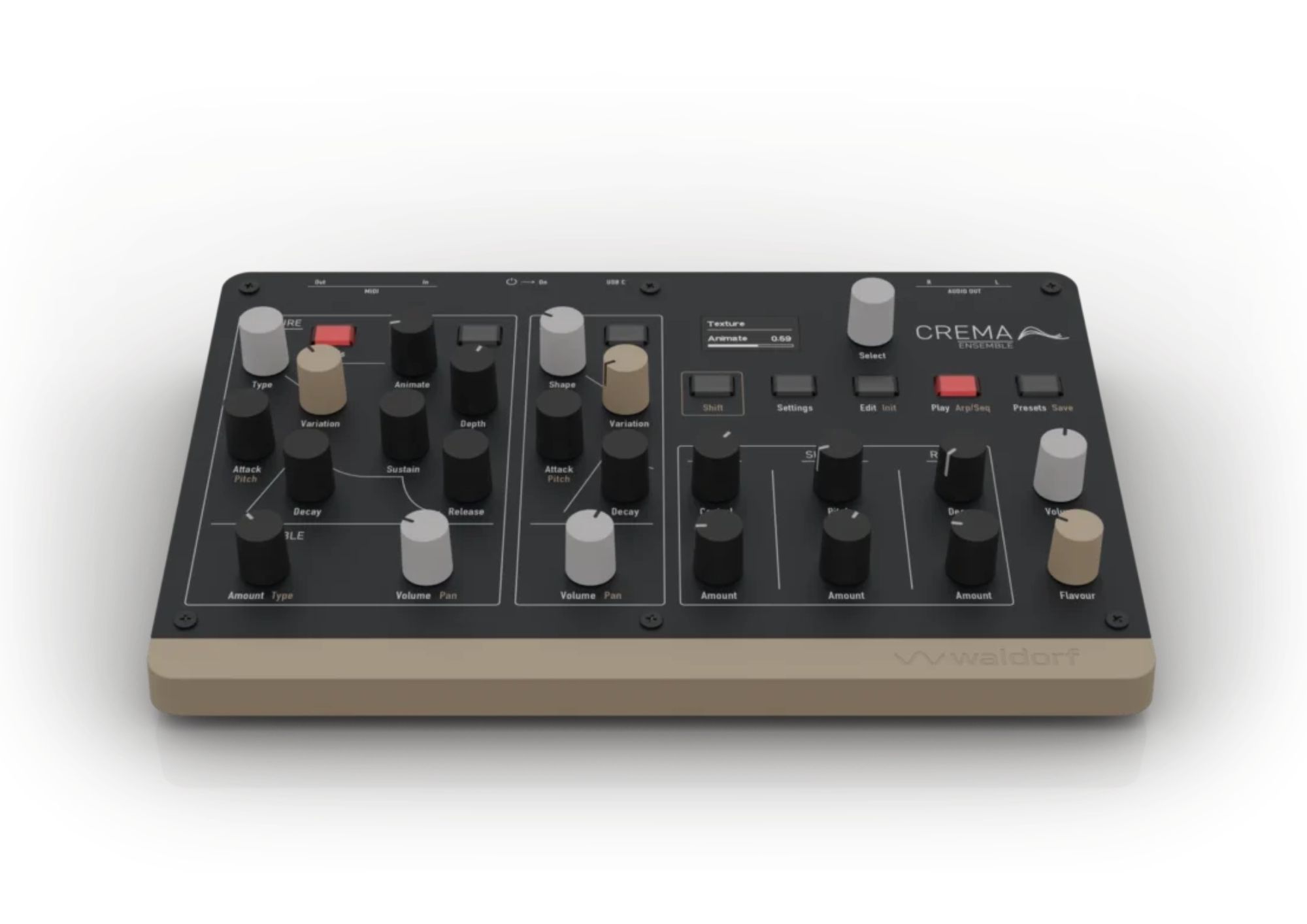
The second instrument in Waldorf’s compact range puts strings, wavetables, FM and a virtual analogue voice through a dual effects section with shimmer reverb.
Waldorf has taken the string machine engine from its Streichfett and pushed it into the digital pad era with Crema, a compact polyphonic synth built for ensemble strings, layered pads and slowly shifting textures.
Where the Streichfett leaned on the sound of 1970s analogue string machines, Crema adds the digital pads of the ’80s and ’90s to the mix, and it’s the second instrument in Waldorf’s compact range after Protein. It runs two sound engines, Texture and Lines, both of which can be routed freely into a dual effects section.
Catch up on all the latest news here.
Texture covers most of the ground, with 24 sound generation types split across strings, wavetables and FM. The string section comes from the fully polyphonic Streichfett, and its Variation knob moves between violin, viola, cello, brass, organ and choir. In wavetable mode, the same knob picks from 17 Waldorf tables, ranging from Resonant to Vibes, each shaped by an envelope and LFO, while six FM types handle bells, keys, brass, bass, woodwind and organ with 12-voice polyphony. Everything in Texture runs through the Streichfett Ensemble effect, which is a big part of that instrument’s sound.
Lines is an eight-voice virtual analogue engine based on the Streichfett’s Solo section, with two detunable pulse or saw oscillators plus stereo tremolo, vibrato and PWM. It’s there to put a bassline, lead or extra synth layer over the top of a Texture patch.
Borrowed from Protein, the Flavor control adds slight variations in pitch, waveform position and other parameters so sounds feel less static, and there’s an arpeggiator and step sequencer that both sync to external clock. The first effects processor offers chorus, flanger, phaser, tremolo, drive and delay, with the second dedicated to reverb, including a Shimmer mode, and the pair can run in series or parallel.
At 252 × 170 × 48 mm and 0.9 kg, Crema is USB-C powered, with USB MIDI, mini TRS MIDI in and out, stereo outputs and a headphone jack. MPE is supported, and each engine can be played on its own MIDI channel, so pads and a bassline can be split across two controllers. It ships with more than 130 factory sounds from designers including Christian Kleine and LimbicBits, with 360 preset slots managed through Waldorf’s free Chutney Librarian app.
For more information, head here