The Queensland builder's new pedal pairs two MN3005s with a vintage MN3101 clock, stretching the delay out to 820ms and adding a full modulation section.
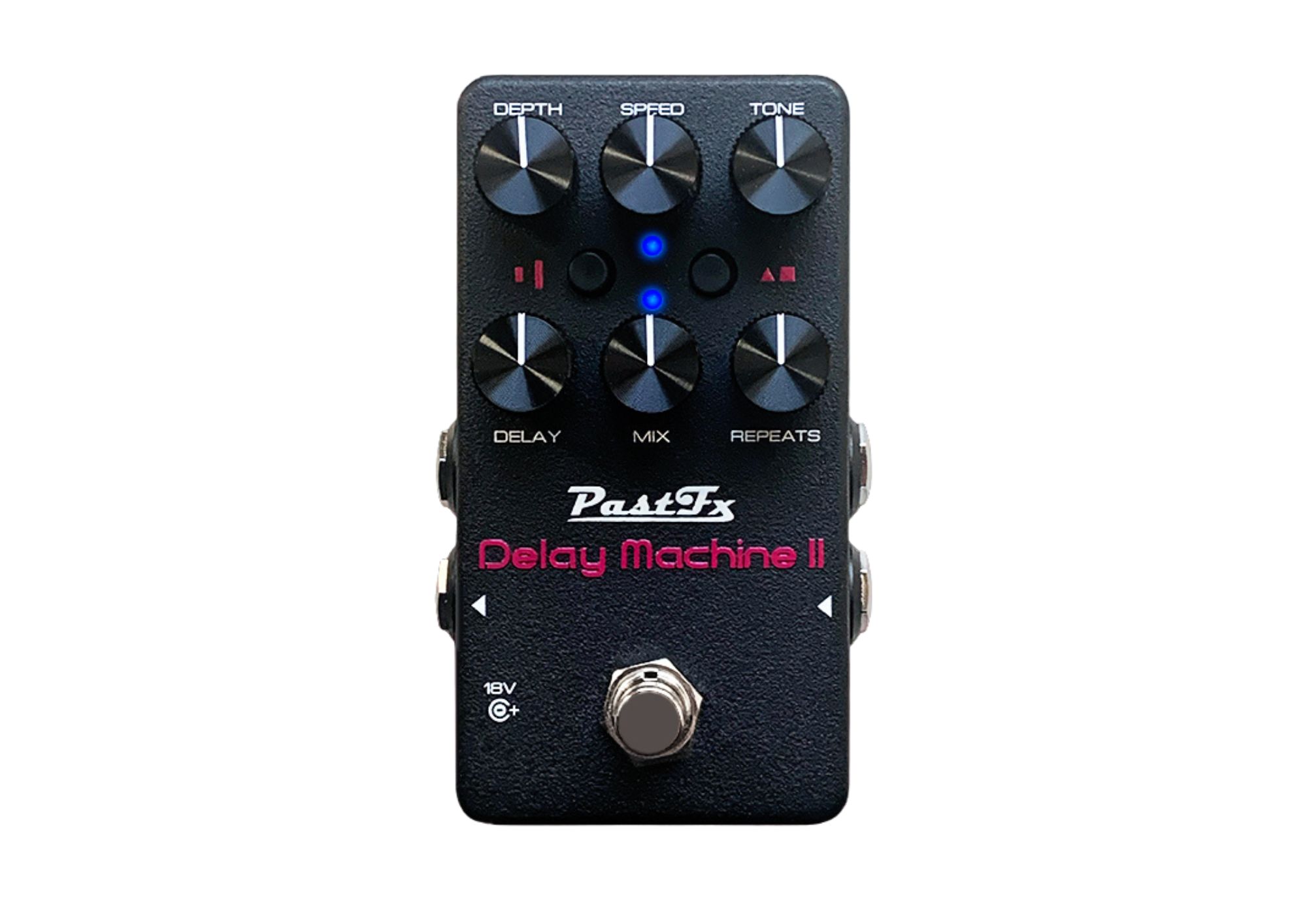
Queensland pedal builder PastFX has released the Delay Machine II, an all-analogue delay that takes the Boss DM-2 as its starting point. It adds the extra delay time and modulation controls the 1980s original never had.
PastFX has built a strong following among pedal collectors for its takes on classic and hard-to-find circuits, often in enclosures a fraction of the size of the originals. Designer Verlie is best known for her modulation pedals, and choruses, phasers and flangers make up a big chunk of the catalogue. The Delay Machine II brings a fair bit of that thinking across to delay.
Catch up on all the latest news here.
The DM-2 got its warm, murky repeats from a single MN3005 bucket brigade chip. PastFX has doubled up here, running two MN3005s alongside a vintage MN3101 clock chip. A Short/Long button switches between roughly 25–410ms and 50–820ms, so the pedal handles tight slapback and doubling as comfortably as the longer, darker repeats that were out of the original’s reach.
Delay time, mix and repeats are joined by a tone control that rolls off the highs for darker echoes, which also helps tame the clock whine that can creep in at longer settings. The modulation section has its own depth and speed controls, plus a switch between triangle and square waveforms. With the repeats turned all the way down, the Delay Machine II works as a rich BBD chorus in its own right. Guitar Pedal X’s Stefan Karlsson was particularly taken with that side of the pedal in his early hands-on, calling it “her most appealing pedal in recent memory.”
Two TRS expression inputs give foot control over the feedback and delay time. That opens up pitch-warping sweeps, and with the repeats pushed past about three o’clock, runaway self-oscillation. The pedal runs on 18V DC rather than the usual 9V and draws under 100mA, so check that your power supply has an 18V output before it goes on the board.
Available now direct from PastFX