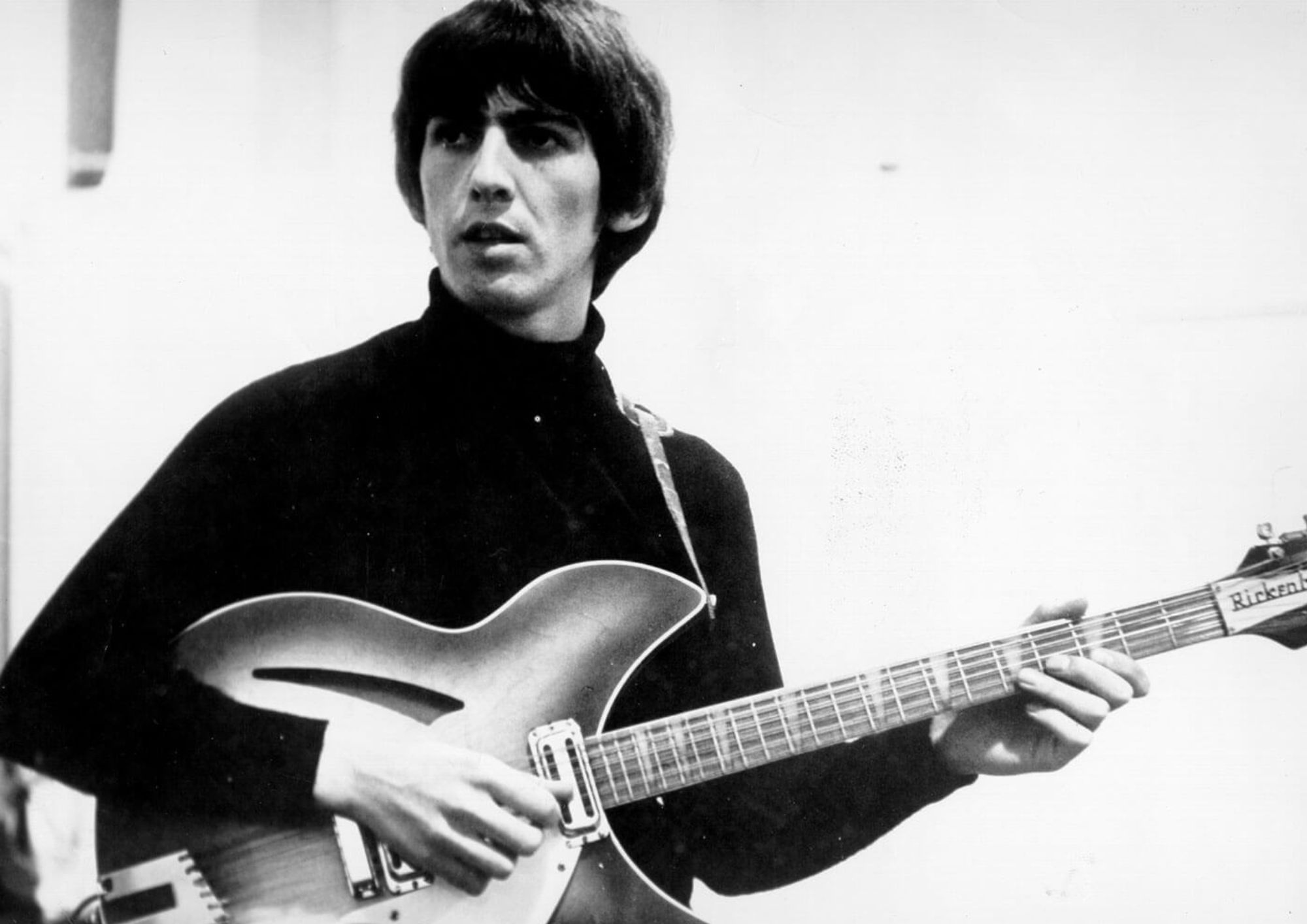
From McGuinn’s compressed Rickenbacker to Stu Mackenzie’s warped Hagstrom, these are the songs that prove a 12-string is worth the restringing.
When Rickenbacker delivered a prototype 12-string to George Harrison in New York in February 1964, it was only the second one the company had ever built. Within a year, Roger McGuinn had built the Byrds’ sound around one and Pete Townshend was hammering out the Who’s first single on another. Electric or acoustic, the 12-string has been behind some of rock’s best-known intros ever since.
Catch up on all the latest features here.
The Beatles – “Ticket to Ride” (1965)
Harrison’s Rickenbacker 360/12 was only the second electric 12-string the company ever made, delivered to him on the Beatles’ first trip to New York, and it’s the guitar most often credited with this riff. The part sits mostly on the top two pairs of strings, so you get a built-in chorus shimmer rather than big octave jumps. Put it over Ringo’s lurching drum pattern and you’ve got the heaviest thing the Beatles had released at that point.
The Byrds – “Mr. Tambourine Man” (1965)
McGuinn saw Harrison with a Rickenbacker in A Hard Day’s Night and promptly traded in his acoustic 12-string and a banjo to get one. Producer Terry Melcher didn’t trust the rest of the Byrds in the studio yet, so McGuinn played alongside the Wrecking Crew on their debut single. Engineer Ray Gerhardt slapped a compressor on the Rickenbacker to keep its level down and accidentally gave it the ring that folk rock would be built on.
The Who – “Substitute” (1966)
Before Pete Townshend became rock’s most prolific guitar wrecker, he was a Rickenbacker 12-string man. According to a later Who guitarist, every track on My Generation has only one guitar on it, and it’s a 12-string Rickenbacker, which is hard to believe given how loud that record is. “Substitute” is the pick of the era, with a riff that sounds like three chords and isn’t. Townshend was still playing it on a Gibson EDS-1275 double-neck in 1967.
The Byrds – “Eight Miles High” (1966)
A year after “Mr. Tambourine Man”, McGuinn decided his Rickenbacker should sound like John Coltrane’s saxophone. The solo borrows heavily from Coltrane’s “India”, and McGuinn has said he couldn’t have sustained the opening note without that same studio compression. It’s often credited as the first psychedelic single, and the solo is still a nightmare to play note for note.
David Bowie – “Space Oddity” (1969)
Bowie wrote “Space Oddity” on a 12-string Hagstrom, with a Stylophone from Marc Bolan for the spacey bleeps. Tony Visconti didn’t rate the song, so Gus Dudgeon took the session at Trident Studios on 20 June 1969. He piled strings, Rick Wakeman’s Mellotron and Herbie Flowers’ bass on top of Bowie’s acoustic 12-string. Visconti later admitted he’d got it wrong, and the single became Bowie’s biggest seller in the UK.
Led Zeppelin – “The Song Remains the Same” (1973)
Page tracked the Houses of the Holy opener on a Fender Electric XII, the same guitar he’d used on Jeff Beck’s “Beck’s Bolero” years earlier. The intro stacks two 12-string parts playing clashing triads over each other, and the result is a wall of chime that hits like a brass section. On stage he played it on his EDS-1275 double-neck so he could go straight into “The Rain Song”. Outside of “Stairway”, which probably never needs to be spoken about again, it’s the best 12-string playing Page ever did.
Pink Floyd – “Wish You Were Here” (1975)
David Gilmour played the intro on a 12-string acoustic and squashed it down to sound like a tinny AM radio. Then he came in over the top with a warm six-string, as if someone had just switched the radio off and picked up a guitar in the same room. Floyd had studios full of gear by 1975, and the most memorable thing on the record is an EQ trick and two acoustic guitars.
Eagles – “Hotel California” (1976)
Every guitar shop in the world has heard this intro a few thousand times, and Don Felder is the man to blame. On the record, it’s a Takamine 12-string with a DeArmond pickup. The band put the mic in the middle of the mix and sent the pickup through an Echoplex and a Leslie, which gives it that woozy, slightly seasick swirl. To play it live, Felder got hold of a white Gibson EDS-1275 double-neck. He ran the 12-string neck through a Leslie for the intro and switched to the six-string neck for the solo trade-off with Joe Walsh.
Tom Petty – “Free Fallin’” (1989)
Petty wrote his biggest hit on a 12-string acoustic, and he only sang the first verse to crack up Jeff Lynne, who was sitting across from him. The finished track is classic Lynne, with acoustic guitars layered on acoustic guitars and Mike Campbell’s 12-string electric riding over the top. Listen to the chorus, where the 12-string grinds against the six-string on those suspended chords.
Temples – “Shelter Song” (2012)
James Bagshaw found the 12-string that sparked Temples’ debut single through a seller on Gumtree in London, which makes it about the best classifieds purchase in recent British rock. The song that came out of it sounds like it fell out of 1966. The Kettering band recorded it themselves at home and got signed to Heavenly off the back of it, and the Byrds’ 12-strings are all over it.
Queens of the Stone Age – “I Appear Missing” (2013)
There was so much 12-string on …Like Clockwork that Troy Van Leeuwen wanted a dedicated guitar for it, and the result was a 6/12 double-neck Jazzmaster, which he plays live on “I Appear Missing”. With three guitarists in the band, Van Leeuwen keeps his 12-string parts to single-note lines high on the neck. They slice through the mix without stepping on Josh Homme’s low-mid riffs.
King Gizzard & the Lizard Wizard – “People-Vultures” (2016)
Stu Mackenzie’s 1967 Hagstrom 12-string has been played into the ground. The neck has warped so badly and the tuning pegs have gone so stiff that it can’t go on tour anymore. It’s also, by his own account, the 12-string on most Gizz recordings, and its microphonic pickups feed back in a way he loves. On Nonagon Infinity it puts a bright, wiry edge on the motorik riffs, and “People-Vultures” is where it’s at its most unhinged.
The Troy Van Leeuwen signature 12-string is available here