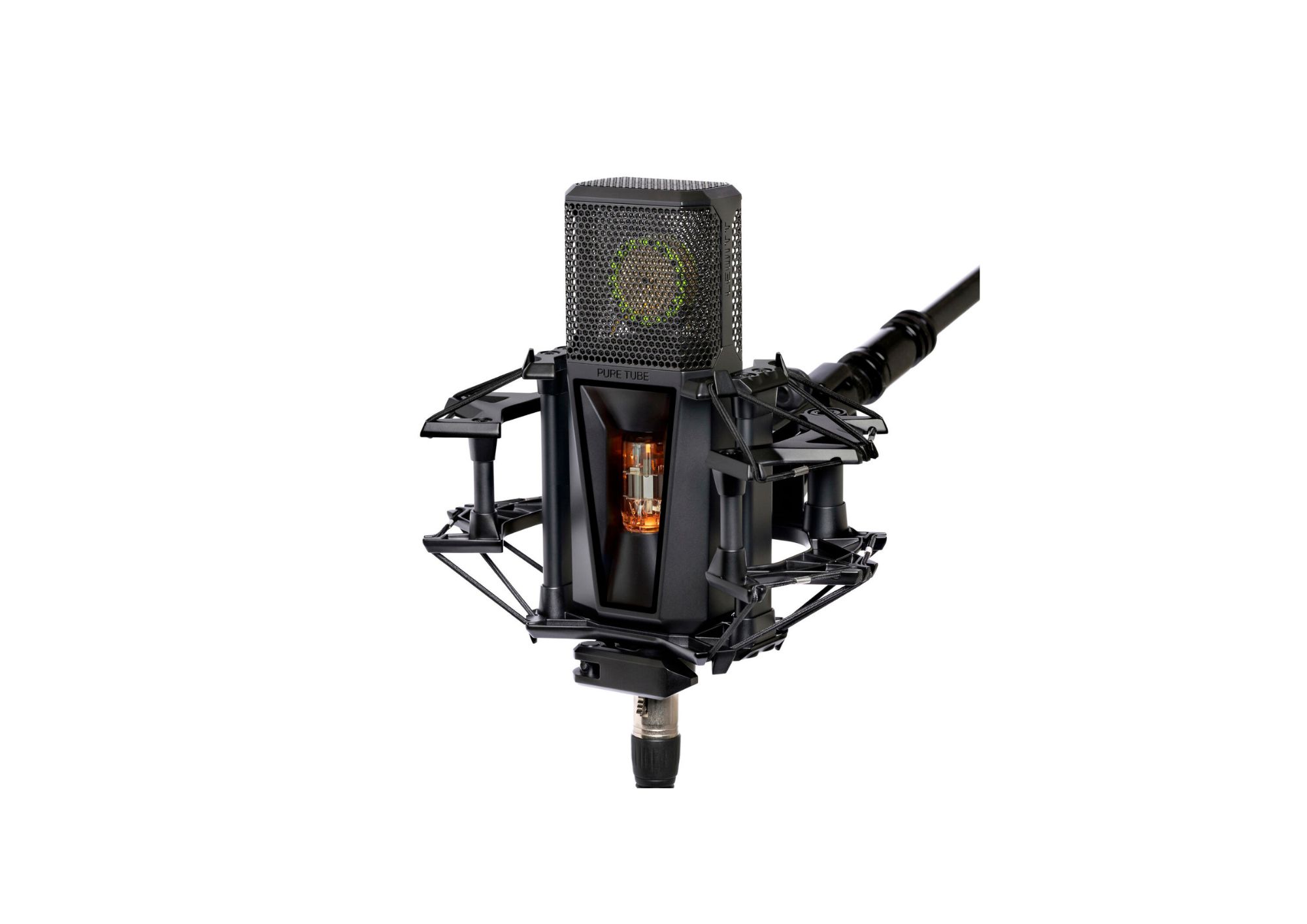
A hand-selected valve provides timeless warmth without the vintage noise floor.
Old valve microphones have a trade-off built into their charm. Producers who love the sound often have to work around a noise floor that gets ugly fast once heavy compression or several vocal layers come into play. LEWITT built Pure Tube to remove that compromise, wrapping a hand-selected 12AU7/ECC82 tube around a signal path with no semiconductors or capacitors in it at all, chasing the warmth without carrying over the hiss.
At a glance
- 1″ true condenser capsule, gold-sputtered 3-micron Mylar diaphragm
- Cardioid polar pattern
- Hand-selected 12AU7/ECC82 tube, semiconductor and capacitor-free signal path
- Self-noise of 7 dB (A), dynamic range of 125 dB (A), max SPL of 132 dB
- Magnetic pop filter integrated with the shock mount
- Compact external PSU, works on 230 V/50 Hz or 110 V/60 Hz
- Available in Essential and Studio sets
- 10-year LEWITT warranty
At the front end sits a 1-inch true condenser capsule with a gold-sputtered, 3-micron Mylar diaphragm in a cardioid pattern, feeding into that valve circuit. The payoff is a self-noise rating of just 7 dB (A), a figure that’s closer to a clean modern condenser than a classic tube mic, with a dynamic range of 125 dB (A) and a maximum SPL of 132 dB.
Vocals are where Pure Tube truly excels, and the low noise floor is what makes that focus useful in practice rather than just a spec sheet number. A singer tracking take after take, a producer stacking harmonies eight deep, or an engineer running a vocal chain through heavy compression and saturation all tend to expose a noisy valve mic fairly quickly, and Pure Tube is built to stay quiet through all of it. The 20 Hz to 20,000 Hz frequency range and the sensitivity of 28.2 mV/Pa give it enough headroom for close-mic’d pop and R&B vocals as well as quieter, more intimate acoustic work, without the capsule running out of puff or the valve circuit adding unwanted colouration.
Catch up on all the latest features here.
The industrial design carries some thought too. A magnetic pop filter clips straight onto the shock mount, giving the reach and coverage of a studio gooseneck filter without the usual fiddling, while the external power supply is compact and runs happily on either 230 V, 50 Hz or 110 V, 60 Hz mains. LEWITT developed Pure Tube through its in-house LEWITT lab research program, and the mic went on to take out the Best Microphone category at the 2024 Sound on Sound awards.
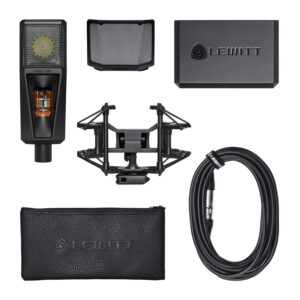
Pure Tube ships in two configurations: an Essential set with a microphone mount, 7-pin XLR cable and transport bag, and a Studio set that steps up to a shock mount, pop filter XL and a transport case. Both come backed by LEWITT’s 10-year warranty.
For local enquiries on LEWITT, head here.