The 664, RE20, 635A and PL11 were built for PA, broadcast and news crews, but musicians have kept them working for decades.
Electro-Voice built its name on microphones for radio booths and news crews, but its mics have found their way onto a surprising number of great rock records too. This is the company whose co-founder drove nails with a microphone before plugging it in to give a sales pitch, and its best-known models have a habit of outliving the jobs they were designed for.
Catch up on all the latest features here.
Knute Rockne
EV started life in 1927 as Radio Engineers, a radio repair shop that Al Kahn and Lou Burroughs ran out of the basement of the Century Tire and Rubber Company in South Bend, Indiana. When the Depression left the pair in debt, they moved into audio. One of their early jobs was a PA system for Notre Dame football coach Knute Rockne, who wanted to address several squads of players at once from a single platform. Rockne called it his “electric voice”, and when Kahn and Burroughs incorporated in 1930, the name stuck.
During World War II the company developed noise-cancelling microphones for military radio, including the T45 lip mic. In 1946 it moved to a bigger site in Buchanan, Michigan, where it stayed for more than half a century, and in 1963 its 642 Cardiline shotgun mic won the first Academy Award ever given to an audio product.
EV later passed through the hands of Telex and Bosch, and today it belongs to the Keenfinity group alongside Dynacord, with a catalogue that reaches well beyond microphones into loudspeakers and live sound systems.
The Buchanan Hammer
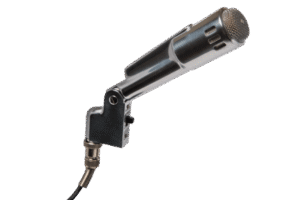
Introduced in 1954, the 664 was the first EV microphone to use Variable-D. Instead of a single rear opening, a Variable-D mic has a series of ports at different distances from the diaphragm. That keeps the cardioid pattern consistent across the frequency range and tames the bass boost you’d normally get from singing right up on the grille.
It was built as a PA mic, and Burroughs had a party trick to prove how tough it was. He’d turn up to a sales presentation, hammer a nail into a board with a 664, then plug it in and use it to give his talk. The mic was nicknamed the Buchanan Hammer after the company’s hometown, and secondhand 664s still turn up cheaply enough that plenty of home recordists and ham radio operators keep one around. It’s also the direct ancestor of the next mic on this list.
RE20
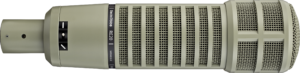
By the late ’60s, EV wanted a dynamic mic that could match the fidelity of a condenser, and it handed the job to engineer Tom Lininger. His answer, the RE20, arrived in 1968 as a large-diaphragm Variable-D dynamic, more than twice the weight of EV’s earlier 666 broadcast mic. It was pitched as a condenser killer, but radio announcers quickly claimed it for themselves, drawn to its natural sound and the way its level held steady as they leaned in and out of the mic.
The RE20 has been a broadcast fixture ever since. Its low-end response and tolerance for volume also made it a favourite on kick drum and bass cabs, and EV followed that use in 2011 with the RE320, which adds a switch with a kick drum voicing. A black version of the RE20 arrived in 2020, and the original grey model is still in production close to 60 years after it first appeared.
635A
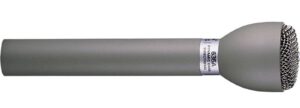
When the 635A replaced the original 635 in 1965, Lou Burroughs announced it with “The 635 is dead, long live the 635A!” It was a compact omnidirectional dynamic, about six inches long in EV’s fawn beige with a steel case, and it was soon plugged into 16mm news cameras. It became the go-to interview mic for news crews around the world, and EV estimates it sold somewhere between 750,000 and a million units over six decades.
Its 80Hz to 13kHz response was made for voices in the field, and that focused, midrange-heavy sound has won it plenty of fans among musicians too. The final 635As left the factory in spring 2024, but with that many in circulation, they won’t be hard to find for a long while yet.
PL11
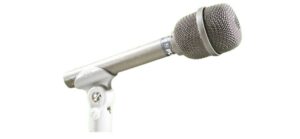
EV’s PL line offered music-market versions of its RE broadcast models, and the PL11 is effectively an RE11 under a different name. Built in Buchanan during the 1980s in fawn beige, it’s a supercardioid Variable-D dynamic, so its pickup pattern is tighter than a standard cardioid and rejects more of what’s happening beside it. That makes it handy on loud stages, where spill from the rest of the band can quickly swamp a vocal mic. The PL11 is long discontinued, but it still turns up on the used market for players after a classic EV dynamic. Here at Mixdown its a favourite for recording lo-fi vocals.
The King Gizz connection
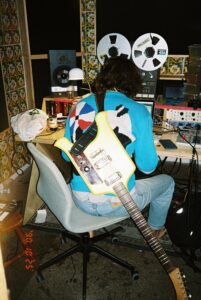
Closer to home, King Gizzard and the Lizard Wizard have made EV mics part of their sound. Stu Mackenzie, who records and produces much of the band’s output himself, told Mixdown earlier this year that “the most expensive mic I own is the Electro-Voice RE20”, and it gets plenty of use. “I know this isn’t conventional but I use them as a mono overhead on a drum kit, there’s heaps of that across King Gizz’s whole discography,” he said, adding that it’s just as good on quiet, close-up vocals.
The 635A has a place in the Gizz setup too. The band can be seen singing into 635As in their 2015 KEXP session, and these days Mackenzie puts one on the hi-hats at live shows. “They’ve got a cool EQ curve that suits a hi-hat in my opinion,” he said.
A drum overhead built from a broadcast mic and a hi-hat mic built for interviews is about as Gizz as it gets, and nearly a century on, EV’s toughest dynamics are still turning up in Melbourne studios.
Check out our interview with Stu Mackenzie here