Walt Fuller’s 1946 pickup lost its premium spot to the humbucker in 1957, then turned up on some of rock’s best records.
Walt Fuller, the head of Gibson’s electronics department, had the P-90 worked out before the Second World War, though it wasn’t until 1946, with the company back to building guitars, that it went into production. It replaced Fuller’s earlier P-13 and the blade-style bar unit that had become known as the Charlie Christian pickup, and for the next 11 years Gibson fitted it to just about everything in the catalogue, from high-end archtops like the ES-175 down to the plainest student models.
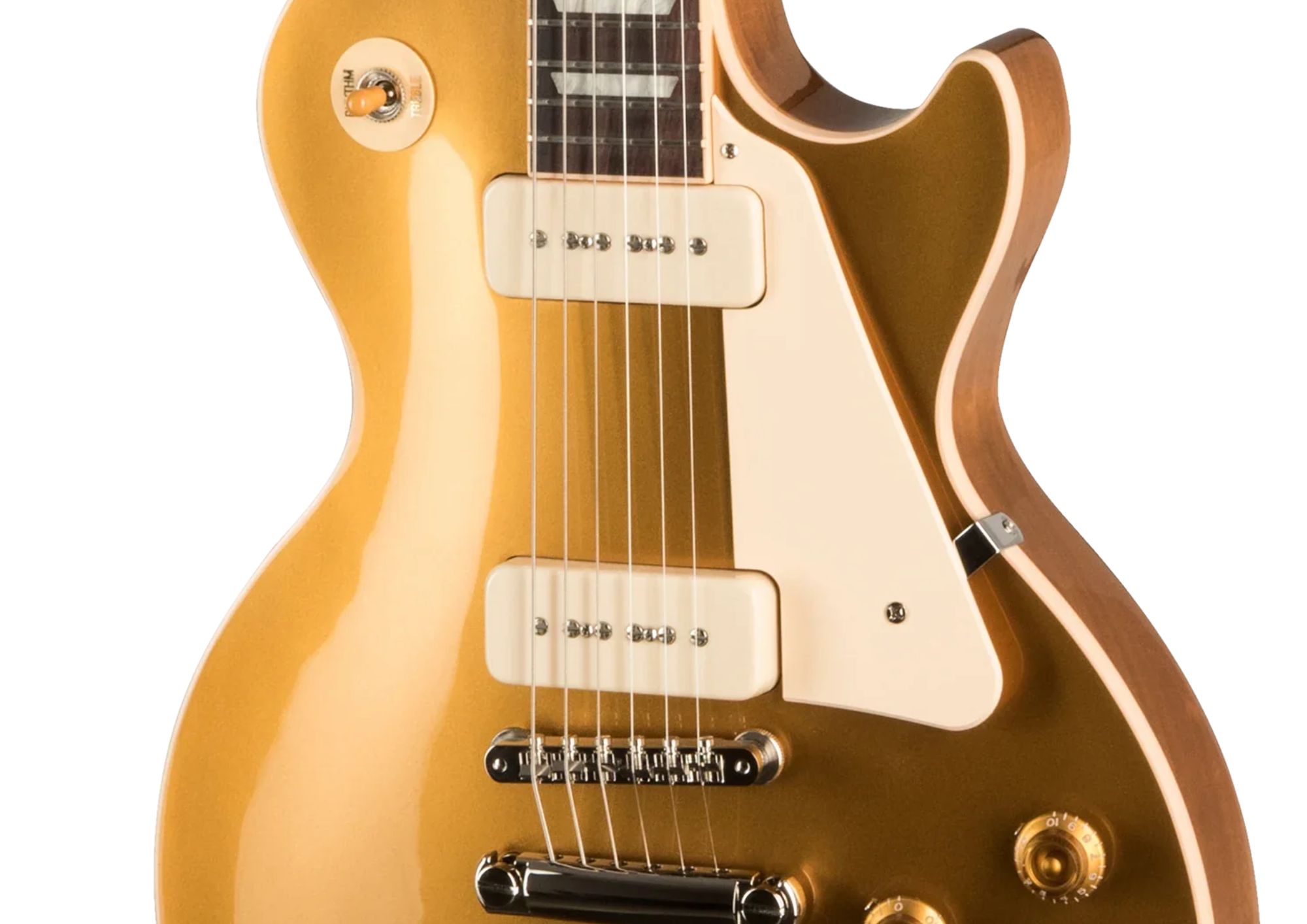
When the Les Paul arrived in 1952 as Gibson’s first solidbody, there wasn’t enough room in the neck position for the archtop-style P-90 with its pointed mounting ears, so Gibson snipped the ears off the baseplates and housed the pickups in cream covers. The rectangular shape soon picked up the soapbar nickname, with the original version becoming the dog-ear by comparison. In 1954 the single-cut Les Paul Junior went out with one dog-ear P-90 in the bridge and only a volume and tone knob for company, and the two-pickup Les Paul Special followed a year later.
Catch up on all the latest features here.
The P-90’s time as Gibson’s top-shelf pickup ended in 1957, when Seth Lover’s humbucker took over the premium models, with Fuller working alongside him on that design too. Gibson kept the P-90 on the Juniors, Specials and the SG-shaped versions that replaced them in 1961, and by the late 60s and 70s plenty of those cheaper guitars were turning up secondhand for very little money, which is how a lot of hard rock and punk players came to own them.
Leslie West
Mountain’s Leslie West got a thick, overdriven tone out of a single bridge P-90 on his Les Paul Junior, and you can hear it all over ‘Mississippi Queen’. Even though the Junior was his main guitar through that era, he reportedly turned down a signature version because he didn’t want his name on a guitar that already existed. Martin Barre recorded all of Jethro Tull’s Aqualung on a 1957 Junior, including the title track’s long solo, while over in New York, Johnny Thunders and Sylvain Sylvain made the Junior part of the New York Dolls’ look and sound. “We called them ‘automatic guitars,’ like a car with an automatic transmission – easy to use,” Sylvain told Gibson in 2009.
Billie Joe Armstrong has kept the Junior in front of younger players for the past two decades. His favourite is a 1956 Junior named Floyd, which he picked up in 2000 right before Green Day recorded Warning, and Gibson and Epiphone have since built several signature Juniors around it.
Pete Townshend
From 1968 to 1971, Pete Townshend played SG Specials with a pair of P-90s almost exclusively, which puts them at Woodstock, both Isle of Wight festivals and the 1970 Leeds show that became Live at Leeds. Carlos Santana also brought a red SG Special with P-90s to Woodstock, the same guitar he used on Santana’s debut album. When Tony Iommi’s Strat developed a faulty neck pickup during the sessions for Black Sabbath’s first record, he switched to a 1965 SG Special called Monkey, with a P-90 in the bridge and a custom John Birch Simplux in the neck. A few years earlier, John Lennon and George Harrison had followed Paul McCartney onto the Epiphone Casino, a thinline hollowbody loaded with two P-90s.
Inside the P-90
Although it’s a single coil, a P-90 is built quite differently to most others. Where other single coils use rod magnets as their pole pieces, the P-90 has two flat alnico bar magnets beneath a wide, flat coil, with six adjustable steel screws running through the middle to carry the magnetic field up to the strings. Raising or lowering those screws changes the output string by string. Most vintage examples used Alnico III magnets until around 1957, when Gibson started moving to Alnico V, and apart from wax potting and better magnets, a P-90 in a new guitar is much the same pickup Fuller put in a 1946 ES-150.
All that extra coil and magnet gives the P-90 more output and a thicker midrange than other single coils, with a warmer top end, while it keeps more bite and clarity than a humbucker, so it tends to get described as somewhere between the two. Having only one coil, it has nothing to cancel mains noise either, so a P-90 will buzz near dimmers and lighting rigs.
Gibson’s own attempts to fix that include the P-100, a stacked P-90 that cancels hum at the cost of some of the original’s character, and the P-94, which puts a P-90 in a humbucker-sized housing. Aftermarket makers including Lindy Fralin and Seymour Duncan have their own hum-cancelling takes, and in the 70s Gibson even sold the pickup under the name “Laid Back”. P-90s are still standard on Gibson’s Les Paul Junior, Les Paul Special and SG Special, alongside a long list of Epiphone and boutique models.
Catch up on all the latest features here.