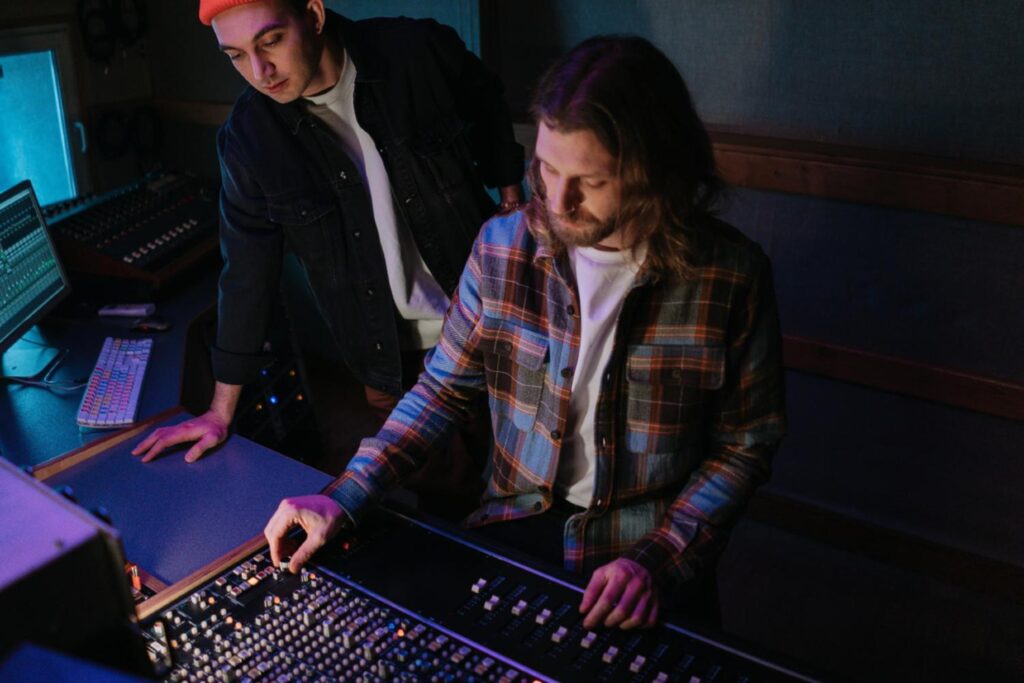
System tech Hugh Webb and monitor engineer Ray Moss break down how the AT 3000 Series held up at the Gympie Music Muster.
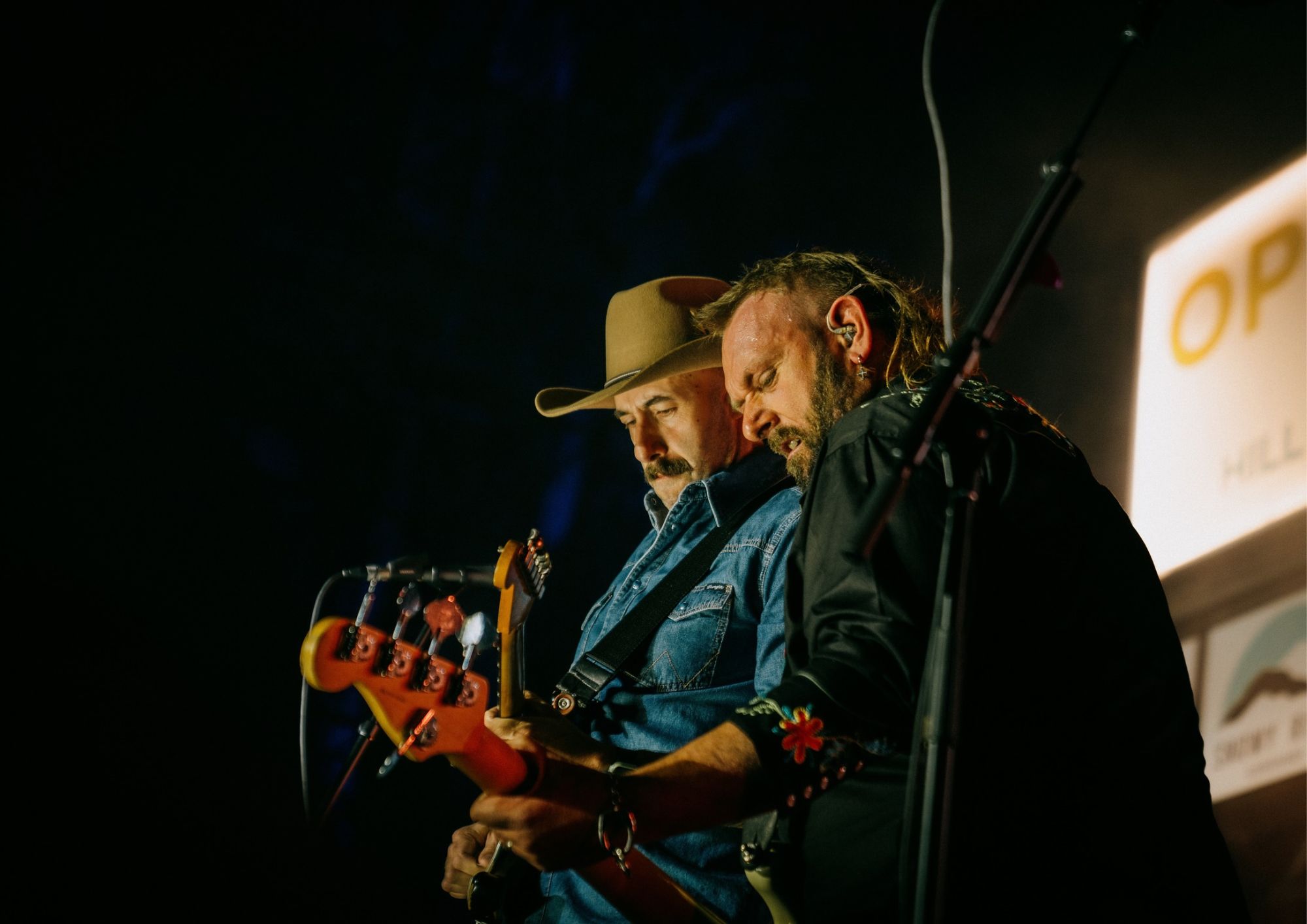
Headlining the main stage at the Muster is no small task, and for the Wolfe Brothers, keeping the show reliable started well before the band walked out. System tech Hugh Webb built the touring in-ear rig specifically around the demands of a high-energy live show, with the brief centred on dependability as much as sound quality.
“The Wolfe Brothers are renowned for their high-energy and audience interaction during their sets, so the main requirement was to provide a great sounding, reliable, lightweight system that is easy to set and pack up,” Webb says. He wanted something the band could rely on regardless of venue size, so the rig was built to fly: a full in-ear system paired with an Allen & Heath SQ5+ (loaded with the SQ+ pack and UFX) and a GX48, giving the band the same sound night after night.
At the centre of the setup is Audio-Technica’s 3000 Series wireless IEM system, which Webb chose for a combination of feature set and value. “The AT 3000 series punch well above their weight and are packed with features, delivering rock solid reliability and premium quality features that are expected by the industry at a very budget friendly price,” he says. The cue mode is one feature he singled out, letting an engineer or stage tech monitor up to ten different mixes from a single pack and cycle through them at the push of a button.
Catch up on all the latest interviews and features here.

Frequency coordination on a festival stage carrying more than 80 channels of RF is no simple job, but Webb says the 3000 Series’ bandwidth made it manageable. The system is documented to the EG2 band 580-714 MHz, modified in Australia to sit between 580-695 MHz — a wider spread than many competing IEM systems, giving more room to find clean air. On arrival, Webb ran a scan using the ATW-R3250 belt pack receiver, which uses the earbud cable as a secondary antenna for improved RF stability, then loaded the results across the rig using the system’s bidirectional IR sync. IJS Productions had already mapped an RF plot for the festival’s full channel count, and the 3000 Series profile slotted in without conflict.
The rig itself comprises six ATW-T3205 transmitters, ten ATW-R3250 belt packs, an ATW-A49a UHF wide-band directional LPDA antenna, an RF Venue Combi 6 combiner and a NETGEAR GS108 switch, racked in a 4U vented sleeve with custom IEM foam by Naut Cases inside a 1607 Pelican case. Fully packed, the case weighs 23.1 kg. Webb also modified the system’s power setup on site, replacing the individual power supplies with a distributed 12V DC supply and adding two spare PSUs as backup — a small change he says was worth making in the field for the sake of reliability.
Though the 3000 Series can run up to twelve mono mixes, the band’s rig is configured with six stereo mixes: five for the band and guests, plus a dedicated cue send for the monitor engineer. Included E40 earphones round out the package, giving users a professional-grade system straight out of the box.
Monitor engineer Ray Moss, who runs the desk for the Wolfe Brothers, says the shift to a dedicated system has changed the way the band operates. Previously, the band relied on IEMs supplied by local vendors at each show, backed up by their own 5GHz pocket systems in case a supplier fell through. “While it gets the job done, the inconsistency has been one of last unturned stones in an otherwise well-oiled machine,” Moss says. “Having a customised pro system that is reliable, and the same every night, has certainly up’d the game for us.” He points to the 3000 Series’ wide-band frequency range as a standout, particularly for finding clear spectrum along the Australian east coast.
On the night, Moss says the RF held firm from soundcheck through to the final song, helped by a quick coordination check with the festival’s monitor engineer Josh Finlayson. Each band member runs a different kind of mix — guitarist Nick works in an isolated environment built around click track and himself, Tom prefers a fuller band mix he can play off, and keyboardist Scott Target likes his mix built out like a studio recording. Moss says the packs are kept largely neutral out of the box, with colour and compression handled at the console instead, and that the band has responded well to how musical the in-ears sound. That’s paired with Audio-Technica’s AE4100 vocal microphones, which the band also uses on stage — Nick runs a AE5400 grille on his mic, preferring the feel of a flat grille, while the kit and guitar are covered by a mix of AE3000s and AT450s.
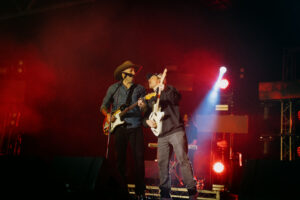
For Tom and Nick Wolfe, the proof was in how the show felt from the stage. Heading into their headline set on Friday night, Tom says the mood was surprisingly calm. “We got the ‘A team’ crew, thanks to AT and TAG we got the gear, and we are really gig fit at the moment, so I just went in with the head space of ‘let’s enjoy this’,” he says. Nick echoes that sense of readiness, pointing to the experience across the band and crew as the reason they could focus on the performance rather than the gear.
Both agree that what they want most from their in-ears is to stop thinking about them altogether. “For me it’s reliability. I don’t want to have to think about it, I just want to be able to focus on the crowd, music, band, etc. and find the groove and the moment,” Tom says. Nick puts it similarly: the best sign of a good show is walking off stage and only then remembering he was wearing in-ears at all.
That reliability extended to the band’s stage movement, including a bit Nick describes where the guitarist heads into the crowd with a spotlight follow, fully confident the wireless will hold. With multiple vocal mic positions and IR sensors spread across the stage and out into the crowd, Nick says the system didn’t miss a beat. Both are keen to run the same setup again, with the rig now carrying through the rest of the band’s Australian Made tour into 2027.
For Webb, the Muster is one data point in a wider case for the 3000 Series as a touring solution. “I am confident in saying these IEMs would be an excellent fit for any musician, venue or production company,” he says, pointing to the system’s combination of reliability, feature set and price as reasons it can scale from a small club to a major festival stage.
Learn more about the 3000 series here