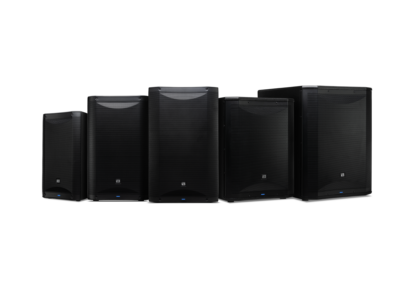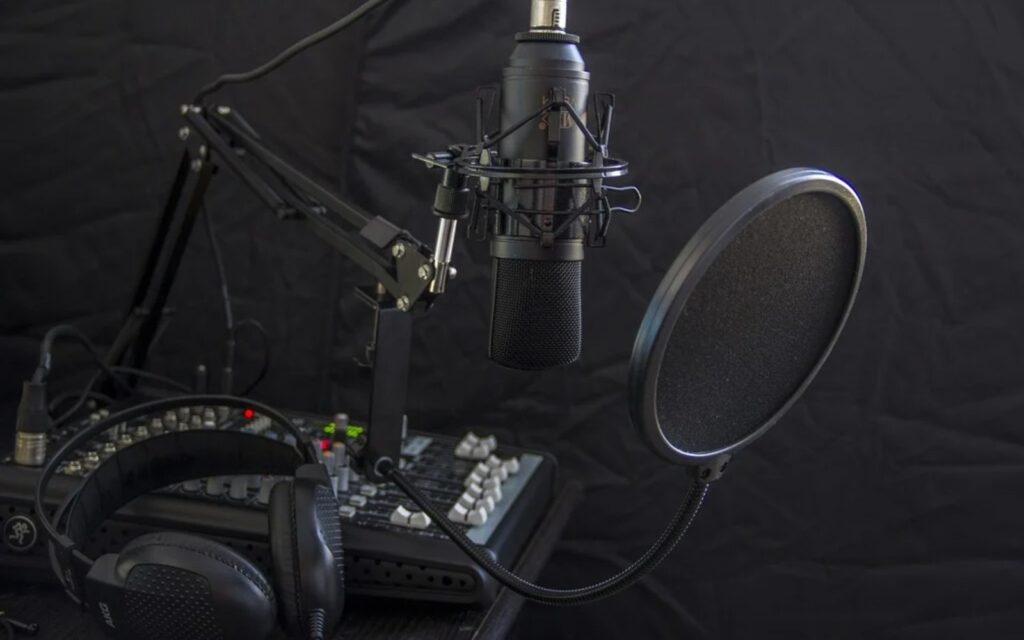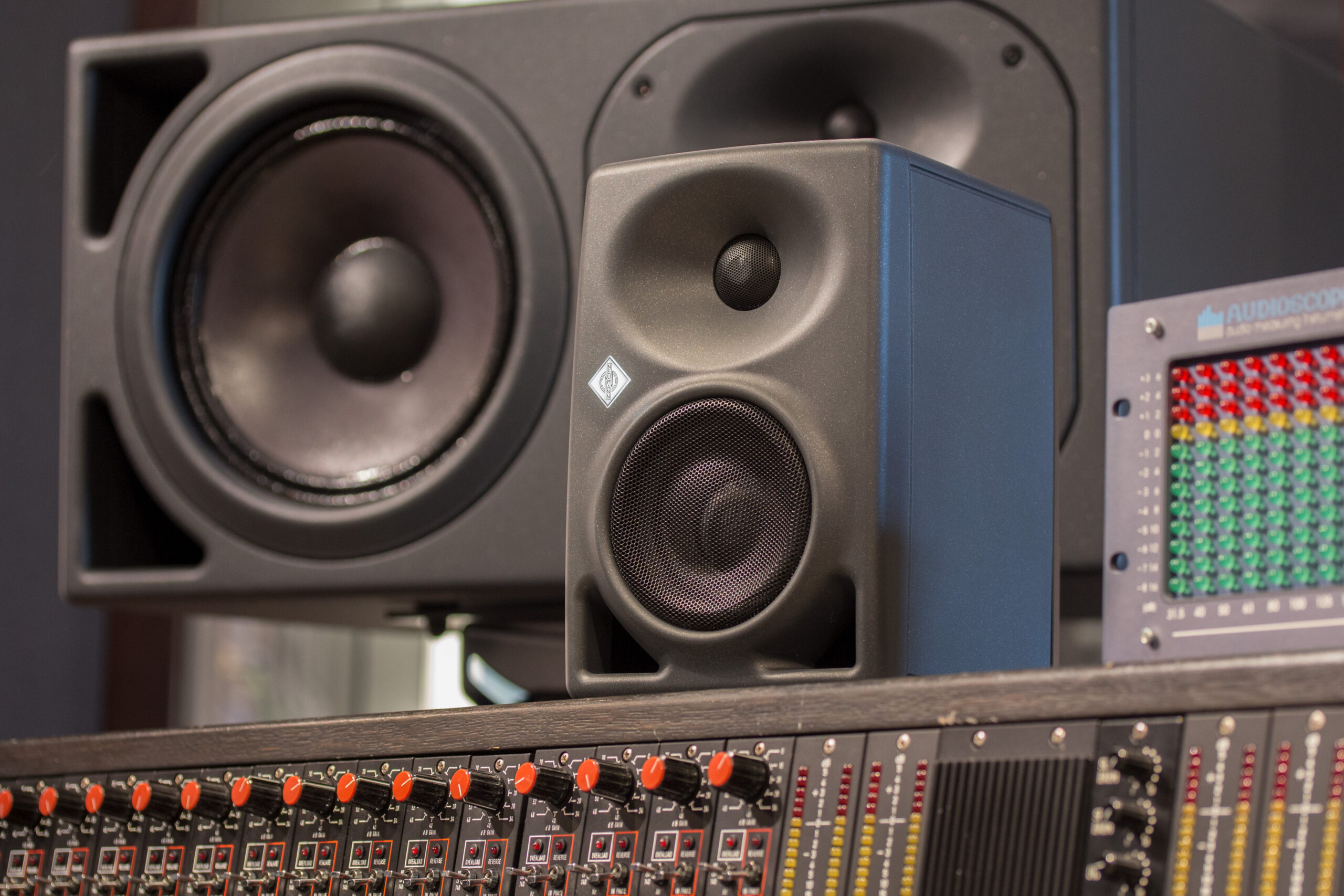
Neumann's KH 80 DSP nearfield monitor and MT 48 interface pair into a single-brand monitoring chain, with room correction that scales from a desktop to a full immersive setup.
Neumann has spent almost a century building a reputation on microphones like the U 47 and U 87, but over the past decade the Berlin company has assembled a monitoring range to match. Two products – the KH 80 DSP nearfield monitor and the MT 48 interface – cover most desk-based work, with the interface also serving as the setup’s monitor controller.
Catch up on all the latest features here.
KH 80 DSP
A two-way, bi-amplified nearfield with a four-inch woofer and a one-inch tweeter, the KH 80 DSP is compact enough to fit either side of a laptop, but still built to reference standards.
Much of that accuracy comes from the Mathematically Modelled Dispersion (MMD) waveguide (if maths isn’t your thing, stick with me), developed from Neumann’s own computer simulations, controlling how sound spreads across the room to give a wide horizontal dispersion. That means you can move across the desk without the stereo image collapsing, while a narrower vertical dispersion cuts down reflections off the console in front of you.
The “DSP” in the name is mostly about room correction. Every room colours what you hear, and the KH 80 DSP deals with that two ways. A four-position Acoustical Control switch on the back offers quick low-mid compensation for free-standing use or small, medium and large desks, which is handy for mobile setups. For something more precise, Neumann’s MA 1 system pairs a measurement mic with Mac or PC software to profile the room and align the monitors automatically, linearising the frequency and phase response, with a multichannel option for surround and immersive rigs.
Housing curves reduce edge diffraction, the front-firing bass reflex ports keep the low end fast and free of pipe resonance, and separate thermal and excursion limiters protect the drivers when the level is pushed. Every KH 80 DSP is pair-matched to any other in final testing, so building a stereo pair or a larger array is straightforward. You could also add a sub for more low-end weight – the KH 750 DSP, for instance, slots in underneath. It comes in black or white and, at 3.5 kg, is light enough to mount almost anywhere – a desktop, stand, wall or ceiling, or as a front or rear speaker in a multichannel system.
On paper, the KH 80 DSP reaches from 57 Hz to 21 kHz (±3 dB) with a maximum SPL of around 108 dB, a linear-phase crossover at 1.8 kHz and bi-amplification putting roughly 120 watts into the woofer and 70 into the tweeter. That mix of compact size, controlled dispersion and built-in room correction makes it a natural fit for anyone working in a room they can’t treat, like a home, makeshift or temporary studio, an editing or broadcast suite, an outside-broadcast van or a shared space. That’s how a lot of us work, and it’s the monitor for the producer or engineer who wants reference accuracy without a purpose-built control room.
MT 48
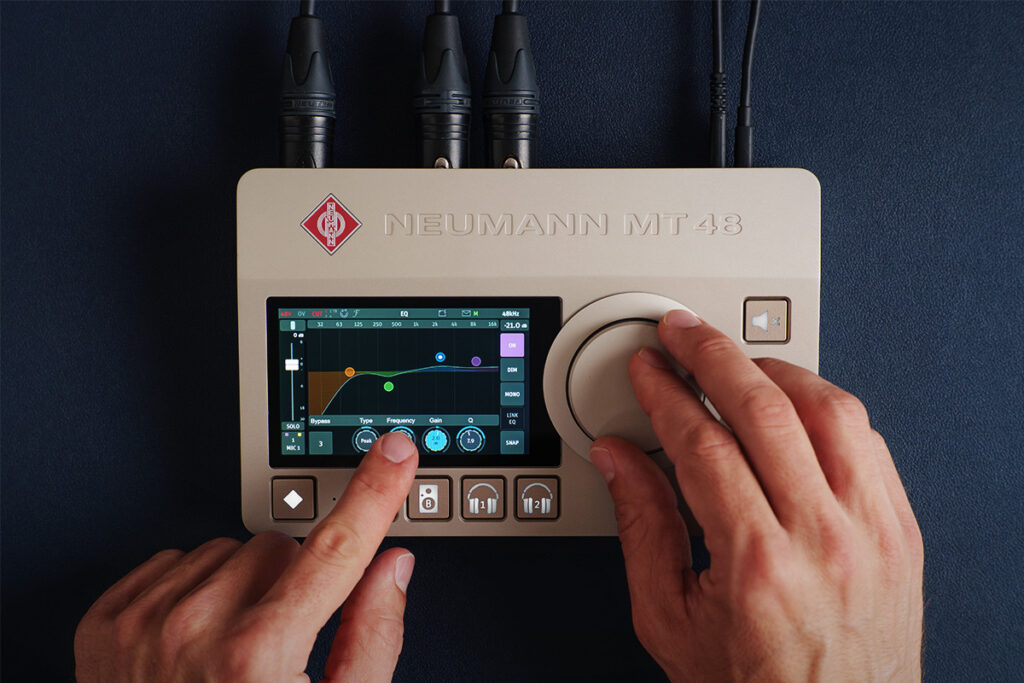
The MT 48 is Neumann’s first audio interface, and the hub that drives the monitors. Built on the Merging Anubis after Sennheiser brought Merging Technologies into the fold in 2022, it’s a four-in, eight-out unit run almost entirely from a capacitive touchscreen and a single rotary control, with 24-bit conversion and two headphone outputs.
With up to 78 dB of gain on tap, very low self-noise and 136 dB dynamic range, the converters and mic preamps are the main draw. The onboard DSP does more than just conversion, with EQ, dynamics and reverb that can be monitored through or printed to the recording. You can also capture the dry and processed signals at once.
The MT 48 splits routing across four independent mixers, each with talkback, and connects over USB, ADAT and AES67. All up, it mixes as many as 48 channels – four physical, eight over ADAT and 36 over AES67. That last figure is what makes networked multichannel setups possible.
For monitoring specifically, the Monitor Mission update turns it into a freely configurable monitor controller. The board inside handles up to 256 AoIP I/O over RAVENNA, with the figure you actually get down to the Monitor Mission fitted – 128/32 on this one, for instance. It covers everything from mono and stereo through surround to immersive formats like Dolby Atmos 7.1.4, with bass management, speaker alignment and downmixing built in.
Its portability and touchscreen control suit engineers who travel a lot, or work across more than one room, and the AES67 connectivity and Monitor Mission make it a strong pick for broadcast and for immersive mixing or mastering. The onboard DSP offers near zero latency for direct monitoring, and works well for anyone who would rather process and monitor at the interface than rely on a computer for everything.
Firmware 2.0 arrived in June, bringing two plugins across from the Anubis platform – Eventide’s Blackhole reverb and the Merging+Deesser. Both run in the interface’s own DSP rather than the DAW.
The same update scaled Dante networking from 8×8 up to 64×64, added support for the AMBEO 2 Channels Live Broadcast Encoder for immersive broadcast, and folded in a set of monitoring tweaks, among them speaker and source grouping, an L/R flip for checking stereo imaging, and Talkback Dim to pull monitoring down automatically when the talkback mic opens.
Taken on their own, the KH 80 DSP is a precise monitor and the MT 48 is a capable interface. Put them together, aligned with MA 1, and they make a monitoring chain that starts on a desktop and scales all the way to an immersive room, with the MT 48 handling conversion and monitor control while the KH 80 DSPs do the listening. This pairing suits a project or home studio that wants a coherent, single-brand path rather than a patchwork of gear, especially anyone planning to grow from stereo into surround or Atmos without replacing everything to get there. For a room short on space or treatment, or a setup that needs to scale later, both keep the whole signal path under the Neumann roof.
For local enquiries, head to Neumann.