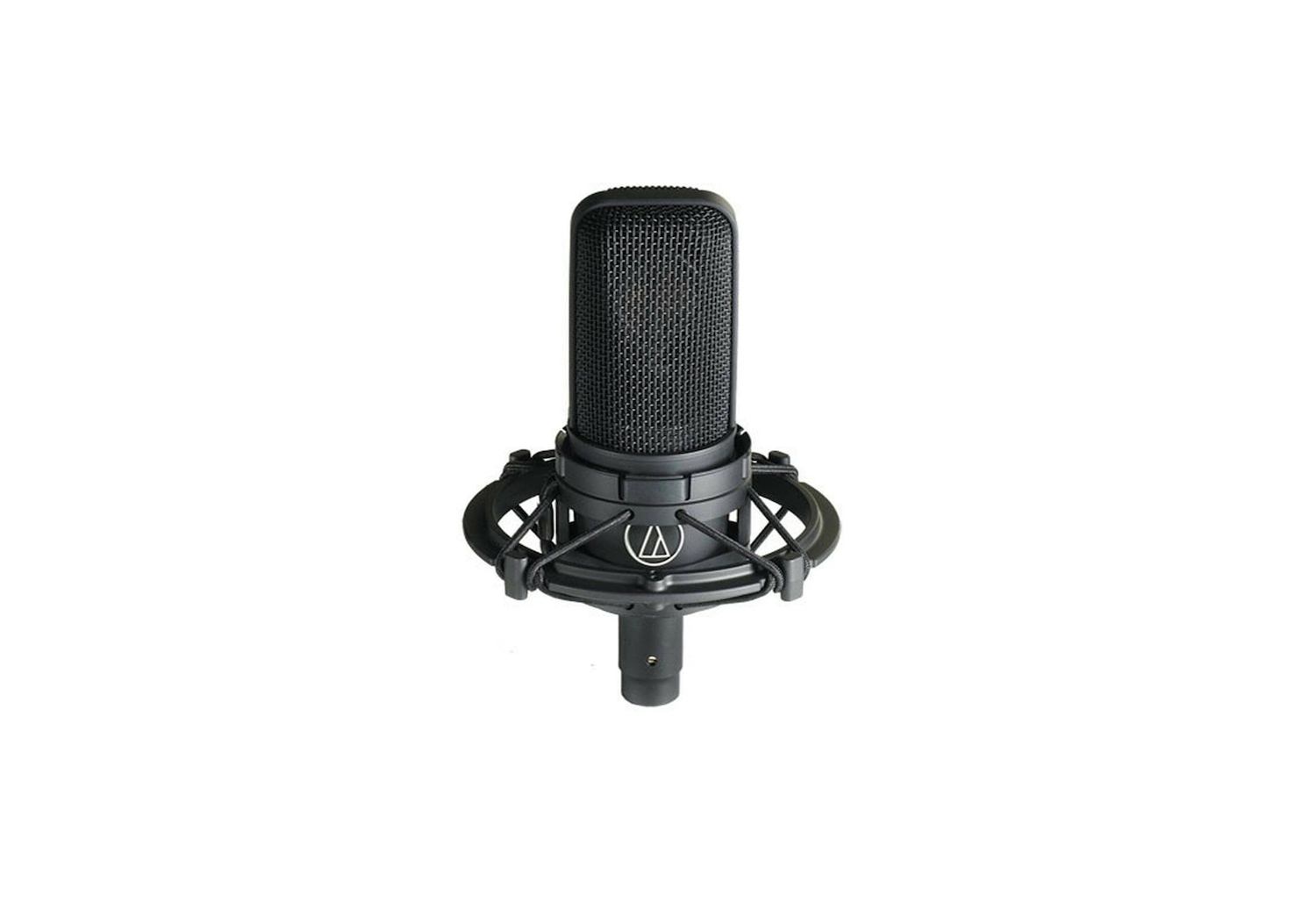
Audio-Technica has a reputation for balancing quality with affordability, and the AT4040 sits right in the middle of their more professional 40 series. It looks modest, unassuming even, but beneath that minimalist exterior lurks a professional in waiting. Opening the coffin-like case, I find a dark matte body nestled in foam. I roll it over and lift it carefully—400 grams of understated intent.
Catch up on all the latest features and reviews here.
Assembled in its cradle, I thumb the cold brushed-steel badge as it catches the light. The capsule has that sweet “new microphone” smell, untouched by breath or use. Beware: newness is hypnotic.
The usual suspects are here: an 80 Hz high-pass filter and a –10 dB pad, tucked discretely on the backside. The AT4040 promises “exceptionally low noise,” “wide dynamic range,” and a “precision-machined acoustic element baffle.”To figure out where it sits in my sonic vocabulary, I’ve got three mics, side by side. Phantom fired up. Cans are ready to judge. A blind vocal test begins: sibilance, plosives, dynamics; the usual gauntlet.
Damn. The AT4040 got hands.
Its voice projected cleanly and openly, folding deep frequencies neatly beneath a crisp, airy high end. Plosives? Parried. A pop filter felt almost redundant. The high-pass switch behaved like a disciplined bouncer, and the –10 dB pad revealed just how sensitive this thing really is. There’s a distinct shimmer around 7–8 kHz; an expressive, crystalline brightness that adds presence and individuality. The AT4040 is sharp, fast, and revealing.
Recording a full song in my untreated home office put it through its paces. On fingerpicked steel-string guitar, the AT4040 handled complex harmonics with poise. Licks that can often turn to mud stayed articulate with percussive clarity; every string comfortably in its own lane. Doubled vocals blended atop with minimal phasing artefacts. The mids bulged with intention, not congestion. Highs were crisp but not brittle. The low end stayed taut even when I leaned into it.
Checking the specs, the AT4040 shares a 20 Hz–20 kHz range with similar SPL tolerance to other mics in its class. But where others offer a buffet of alternate patterns and pads, the AT4040 simply asks: Tap or sparkling? It’s sensitive enough to capture every nuance—you can push your preamp gain further before noise becomes noticeable, confidently skirting the headroom during dynamic performances.
There’s a distinct shimmer around 7–8 kHz; an expressive, crystalline brightness that could bite on certain sources but adds presence and individuality I’d hoped to find. The AT4040 is sharp, fast, and revealing. It’s sensitive enough to pick up the meditative whirring of my PC fans, though I happen to appreciate this as grounded dithering.
A couple of operational notes: there’s a volume spike when phantom power engages, and a capacitor discharge when powering down—behaviours you’ll find in many high-quality condensers. It’s simply how these circuits work. The solution is standard practice: mute your monitors before toggling phantom, and reduce gain before shutdown. Once it’s part of your routine, you won’t think twice about it. The payoff is respectfully low self-noise and excellent transient response. You can push your preamp gain further before noise becomes noticeable, confidently skirting the headroom during your more dynamic performances.
The AT4040 stands to bridge the gap between professional and personal studio spaces. Concrete in its polarity, confident in its simplicity, and resilient against abuse, it’s a mic that reveals more than sound. Its technical refinements and transparency mean there’s less room to hide behind the mic’s character; it tells the truth.
In the right hands—or even just the right bedroom—it’s a mic that reveals more than sound: it reveals you. If you’re ready for that kind of conversation, the AT4040 is an excellent translator.
Head to Audio-Technica for more information.