With Segall set to tour Australia in 2026, we break down the guitars, amps, pedals and other gear that define his signature fuzzy sound.
Prolific garage rocker and psychedelic maestro Ty Segall is set to bless Australian shores with a string of dates in early 2026, including an appearance at the beloved Victorian festival Golden Plains. Known for his incredibly consistent output, vast array of impressive side projects and his signature gnarly lo-fi sound, Segall has become a highly influential artist for contemporary lovers of all things fuzzy. So, given that his immense sound is talked about as much, if not more than his actual songs, we thought we’d take a look at the gear we can expect to see him rocking when he comes to town next year.
Read all the latest features, columns and more here.
Guitars
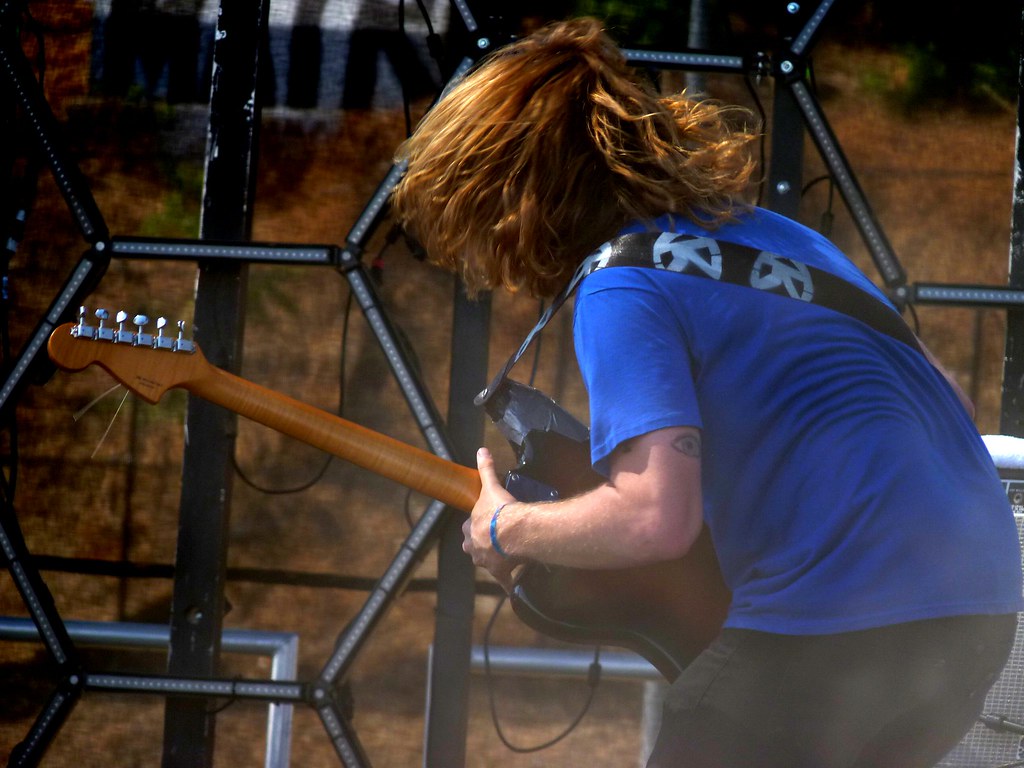
Segall has an eclectic collection of guitars that suit his varied catalogue and he is definitely not adverse to customisation. Whilst he has stated that he mostly favours a Les Paul in the studio, he is more often than not seen spotting SGs and Fender offsets live, as well as a handful of more obscure models.
In previous years, Segall’s main touring guitar was a green 1966 Fender Mustang, but more recently he has favoured his 1978 Travis Bean TB1000S which he has called his favourite guitar. The Travis Bean features a very thin but wide neck which Segall seems to dig and is very lightweight. Travis Beans are known for being very loud and having an incredibly wide frequency range, making it a powerful sonic tool perfect for his heavier tracks.
Segall’s main SG is a 1962 model originally loaded with P90’s that he has replaced with some late 60s humbuckers. A blasphemous move according to some, but Segall couldn’t care less. He also toured with a red 1965 Gibson Melody Maker which he received upon graduating college, but tragically it didn’t survive Segall’s rigorous touring schedule and was accidentally destroyed. Segall is also a big fan of Fender Jaguars and Jazzmasters and has
recently been playing what looks to be a vintage sunburst Jazzmaster that he has customised with a pair of humbuckers.
When it comes to acoustics, Segall favours a Gibson B-25 which he says was very beat up when he bought it but sounds great with a lively, punchy midrange. Whilst he may have some Martins at home, the B-25 is a great touring guitar due to its durability and its ability to cut through a mix. Other more rarely seen members of his collection include a 1977 Gibson ES-335, a 1970s Italian-made 12 string acoustic of ambiguous origin, a Stella acoustic and a 1968 Gibson EB-0 bass which he uses for recording.
Amps
When it comes to amps, Segall keeps things simple and sticks to his guns. His main amp is a 1972 Fender Quad Reverb which is basically two Fender Twins stuck together (boy that’s gotta be heavy). Segall has also been spotted using Silverface Twins but definitely favours his Quad both live and in the studio, taking full advantage of its massive sound, reverb and master volume circuit.
Segall has stated that he runs both guitars and bass through the Quad in the studio and has described it as both his ‘good luck charm’ and ‘the only amp that matters’. Segall’s Quad is also somewhat unique in that it contains a Peavey power transformer, installed by a previous owner.
Live, Segall runs his Quad in conjunction with either a Music Man HD130 or a Traynor YBA-3 which he usually runs through a 1×15 cabinet. Segall has stated that he generally sets his secondary amp to have as much clean headroom as possible whilst running the Quad flat out dimed. Segall has also used a Peavey Mace as a secondary amp for a short spell but apparently it broke.
Pedals
Segall is best known for his use of fuzz so his pedal collection will no doubt be of most interest to his fans. His main fuzz pedal, it is no secret, is the Death By Audio Fuzz War. The Fuzz war is a beloved boutique circuit known for being an all out, chaotic noise machine capable of some of the raunchiest tones known to man. With a simple three knob design, the Fuzz War’s active multi-curve Tone control changes the timbre from a deep sludge-bass rumble to screaming top-end lead tones that slice through the mix with a whole bunch of useful sounds in-between.
Segall is also a big fan of the legendary Univox Super Fuzz in the studio, but given the pedal’s significant value, it’s no surprise that he swaps it out for the more accessible Boss FZ-2 Hyper Fuzz for live performances. Also in his collection is a Death By Audio Octave Clang and a Death By Audio Apocalypse, two more ferociously filthy fuzzes but with a wider variety of options than the Fuzz War.
Aside from his fuzzes, Segall uses a DOD Flanger 575, a Moog Minifooger Delay as his main sources of live modulation and delay. Additionally, he’s occasionally been known to use a EHX Small Stone Reverb, a EQD Grand Orbiter Phaser and has collaborated with Death By Audio on his own reverb unit, the Sunshine Reverb.
Drums
When he’s not touring as one of garage rock’s most beloved frontmen, Segall can be found behind the kit and his other band, the aptly named hard rock outfit Fuzz. His kit of choice for this project is a beautiful Ludwig Classic Maple Kit in Black Oyster Pearl, which he puts to great use. Is there anything this man cannot do?
Recording
As well as being a prolific musician, Segall is also a prolific engineer, producing and mixing many of his own records. Segall’s studio is centred around a Trident 88 mixing console and a Studer 2” Tape Machine and his collection of outboard gear includes vintage Ampex 351 Preamps, an Antelope Audio Orion 32 AD/DA audio interface, an Electrical Audio EAPreQ, an Eventide H949 Harmonizer, a Highland Dynamics BG2 compressor, Normaphone custom preamps, an SPL Transient Designer and a Universal Audio Classic 1176 Compressor. He has also expressed a fondness for Neumann U67 microphones, particularly for tracking guitars.
And that’s a wrap!